

What Is Coffee Bloom and Why Does It Matter? A Complete Guide
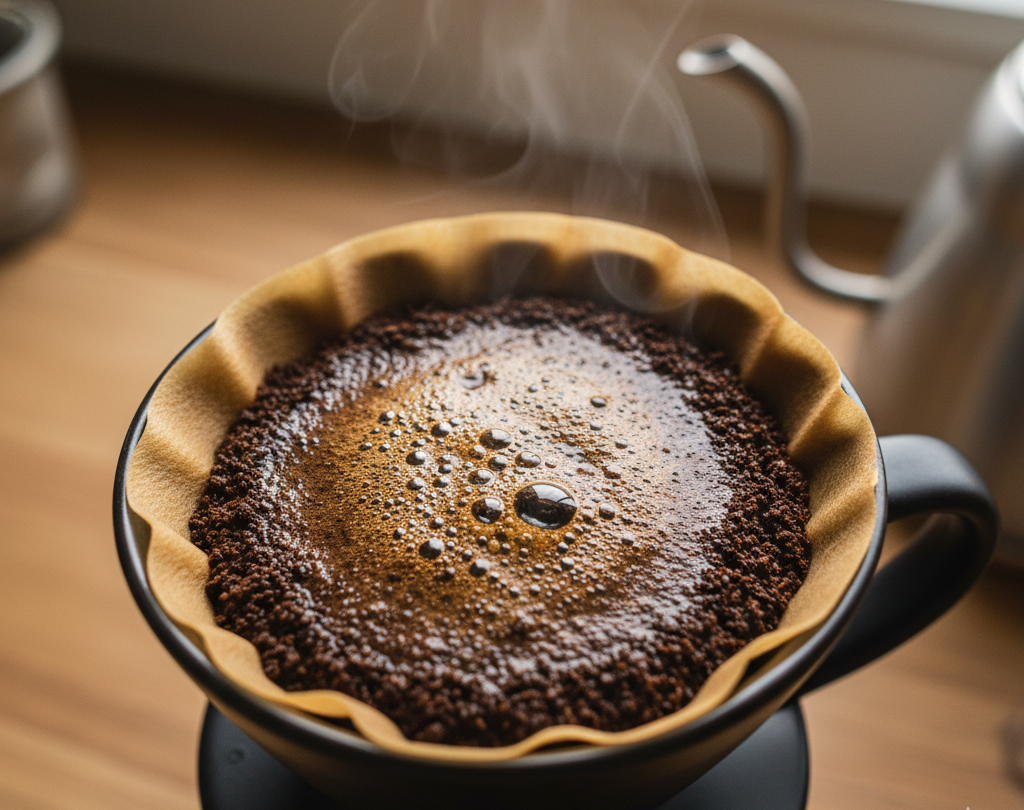
If you've ever watched a pour-over being made at a specialty café and noticed the barista pour a small amount of water, then wait — watching the coffee swell, bubble, and exhale a cloud of aroma — you witnessed the coffee bloom. It looks almost ceremonial. And it is, in a sense. But it's also genuinely functional chemistry that affects the flavor of every cup.
Most home brewers either skip the bloom entirely or treat it as a vague formality. This guide explains exactly what the coffee bloom is, why the science behind it matters, how to do it correctly for different brewing methods, and what it tells you about the freshness of your beans.
Table of contents
- What Is Coffee Bloom?
- Why Does the Coffee Bloom Matter?
- The Science Behind the Bloom: What's Actually Happening
- How to Bloom Coffee Properly
- Coffee Bloom by Brewing Method
- What Happens When You Skip the Bloom?
- What's Happening at the World Brewers Cup: Advanced Bloom Techniques
- Common Bloom Mistakes and How to Fix Them
- The Bloom as a Freshness Test
- Frequently Asked Questions
- The Bottom Line
What Is Coffee Bloom?
Coffee bloom is the rapid release of carbon dioxide (CO2) that occurs when hot water first contacts fresh coffee grounds. You'll see the grounds swell, bubble, and puff up — sometimes dramatically, sometimes subtly — before settling back down. This typically lasts 30 to 45 seconds and marks the very beginning of the brewing process.
It's also called pre-infusion in professional brewing contexts, because that's exactly what it is: a preliminary wetting of the grounds before the main extraction begins.
The bloom happens because of what takes place during coffee roasting. As green beans are transformed by heat, chemical reactions produce CO2 as a byproduct. This gas becomes trapped inside the bean's cellular structure. After roasting, beans slowly release this CO2 over days and weeks — a process called degassing. But a significant amount remains trapped inside until the moment hot water hits the grounds and accelerates its release all at once.
☕ Recommended by cocondo.coffee

Cocondo Orgánico — The only certified organic coffee from Antioquia, Colombia
Reserve Your Bag →Why Does the Coffee Bloom Matter?
The bloom isn't just visually satisfying. It serves two critical functions that directly affect what ends up in your cup.
Function 1: Enabling Even Extraction
Here's the chemistry that makes this important: CO2 is hydrophobic — it repels water. When you pour water onto coffee grounds that still contain significant trapped CO2, the escaping gas creates a physical barrier that prevents water from fully saturating the grounds evenly. Water flows around the gas pockets rather than through the coffee particles, leading to what baristas call channeling — water finding the path of least resistance rather than flowing uniformly through the entire coffee bed.
The result of channeling is uneven extraction: some grounds are over-extracted (contributing bitterness) while others are barely extracted at all (contributing sourness). The cup tastes simultaneously bitter and sour — flat and unbalanced.
By allowing the bloom to happen first — letting CO2 escape before the main pour begins — you give the coffee bed a chance to fully degas and become uniformly receptive to water. When you then pour the main volume of water, it can flow evenly through every particle of coffee, extracting at the same rate across the entire bed. The result is a more balanced, sweeter, more complex cup.
Function 2: Indicating Coffee Freshness
The bloom is the most reliable visual indicator of coffee freshness available to the home brewer — more honest than roast dates, more immediate than smell.
Fresh coffee blooms dramatically — the grounds swell and rise significantly, bubbles form vigorously across the surface, and the bloom phase lasts a full 30 to 45 seconds or more. Stale coffee barely blooms at all — a weak fizz, minimal swelling, and the bloom is over in seconds, if it happens at all.
This difference reflects how much CO2 remains in the beans. Freshly roasted coffee is full of trapped CO2 that is actively degassing. Older coffee has already released most of its CO2 over time, leaving little left to fuel a dramatic bloom. When you see a vigorous, dome-like bloom, you know your beans were roasted recently and stored well. A flat bloom tells you the opposite.
The Science Behind the Bloom: What's Actually Happening
During the bloom phase, several simultaneous processes occur:
- CO2 venting: Trapped gas escapes from the grounds, creating the visible bubbling. This is the primary event.
- Initial wetting: Water begins saturating the dry coffee particles, preparing them for full extraction. The grounds expand as they absorb water and release gas.
- Volatile aromatic release: The heat and initial water contact trigger the release of the most volatile aromatic compounds — the first hints of what the coffee will taste like. This is why the aroma during bloom is often the most intense moment of the entire brewing process.
- Temperature equalization: The bloom water raises the temperature of the coffee bed, which speeds up the degassing process (gases are less soluble in hotter water) and prepares the grounds thermally for optimal extraction.
Royal Coffee Lab conducted experiments testing different bloom times and found that 40 seconds appears to be the optimal bloom duration, with minimal additional benefit beyond that point. Extended blooms past 60 seconds showed diminishing returns — the coffee bed was effectively primed by 40 seconds, and longer waits didn't meaningfully improve extraction. This aligns with the standard professional guidance of 30 to 45 seconds as the practical sweet spot.
How to Bloom Coffee Properly
The Basic Formula
The bloom formula is consistent across most brewing methods:
- Water amount: 2 to 3 times the weight of your coffee grounds. For 20g of coffee, use 40 to 60g of bloom water.
- Water temperature: Same as your brewing temperature — 90 to 96°C (195 to 205°F). Too cool produces a weak bloom and poor extraction; too hot can introduce bitterness.
- Bloom duration: 30 to 45 seconds for most coffees. Watch the bed rather than the clock — when vigorous bubbling slows noticeably, your bloom is done.
- Pour technique: Pour slowly in a circular motion from center outward, wetting all grounds evenly. Avoid dry spots — every particle should be saturated.
Adjusting Bloom Time by Coffee Freshness and Roast
The right bloom time isn't fixed — it varies with how fresh your coffee is and how it was roasted:
- Very fresh coffee (1 to 5 days post-roast): May need 45 to 60 seconds, as more CO2 is actively degassing. Interestingly, very fresh coffee can sometimes taste metallic or sour even with proper bloom — the CO2 is still so active it affects extraction. If this happens, consider waiting until day 5 to 7 post-roast before brewing.
- Peak window coffee (6 to 14 days post-roast): 30 to 45 seconds — the ideal bloom range for most coffees at their flavor peak.
- Older coffee (15+ days post-roast): 20 to 30 seconds is often sufficient. Less CO2 remains, so the bloom phase is shorter.
- Light roasts: Denser bean structure, subtler bloom, but still fresh. Don't mistake a smaller bloom for staleness in light roasts — the beans are denser and release CO2 more slowly.
- Dark roasts: More porous bean structure (heat breaks down cell walls), larger and faster bloom, often completes closer to 30 seconds.
The best approach: watch the visual cues. When bubbling slows significantly and the dome begins to deflate slightly, your bloom is complete — regardless of what the clock says.
Coffee Bloom by Brewing Method
Pour-Over (V60, Chemex, Kalita Wave)
This is where the bloom makes the most dramatic difference and is most clearly defined. Pour-over is a percolation method — water flows through a bed of coffee — which means channeling from CO2 is most problematic here. Use the standard 2:1 to 3:1 water-to-coffee ratio, pour gently in spirals from center to edge, and wait until bubbling slows before beginning the main pour. A gooseneck kettle gives you the control needed for an even bloom pour.
French Press
Often overlooked for French press, but the bloom still matters. Before adding all your water, pour just enough to cover the grounds (roughly 2:1 ratio), stir gently to wet all the coffee, and wait 30 seconds. Then add the remaining water. This pre-saturation reduces the CO2 interference with extraction and produces a cleaner, more balanced cup than simply pouring all the water at once.
AeroPress
Add enough water to cover the grounds and let them bloom for 30 seconds before pressing or adding remaining water. The immersion nature of the AeroPress means CO2 can partially escape on its own, but an intentional bloom still improves consistency — especially with fresh, light-roast coffees.
Espresso Machine (Pre-Infusion)
Espresso machines handle the bloom through a feature called pre-infusion. Before applying full extraction pressure (typically 9 bars), the machine introduces low-pressure water to the coffee puck for several seconds. This wets the puck, allows CO2 to escape, and prevents high-pressure water from blasting channels through dry coffee. Most prosumer and commercial espresso machines have adjustable pre-infusion settings. If yours does, a 5 to 10 second pre-infusion at 1 to 3 bars before full pressure makes a noticeable difference in shot consistency.
Standard Drip Coffee Maker
Basic drip machines don't bloom — they spray water continuously without a pre-infusion pause. This is one reason specialty-grade coffee often tastes underwhelming from cheap drip machines. High-end SCA-certified drip brewers (like those from Breville, Moccamaster, or OXO) include a bloom/pre-infusion cycle that pauses after initial saturation. If you use a standard drip machine, there's unfortunately not much you can do about this — it's a limitation of the design.
What Happens When You Skip the Bloom?
Skipping the bloom doesn't ruin your coffee — but it does prevent it from being as good as it could be. Specifically:
- Channeling is more likely — CO2 repels water, creating uneven flow paths through the coffee bed
- Extraction is less uniform — some particles over-extract, some under-extract
- The cup tastes less balanced — simultaneously flat/sour and/or bitter rather than sweet and complex
- Aroma is less pronounced — the volatile compounds that bloom releases are trapped rather than expressed
The effect is most noticeable with very fresh coffee — within 7 to 14 days of roasting. Older coffee has already lost much of its CO2, so skipping the bloom with stale beans has less impact, though the bloom serves as a freshness indicator you'd miss regardless.
What's Happening at the World Brewers Cup: Advanced Bloom Techniques
At the 2025 World Brewers Cup Championship, competitors took the bloom concept further than most home brewers would recognize. Swedish finalist Lakis Psomas used an "inverted bloom" — pouring water into the dripper first (using hydrophobic paper filters) and then adding the ground coffee on top, before stirring with a WDT (Weiss Distribution Tool). This unconventional approach allowed full, uniform saturation of the coffee from below rather than above.
The 2024 World Brewers Cup winner, Martin Wölfl, stirred his coffee bed using a WDT during the bloom phase to ensure even distribution of grounds before the main pour — a technique that's become increasingly common among competition brewers.
Many 2025 finalists moved away from a single defined bloom phase entirely, replacing it with multiple small "pulse pours" — a series of smaller additions of water with pauses between each, which achieves similar degassing effects while also giving more control over extraction yield.
These advanced techniques aren't necessary for home brewing — the standard 30 to 45 second bloom with a 2:1 water ratio produces excellent results. But they illustrate how seriously professional baristas take this initial brewing phase.
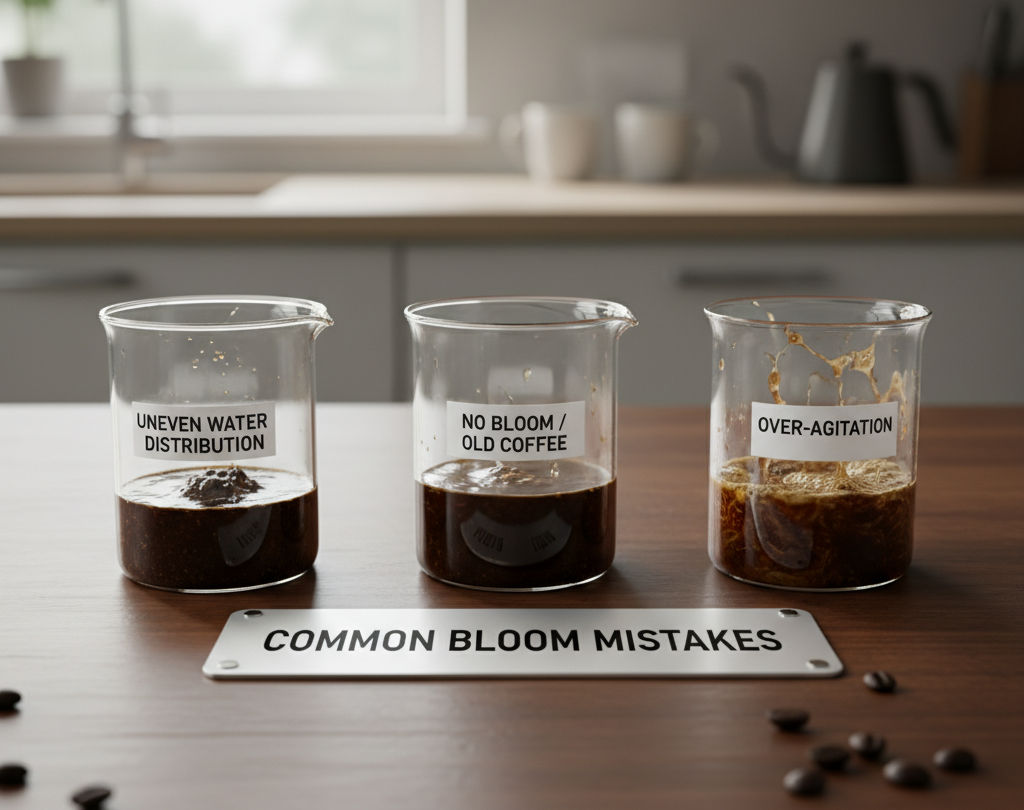
Common Bloom Mistakes and How to Fix Them
Dry Spots After Pouring Bloom Water
Problem: Some grounds aren't wetted during the bloom, meaning they won't degas properly and will interfere with extraction later.
Fix: Pour more slowly and deliberately, using spiral motions from center to edge. A gooseneck kettle makes this much easier. After pouring, a gentle swirl of the dripper can help wet any remaining dry edges.
Rushing the Bloom
Problem: Starting the main pour before CO2 has fully escaped — typically under 25 seconds — means residual gas continues escaping during extraction, disrupting flow.
Fix: Watch the bubbles, not the clock. Wait until vigorous bubbling has clearly slowed before continuing. For very fresh coffee, this may take longer than you expect.
Too Much Bloom Water
Problem: Using more than 3:1 water-to-coffee during the bloom can cause water to start draining through the filter before the bloom phase is complete, which disrupts the degassing process.
Fix: Keep bloom water at 2:1 to 3:1 (coffee weight to water weight). More isn't better here.
Using Stale Beans and Expecting a Big Bloom
Problem: If your coffee is 4 to 6 weeks past roast, there's simply not much CO2 left to release. You won't see a dramatic bloom regardless of technique.
Fix: The bloom can't be fixed — the freshness needs to be addressed. Buy fresher beans with a visible roast date.
The Bloom as a Freshness Test
One of the most practical uses of understanding the bloom is as a real-time freshness test for your beans. Before your first brew from a new bag:
- Grind a small amount (15 to 20g)
- Pour 30 to 40g of hot water over the grounds
- Watch what happens
What you see tells you:
- Large dome, vigorous bubbling for 30+ seconds: Beans are fresh — likely roasted within the past 2 weeks. Excellent.
- Moderate dome, bubbling subsides within 20 seconds: Beans are acceptable — 2 to 4 weeks post-roast. Still good.
- Minimal swelling, weak bubbling: Beans are older — 4 to 6+ weeks post-roast. May still taste decent but past peak freshness.
- Essentially flat — barely any reaction: Beans are stale. The complex flavors that were once in those beans have significantly degraded. Consider replacing them.
Frequently Asked Questions
What is coffee bloom?
Coffee bloom is the rapid release of carbon dioxide (CO2) that occurs when hot water first contacts fresh ground coffee. The grounds visibly swell, bubble, and puff up for 30 to 45 seconds as trapped gas escapes. It's both a brewing technique — allowing CO2 to escape before full extraction begins for more even flavor — and a visual indicator of coffee freshness. More dramatic blooming indicates fresher, recently roasted coffee.
Why does coffee bloom matter?
Blooming matters because CO2 is hydrophobic — it repels water. If CO2 is still escaping from the grounds during main extraction, it interferes with even water flow and saturation, causing channeling. This leads to uneven extraction — simultaneously bitter (over-extracted grounds) and sour (under-extracted grounds). By allowing the bloom phase first, CO2 escapes before the main pour, enabling water to flow uniformly through the coffee bed and extract consistently.
How long should you bloom coffee?
The standard bloom time is 30 to 45 seconds for most coffees. Very fresh coffee (within 5 days of roasting) may need up to 60 seconds. Older coffee (15+ days post-roast) may be done in 20 to 30 seconds. Rather than watching the clock strictly, watch the visual cues: when vigorous bubbling slows noticeably and the dome begins to deflate, your bloom is complete. Research from Royal Coffee Lab suggests 40 seconds as the optimal bloom duration, with diminishing returns beyond that point.
What is the coffee bloom ratio?
The standard bloom ratio is 2:1 water to coffee by weight — 2 grams of water for every 1 gram of coffee. For 20g of coffee, use 40g of bloom water. Some baristas use 2.5:1 or 3:1 for very fresh or dense beans. The bloom water should cover all the grounds evenly without flooding the filter. This ratio applies specifically to the bloom phase; the full brew ratio (typically 15:1 to 18:1 water to coffee) is different.
Should you bloom French press coffee?
Yes — though it's less commonly discussed for French press than for pour-over. Before adding all your water, pour enough to cover the grounds (roughly 2:1 ratio), stir gently to wet all the coffee, and wait 30 seconds. Then add the remaining water. This reduces CO2 interference with extraction and produces a more balanced cup than pouring all the water at once.
Does coffee bloom indicate freshness?
Yes — the coffee bloom is one of the most reliable visual indicators of freshness available to home brewers. Fresh coffee (roasted within 1 to 2 weeks) produces a dramatic, dome-like bloom with vigorous bubbling lasting 30 to 45 seconds. Stale coffee (4 to 6+ weeks post-roast) barely blooms at all — a weak fizz with minimal swelling. The bloom reflects how much CO2 remains in the beans, which directly indicates how recently they were roasted.
The Bottom Line
Coffee bloom is one of those brewing concepts that seems technical at first but becomes intuitive quickly. The practical summary: pour 2 to 3 times your coffee weight in hot water, wait 30 to 45 seconds while the coffee bubbles and swells, then continue your brew. That's it. That simple step produces more even extraction, better flavor balance, and a more expressive cup.
It also tells you something valuable about what you're working with. A vigorous bloom means fresh beans worth brewing carefully. A flat bloom means either older beans or very dense light-roast beans. Either way, paying attention to the bloom makes you a more informed and intentional brewer.
And the best blooms come from the freshest beans. Single-origin specialty coffee — roasted recently and sourced from farms where quality is prioritized — produces those dramatically billowing, aromatic blooms that make pour-over brewing feel genuinely magical. Coffee grown at high altitude, like the beans from Colombia's Antioquia region, develops a denser, more complex bean structure that holds CO2 longer and produces a more expressive bloom when it finally releases. It's a small thing, but it's the kind of detail that separates a memorable cup from a forgettable one.
If you'd like to read other articles similar to What Is Coffee Bloom and Why Does It Matter? A Complete Guide you can visit the category The Art and Science of Coffee: Guides, Reviews, and Expert Tips.
Does Coffee Affect Cortisol Levels? The Science Behind Caffeine and Your Stress Hormone

Is Coffee Good for Depression Risk? What the Research Actually Shows

Is Coffee Bad for Anxiety? What the Science Actually Shows
The 5 Elements of Coffee Tasting Every Coffee Lover Should Know
What Is Green Coffee? How Raw Beans Differ From Roasted — and What That Means for Your Health
How Is Coffee Decaffeinated? The 4 Methods Explained — Including the One You Should Avoid
What Is Coffee Degassing? Why Fresh Roasted Beans Release CO2 — and Why It Matters
What Is a Coffee Cooperative? How They Help Farmers — and Why They Matter for Your Cup
How Altitude Affects Coffee Flavor: Why High-Grown Coffee Tastes Different
Leave a Reply
Related post