

What Is Direct Trade Coffee? (And How It Compares to Fair Trade)
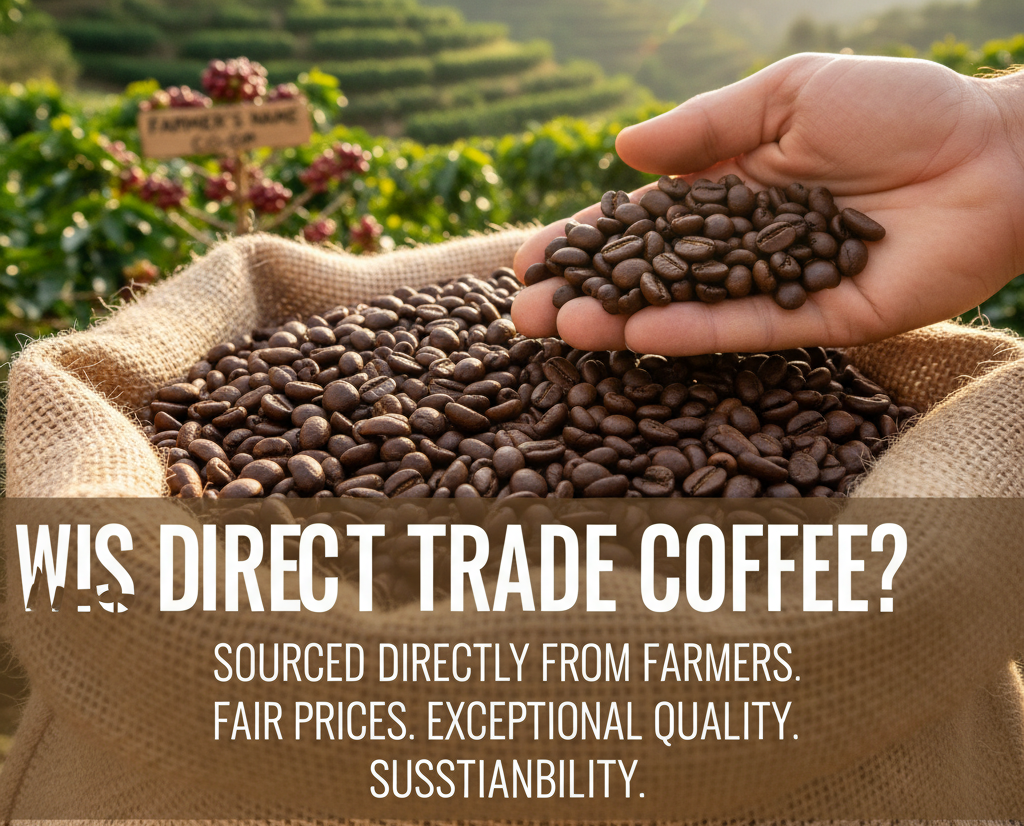
If you've spent any time looking at specialty coffee bags, you've encountered the terms "direct trade" and "fair trade" — often used as quality and ethics signals. Most coffee drinkers assume they're roughly the same idea with different names. They're not. They're meaningfully different models with different structures, different guarantees, and different implications for the farmers who grow your coffee and the quality of what ends up in your cup.
Here's the complete picture — what each model actually means, what it guarantees (and doesn't), how prices compare at every level of the supply chain, and which one to look for depending on what matters most to you.
Table of contents
- The Problem Both Models Are Trying to Solve
- What Is Fair Trade Coffee?
- What Is Direct Trade Coffee?
- The "Relationship Washing" Problem in Direct Trade
- The Supply Chain Comparison: Where Your Money Goes
- Does Direct or Fair Trade Coffee Taste Better?
- Can Coffee Be Both Direct Trade and Fair Trade?
- Which Is Better for Farmers?
- The Role of Importers in "Direct" Trade
- How to Identify Genuinely Ethical Coffee as a Consumer
- Direct Trade, Fair Trade, and Colombian Coffee
- Frequently Asked Questions
- The Bottom Line
The Problem Both Models Are Trying to Solve
To understand why direct trade and fair trade exist, you need to understand the standard coffee supply chain — and why it's a problem.
In conventional commodity coffee trading, the journey from farm to cup passes through multiple intermediaries:
- Farmer grows and harvests coffee cherries
- Local coyote or middleman buys from the farmer, typically at the lowest possible price
- Regional exporter aggregates coffee from multiple intermediaries
- International importer brings coffee to consuming countries
- Roaster buys from the importer
- Consumer buys from the roaster
Each step extracts margin. By the time coffee reaches the consumer at $20 to $30 CAD per 500g bag, the farmer who grew it may have received as little as $0.80 to $1.10 USD per pound of green coffee — often below the actual cost of production. In years when the global commodity price (called the C Market price) drops, farmers lose money on every harvest.
☕ Recommended by cocondo.coffee
Cocondo Orgánico — The only certified organic coffee from Antioquia, Colombia
Reserve Your Bag →This isn't an abstract concern. The International Coffee Organization estimates that over 25 million smallholder farmers and their families depend on coffee for their livelihoods — the vast majority in countries where the income gap between producing and consuming countries is extreme. When C Market prices collapse, farmers abandon coffee farms, reduce quality to cut costs, or face genuine poverty.
Both fair trade and direct trade emerged as attempts to fix this. They just approach it differently.
What Is Fair Trade Coffee?
Fair trade coffee is a third-party certified system that guarantees farmers receive a minimum price for their coffee — protecting them from the worst volatility of the commodity market — while also requiring compliance with labor, environmental, and social standards.
The certification is administered by independent organizations that inspect farms, verify compliance, and issue seals that appear on consumer packaging. There are two major fair trade certification bodies with different standards and scope:
Fairtrade International (FLO)
The global standard, operating in over 75 countries. Sets the minimum price for coffee at $1.80 USD per pound plus a $0.20 per pound Fairtrade Premium — money that goes into a community development fund that farmers collectively decide how to use (schools, infrastructure, healthcare, farm improvements). Fairtrade International only certifies organized farmer cooperatives — not large plantations — on the principle that smallholder farmers benefit most from fair trade protections.
Fair Trade USA
The US-focused certification body, which split from Fairtrade International in 2011 over a policy disagreement. Sets a minimum price of $1.40 USD per pound (lower than Fairtrade International's floor) through 2025. Controversially, Fair Trade USA will also certify large plantations — a decision Fairtrade International rejected because it extends fair trade branding to operations that critics argue don't align with the movement's smallholder farmer focus. When you see "Fair Trade Certified™" on a bag in North America, it's typically Fair Trade USA. "FAIRTRADE" (the Fairtrade International mark) is a different certification.
What Fair Trade Actually Guarantees
- ✅ Minimum price floor — protects against market price collapse
- ✅ Community development premium — funds go to democratically managed community projects
- ✅ Safe working conditions — no forced labor, no child labor
- ✅ Environmental standards — encourages organic practices, restricts certain pesticides
- ✅ Democratic cooperative structure — farmers have voice in pricing and premium use
- ✅ Annual third-party auditing — external verification of compliance
- ❌ Does not guarantee quality — fair trade minimum price is the same for excellent and mediocre coffee
- ❌ Does not guarantee premium quality prices — the minimum floor applies even to specialty-grade lots
- ❌ Does not eliminate intermediaries — coffee still passes through cooperative structures and exporters
What Is Direct Trade Coffee?
Direct trade is fundamentally different from fair trade in one critical way: there is no certification body, no minimum standard, no third-party verification. Direct trade is a sourcing philosophy, not a certification system.
In a genuine direct trade relationship, a roaster buys coffee directly from the farm or cooperative — no importers, no exporters, no intermediaries between the roaster and the producer. The roaster visits the farm, cups the coffee, negotiates price directly with the farmer, and builds an ongoing relationship over multiple harvest seasons.
The term was popularized in the early 2000s primarily by Intelligentsia Coffee in Chicago and Stumptown Coffee Roasters in Portland — two specialty roasters who rejected the fair trade model as insufficient and established their own direct sourcing programs, paying significantly above market and fair trade minimums for exceptional quality coffee.
How Direct Trade Works in Practice
A genuine direct trade relationship typically involves:
- The roaster traveling to the origin country and visiting the specific farm or cooperative — sometimes multiple times per year
- Cupping coffee samples at origin before purchasing, evaluating quality directly
- Negotiating price based on quality — with premiums paid for exceptional lots
- Multi-year commitments that give farmers income stability to plan and invest
- Technical assistance — roasters often help farmers improve processing, fermentation, or drying practices to enhance cup quality
- Transparency about pricing — many direct trade roasters publish exactly what they pay per pound to specific farms
The prices in genuine direct trade relationships are significantly higher than both the commodity market and fair trade minimums. Commodity coffee on the C Market typically ranges from $0.80 to $1.10 per pound, while Fair Trade USA sets a $1.40 per pound minimum, Fairtrade International sets a $1.80 minimum plus a $0.20 premium, and direct trade usually ranges from $2.00 to $4.00 or more per pound based on quality. For exceptional microlots, prices can reach $8 to $15 per pound or more.
What Direct Trade Actually Guarantees
- ✅ Higher prices — typically well above commodity and fair trade levels
- ✅ Direct relationship — money flows more directly to the farmer
- ✅ Quality incentive — better coffee = better price, incentivizing quality improvement
- ✅ Transparency (when genuine) — roasters can tell you exactly where the coffee comes from
- ✅ Farmer investment — roasters often assist with farm improvements and processing
- ❌ No third-party verification — there is no independent auditing of claims
- ❌ No standardized definition — anyone can use "direct trade" on packaging with zero accountability
- ❌ No labor standard requirements — unlike fair trade, there's no required compliance with labor practices
- ❌ No community development fund — all premium goes to the farmer/cooperative, not a shared fund
- ❌ Scalability limits — works best for small-to-medium specialty roasters; difficult to maintain at large scale
The "Relationship Washing" Problem in Direct Trade
Here's the part most articles about direct trade skip — and it's important for honest consumer understanding.
Because "direct trade" has no legal definition and no certifying body, it can be — and frequently is — used as a marketing label with no substantive meaning. A large commercial roaster that buys through a single importer rather than multiple intermediaries might call that "direct trade." A company that visited a farm once three years ago might still feature the relationship prominently on all its packaging. A roaster might claim "direct relationships" while actually buying through brokers who have the direct relationships.
This practice — using the emotional language of direct relationships without the actual practices that give the term meaning — is sometimes called "relationship washing." It's the direct trade equivalent of greenwashing, and it's common enough that informed consumers should approach "direct trade" labels with healthy skepticism unless the roaster can provide specifics.
Questions to ask to evaluate genuine direct trade:
- Can you tell me the name of the specific farm or cooperative?
- How often does someone from your company visit the farm?
- What price did you pay per pound this harvest?
- How long have you been working with this producer?
- What specific improvements have you made at the farm together?
Roasters with genuine direct trade relationships answer these questions readily and with specifics. Roasters using "direct trade" as marketing typically can't or won't.
The Supply Chain Comparison: Where Your Money Goes
Understanding where money flows in each model helps clarify the practical difference for farmers:
Commodity Coffee Supply Chain
Consumer pays: ~$10 CAD per 500g bag
Farmer receives: ~$0.80 to $1.10 USD per pound of green coffee
Percentage to farmer: approximately 2 to 4% of retail price
Fair Trade Coffee Supply Chain
Consumer pays: ~$18 to $25 CAD per 500g bag
Farmer/cooperative receives: $1.80 USD minimum per pound (Fairtrade International) + $0.20 premium
Percentage to farmer: approximately 5 to 8% of retail price
Additional: community development premium funds shared projects
Direct Trade Coffee Supply Chain
Consumer pays: ~$22 to $35 CAD per 500g bag
Farmer receives: $2.00 to $6.00+ USD per pound (quality-dependent)
Percentage to farmer: approximately 8 to 15% of retail price (varies significantly by roaster)
Additional: no certification fees, no intermediary margins
Key Insight on Certification Fees
Fair trade certification costs farmers money — cooperatives pay annual certification and auditing fees that can range from hundreds to thousands of dollars per year. For small cooperatives with thin margins, these fees are a real burden. Direct trade has no such cost, meaning the entire premium negotiated by the roaster goes to the farmer rather than being partly absorbed by certification infrastructure.
Does Direct or Fair Trade Coffee Taste Better?
This is where the two models diverge most significantly from a consumer quality perspective.
Fair trade certification has no quality component. The minimum price floor is the same for a 78-point commercial-grade coffee and a 92-point exceptional specialty lot. Fair trade incentivizes ethical production practices but does not specifically incentivize quality improvement. A certified fair trade coffee can be mediocre.
Direct trade is inherently quality-driven. The fundamental premise is that the roaster pays more because the coffee is better — and maintains the relationship because quality remains high. The direct relationship creates a direct quality incentive: if the coffee deteriorates, the roaster stops buying. This creates a feedback loop that rewards and encourages continuous quality improvement.
In practice, the best specialty coffees in the world — the ones that score 90+ points on professional cupping forms, the ones with extraordinary flavor profiles, the ones that coffee enthusiasts seek out — are almost always the result of direct trade relationships. The intimacy of the relationship allows roasters to communicate exactly what flavor profiles they want, help farmers experiment with processing methods, and pay the premiums that make investment in quality worthwhile.
This doesn't mean fair trade coffee tastes bad — many excellent coffees are fair trade certified. But the certification itself doesn't drive quality the way a genuine direct trade relationship does.
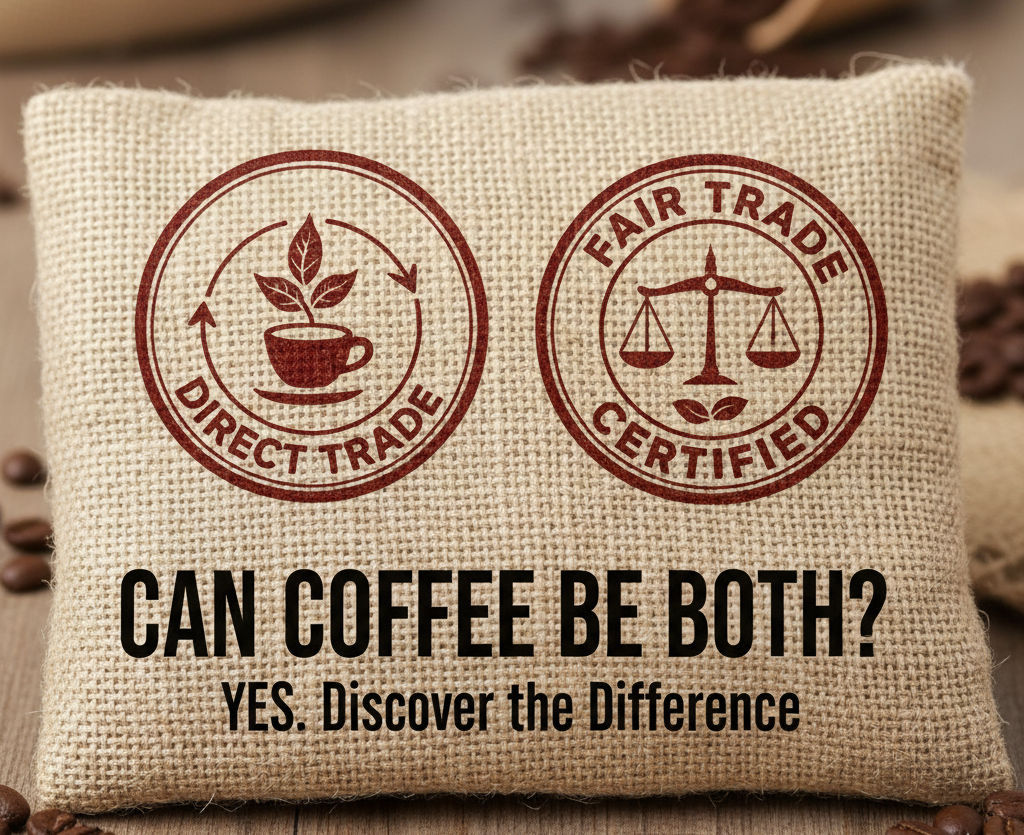
Can Coffee Be Both Direct Trade and Fair Trade?
Yes — and the best of both worlds is when a roaster has a genuine direct trade relationship with a farm that is also fair trade certified. This means:
- The price paid exceeds fair trade minimums (direct trade premium)
- Labor and environmental standards are independently verified (fair trade certification)
- The farmer benefits from both the direct relationship and the community development premium
- The consumer has both roaster transparency and independent third-party verification
Some of the most respected specialty roasters maintain relationships that satisfy both — they build direct relationships with cooperatives that are also fair trade certified, providing multiple layers of protection and incentive for farmers.
Which Is Better for Farmers?
The honest answer is: it depends on the farmer's situation.
Fair trade tends to benefit farmers most when:
- The C Market price is low — the price floor protection matters most when market prices are depressed
- The farmer is part of a large cooperative — pooled resources and community premium use collective bargaining power
- Quality is consistent but not exceptional — fair trade premium doesn't reward quality above its floor but guarantees the floor
- The farmer needs stability over maximization — predictable minimum income allows planning
Direct trade tends to benefit farmers most when:
- The coffee is exceptional quality — direct trade price premiums for quality can reach 4 to 10x commodity prices
- The farmer has a consistent relationship with a reliable roaster — the multi-year commitment provides stability
- The farmer wants to improve quality and receive investment — direct trade partners often provide technical assistance and co-investment in processing equipment
- The farmer's situation benefits from flexibility — direct negotiation can adapt to specific needs
The Role of Importers in "Direct" Trade
One nuance worth understanding: truly direct trade — where a roaster in Canada or the US buys directly from a farmer in Colombia or Ethiopia with no intermediary — is logistically complex. Green coffee requires export permits, international shipping, customs clearance, and quality testing. Most specialty roasters, even those with genuine farm relationships, work with specialty importers who handle the logistics while preserving the direct relationship's pricing and transparency.
This is generally understood and acceptable in the specialty coffee community. What matters is whether the pricing agreement and relationship exist between the roaster and the farmer — not whether a logistics facilitator is involved. The meaningful question is: does the farmer know exactly who is buying their coffee, at what price, and do they have a voice in that relationship? If yes, the "direct" in direct trade is substantive regardless of logistical intermediaries.
How to Identify Genuinely Ethical Coffee as a Consumer
Given that "direct trade" can be marketing and fair trade certifications vary significantly, here's a practical framework for making informed purchasing decisions:
- Look for transparency, not just labels. Can the roaster tell you the farm name, the country and region, the price paid per pound, and the length of the relationship? Genuine ethical sourcing is specific and verifiable.
- Check which fair trade certification. "FAIRTRADE" (Fairtrade International) has a higher price floor and stricter standards than "Fair Trade Certified™" (Fair Trade USA). Both are better than commodity, but they're not identical.
- Prioritize roasters who show their sourcing work. Roasters like Intelligentsia, Counter Culture, Stumptown, and many smaller specialty roasters publish their sourcing practices, prices paid, and farm profiles publicly — this is the standard of transparency that genuine direct trade should meet.
- Consider combined certifications. Coffee that is both fair trade certified AND sourced through a direct relationship provides the strongest guarantees — independently verified labor and environmental standards plus quality-driven relationship pricing.
- Support small specialty roasters with named origins. A 500g bag that names a specific farm, a specific region, a specific harvest, and a specific processing method is almost always the product of a direct or near-direct relationship — the specificity is only possible when the roaster knows the farmer.
Direct Trade, Fair Trade, and Colombian Coffee
Colombia is particularly interesting in the direct trade vs fair trade context. The country's National Federation of Coffee Growers (FNC) — the organization behind the "Juan Valdez" brand — is one of the largest fair trade structures in the world, collectively representing over 500,000 Colombian smallholder farmers.
But beyond the FNC's collective structure, Colombia has also become one of the most important origins in the direct trade specialty market. Farms in regions like Huila, Nariño, and Antioquia have built direct relationships with specialty roasters worldwide — often selling exceptional microlots at prices 3 to 10 times above commodity. These relationships have funded the kind of investment in processing, equipment, and experimentation that has made Colombian specialty coffee some of the most celebrated in the world.
The farms that produce Colombia's finest specialty coffee — including small family farms in places like Titiribí in Antioquia — are often beneficiaries of exactly this model: direct relationships with quality-focused roasters who pay genuinely premium prices and invest in long-term partnership. The result is both better livelihoods for farmers and better coffee for consumers.
Frequently Asked Questions
What is direct trade coffee?
Direct trade coffee is coffee sourced through a direct relationship between a roaster and a specific farm or cooperative, without intermediaries. Roasters visit farms personally, negotiate prices directly with farmers (typically well above commodity and fair trade minimums), and build long-term partnerships focused on quality improvement and mutual benefit. Unlike fair trade, direct trade has no certification body, standardized definition, or third-party verification — its value depends entirely on the integrity of the roaster-farmer relationship.
What is the difference between direct trade and fair trade coffee?
Fair trade is a certified system with third-party verification, minimum price floors ($1.40–$1.80+ per pound depending on certification body), and required compliance with labor and environmental standards — but no quality component. Direct trade is a sourcing philosophy with no certification, no price floor, and no independent verification, but with typically higher prices ($2.00–$6.00+ per pound), a quality-driven incentive structure, and a direct financial relationship between roaster and farmer. Both aim to improve farmer welfare through better pricing, but through very different mechanisms.
Does fair trade guarantee better quality coffee?
No — fair trade certification is specifically about pricing and labor/environmental standards, not cup quality. The minimum price floor is identical for exceptional and mediocre coffee. Direct trade, by contrast, is inherently quality-driven — better coffee commands higher direct trade prices. The best specialty coffees in the world are almost always the result of direct trade relationships rather than fair trade certification.
Is direct trade coffee more expensive?
Typically yes — but not dramatically so at the consumer level. The premium goes primarily to the farmer rather than to intermediaries or certification infrastructure. Direct trade specialty coffee typically retails at $22 to $35 CAD per 500g, compared to $18 to $25 CAD for fair trade and $10 to $15 CAD for commodity. The price difference between quality direct trade and commodity coffee is significant; the difference between direct trade and fair trade is more modest.
How do I know if "direct trade" on a coffee bag is genuine?
Ask for specifics: the farm name, the region, the price paid per pound, and how long the relationship has existed. Genuine direct trade roasters answer these questions readily and often publish the information on their websites. If a roaster uses "direct trade" as a label but cannot tell you the farm name, the price paid, or when they last visited, treat it as a marketing claim rather than a substantive sourcing practice.
Which is better: direct trade or fair trade coffee?
Neither is universally better — they serve different needs. Fair trade's certified minimum price floor provides critical protection when commodity prices crash, and its independent auditing gives consumers verified assurance of labor standards. Direct trade's quality-driven premium can provide farmers significantly more income when their coffee is exceptional, and the direct relationship incentivizes continuous quality improvement. Ideally, look for coffee that combines both: a genuine direct relationship with a farm that also maintains fair trade certification, giving you quality transparency and independent labor standard verification simultaneously.
The Bottom Line
Direct trade and fair trade are both genuine attempts to fix the same broken supply chain — but they take fundamentally different approaches. Fair trade offers certified protection through minimum price floors and independent auditing. Direct trade offers relationship-based quality premiums without certification's overhead or limitations.
For consumers, the most important shift is from seeking labels to seeking transparency. The roaster who can name the farm, describe the farmer, explain the price paid, and tell you how the relationship developed is almost certainly giving you a better product and a better deal for the people who grew it — regardless of which label appears on the bag.
And that transparency is most meaningful when the coffee itself is exceptional — when the direct relationship has produced something worth the price premium and worth understanding. Single-origin specialty coffee from farms in Colombia's high-altitude growing regions, produced by farmers who have long-term relationships with quality-focused buyers, is exactly where the direct trade model works at its best: exceptional coffee, exceptional farmer income, and a supply chain where every participant knows and respects the others.
If you'd like to read other articles similar to What Is Direct Trade Coffee? (And How It Compares to Fair Trade) you can visit the category The Art and Science of Coffee: Guides, Reviews, and Expert Tips.
Does Coffee Affect Cortisol Levels? The Science Behind Caffeine and Your Stress Hormone

Is Coffee Good for Depression Risk? What the Research Actually Shows

Is Coffee Bad for Anxiety? What the Science Actually Shows
The 5 Elements of Coffee Tasting Every Coffee Lover Should Know
What Is Green Coffee? How Raw Beans Differ From Roasted — and What That Means for Your Health
How Is Coffee Decaffeinated? The 4 Methods Explained — Including the One You Should Avoid

What Is Coffee Degassing? Why Fresh Roasted Beans Release CO2 — and Why It Matters
What Is a Coffee Cooperative? How They Help Farmers — and Why They Matter for Your Cup
How Altitude Affects Coffee Flavor: Why High-Grown Coffee Tastes Different
Leave a Reply
Related post