

What Is a Coffee Cooperative? How They Help Farmers — and Why They Matter for Your Cup
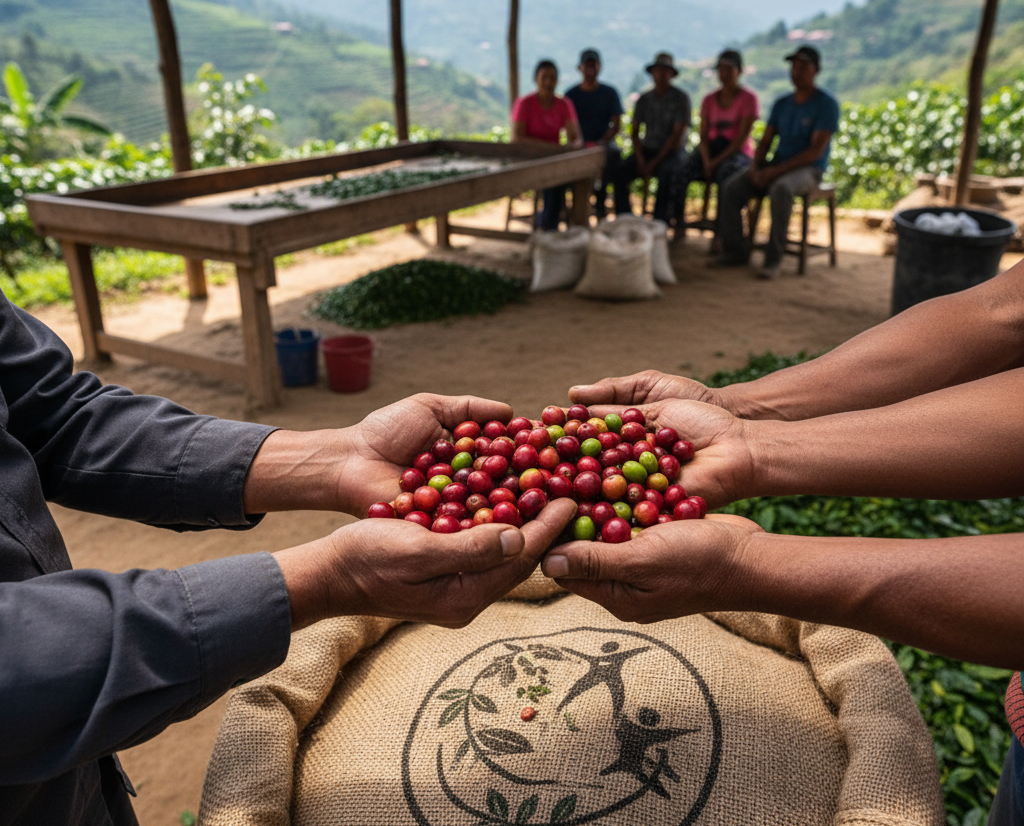
If you've spent time reading specialty coffee bag labels, you've encountered the word "cooperative" — often alongside the name of an Ethiopian washing station, a Kenyan farmers' group, or a Colombian producer organization. Most coffee drinkers assume it's an ethical signal, similar to "fair trade" or "organic." It is — but a coffee cooperative is also a very specific economic and organizational structure that directly shapes the quality, traceability, and sustainability of the coffee in your cup in ways that go far beyond a label.
Understanding what a coffee cooperative actually is, how it functions, and why it matters gives you a more complete picture of how specialty coffee gets from a smallholder farmer's few hectares to your morning brew.
Table of contents
- What Is a Coffee Cooperative?
- Why Cooperatives Exist: The Problem They Solve
- How a Coffee Cooperative Actually Works
- The Four Types of Coffee Cooperatives
- Famous Coffee Cooperatives Worth Knowing
- What Cooperatives Mean for Cup Quality
- How to Identify Whether a Cooperative Is Genuine
- The Honest Limitations of Cooperatives
- Cooperatives and the Colombian Coffee Story
- Frequently Asked Questions
- The Bottom Line
What Is a Coffee Cooperative?
A coffee cooperative — or coffee co-op — is an organization owned and democratically governed by a group of coffee farmers who pool resources, share infrastructure, and collectively market their coffee to access markets and prices that individual smallholders could never reach alone.
The cooperative model follows the internationally recognized Rochdale Principles, developed by the first modern cooperative (a grocery store in Rochdale, England, in 1844):
- Voluntary and open membership: Any qualifying farmer can join
- Democratic member control: One member, one vote — regardless of farm size or contribution volume
- Member economic participation: Members contribute to and share in the cooperative's capital
- Autonomy and independence: The cooperative is controlled by its members, not external investors
- Education and training: The cooperative invests in its members' knowledge and skills
- Cooperation among cooperatives: Co-ops work with other cooperative structures
- Concern for community: The cooperative works for the sustainable development of its community
In practice, coffee cooperatives vary enormously — from small village-level groups of 50 farmers sharing a single depulper, to massive national organizations like Colombia's National Federation of Coffee Growers (FNC) representing over 500,000 smallholder families. The structure is remarkably flexible while the core principle remains constant: collective action by farmer-owners to overcome the disadvantages of scale.
☕ Recommended by cocondo.coffee

Cocondo Orgánico — The only certified organic coffee from Antioquia, Colombia
Reserve Your Bag →Why Cooperatives Exist: The Problem They Solve
To understand why cooperatives matter, you need to understand the structural problem facing most coffee farmers worldwide.
Approximately 125 million people depend on coffee farming for their livelihoods globally. The vast majority are smallholder farmers — families farming 1 to 3 hectares (2.5 to 7.4 acres) of coffee. At typical production rates, a smallholder's annual harvest might yield 500 to 1,500 kg of cherry — which translates to roughly 100 to 300 kg of green coffee.
This creates an unavoidable problem: 200 kg of green coffee is invisible to the international market. Exporters, importers, and specialty roasters work in containers — minimum shipments of 300 to 600 bags (each approximately 60 kg). A single smallholder's annual production doesn't fill a fraction of one export container. Without some form of aggregation, small farmers have no realistic path to export markets.
Forced to sell locally, they typically deal with intermediaries — local traders called "coyotes" in Latin America and "cherry buyers" in East Africa — who aggregate coffee from many farms, blend quality levels together, and sell to regional exporters at commodity prices. The farmer in this chain has essentially no negotiating power: accept the offered price or keep the coffee. The offered price is often below the cost of production.
Green Coffee Collective describes the core cooperative value proposition clearly: "Without cooperatives, the majority of the world's coffee farmers would have no realistic path to specialty markets. The infrastructure, quality control, and market access that co-ops provide are what make specialty coffee possible for smallholders."
A cooperative solves this by aggregating harvests from hundreds or thousands of members into exportable volumes — and doing so with enough organizational structure to pursue fair trade certification, specialty market relationships, and direct trade agreements that no individual farmer could access alone.
How a Coffee Cooperative Actually Works
Membership and Governance
Farmers join the cooperative by paying a membership fee — typically a modest amount intended to create shared ownership rather than present a financial barrier. Upon joining, they become owners of the cooperative with full voting rights on governance decisions: who sits on the board, how profits are distributed, what infrastructure investments to make, which certifications to pursue.
The governance structure typically follows a hierarchy:
- General Assembly of Members: The full membership votes on major strategic decisions and elects the Board of Directors. Operates on the "one member, one vote" principle regardless of farm size.
- Board of Directors: Elected farmer representatives who oversee the cooperative's overall direction and management.
- Executive Committee / Management: Professional staff who handle day-to-day operations — typically including a manager, accountants, quality specialists, and agronomists.
- Specialized Committees: Sub-groups handling specific areas — quality control, environmental practices, women's programs, youth development.
COOPAC cooperative in Rwanda, with over 2,300 members, operates a multi-tiered decision-making structure specifically designed to ensure every farmer's voice is heard even at scale. Ethiopia's Layo Toraga cooperative, with 1,814 members, operates on strict "one member, one vote" governance that has earned it recognition for democratic accountability in the coffee sector.
Collection and Processing
The cooperative typically owns and operates centralized processing infrastructure that would be financially impossible for individual members to own:
- Wet mills (washing stations): Where freshly picked cherry is depulped, fermented, washed, and prepared for drying. In Kenya and Ethiopia, the cooperative washing station is often the entire first step of processing — farmers bring cherry to the station the day of picking.
- Drying infrastructure: Raised African beds, drying patios, or mechanical dryers for post-processing drying under consistent conditions.
- Dry mills: Where dried coffee in parchment is hulled, sorted, graded, and prepared for export.
- Cupping labs: Quality control facilities where coffee is evaluated before export — essential for specialty market access and for providing farmers with feedback on their coffee's quality.
- Storage: Secured warehouses for holding green coffee through the export preparation process.
The quality of the cooperative's processing infrastructure directly affects the quality of the final coffee. A cooperative with excellent, well-maintained wet mills, clean water sources, and skilled processing staff can elevate member coffee significantly above what individual farm-level processing would produce.
Aggregation and Lot Management
This is where cooperative management becomes most technically demanding from a quality standpoint. Member cherry may arrive from farms across a significant geographic area, at various stages of ripeness, from multiple varietals. How the cooperative handles aggregation determines whether the final export lots are uniform specialty-grade coffee or inconsistent blends.
The best cooperatives implement:
- Cherry sorting at intake: Weighing and sorting incoming cherry by quality grade — only red, ripe cherry enters the specialty processing line
- Member-specific tracking: Recording which cherry came from which farmer, enabling quality feedback and premium payments to the best producers
- Lot separation: Processing cherry from different villages, varietals, or quality grades as separate lots — preserving traceability for specialty buyers who want specific-origin character
- Standardized fermentation: Consistent controlled fermentation parameters across all processing to minimize variation
Traceability within a cooperative — knowing exactly which member farms contributed to a specific export lot — is increasingly valuable for specialty buyers who want to offer farm-level origin stories to consumers. Some cooperatives have invested in digital tracking systems that assign each bag of cherry a farmer ID at intake, maintaining traceability through processing to export.
Marketing and Export
The cooperative represents its members in international markets — negotiating with importers, maintaining relationships with specialty roasters, pursuing certifications, and attending industry events that individual smallholders could never access or afford. This marketing function is often the highest-value service a cooperative provides.
Cooperatives can access:
- Fairtrade certification: Requiring organizational structure and documentation that makes it practical for cooperatives but not individual farmers
- Organic certification: Collective certification programs that spread the cost across members
- Cup of Excellence and other competitions: The recognition and auction premiums from winning lots benefit members directly
- Direct trade relationships: Long-term relationships with specialty roasters who pay above-market prices for consistent quality and traceability
- Export licensing and logistics: Handling the complex paperwork and logistics of international shipping that overwhelm individual farmers
Member Services and Profit Distribution
Beyond processing and marketing, effective cooperatives provide services that improve member farm quality and productivity over time:
- Agronomic training: Best practices for pruning, fertilization, pest management, and harvest timing
- Quality feedback: Cupping results communicated to individual farmers, linking quality improvement to premium payments
- Low-interest financing: Pre-harvest loans for farming inputs (fertilizer, labor) against the security of the coming harvest — critical for farmers who lack access to formal banking
- Input supplies: Cooperative bulk-purchasing of agricultural inputs (fertilizer, disease treatments) at lower prices than individual farmers could negotiate
- Community development: Infrastructure investments — roads, schools, healthcare clinics — funded by cooperative surplus that benefits the broader community
End-of-year profits (after operating costs and reinvestment) are distributed to members in proportion to their contributions — typically based on the weight and quality grade of cherry delivered. Members who deliver more, higher-quality cherry earn more.
The Four Types of Coffee Cooperatives
Not all cooperatives function identically. The main structural types vary by which functions they centralize:
Type 1: Processing Cooperative
Focuses specifically on centralized processing infrastructure — the wet mill, drying beds, and dry mill. Members bring their cherry to the cooperative for processing, then the cooperative sells the resulting green coffee. Most common in Kenya and Ethiopia, where wet mill cooperatives are the standard model. Members don't individually market their coffee — the cooperative handles all post-harvest activity.
Type 2: Marketing Cooperative
Members process their own coffee on their farms (or at smaller village stations) and bring green coffee to the cooperative for export marketing. The cooperative provides market access, certifications, and negotiating power without centralizing processing. More common in origins where farm-level processing is already established.
Type 3: Multi-Function Cooperative
Provides the full range of services: processing, quality control, marketing, technical training, financial services, and community development. The most comprehensive model and typically the most effective at improving member livelihoods across all dimensions. Colombia's FNC (Federación Nacional de Cafeteros) is arguably the world's most famous example, providing services from agricultural research to café management to social programs for 500,000+ member families.
Type 4: Cooperative Union / Federation
A second-tier organization that federates multiple smaller cooperatives. Individual village cooperatives maintain member relationships but collectively join a union for export, certification, and market access. Ethiopia's Sidama Coffee Farmers Cooperative Union — one of the largest in Africa — brings together dozens of primary cooperatives under a federated structure that enables international-scale marketing while preserving village-level governance. These union structures are common in Ethiopia, Uganda, and Tanzania.
Famous Coffee Cooperatives Worth Knowing
Kochere Cooperative — Ethiopia, Yirgacheffe
When you see "Kochere" on a specialty coffee bag, you're seeing one of Ethiopia's most celebrated washing station cooperatives. Located in the Yirgacheffe zone, Kochere processes cherry from multiple village farmers and produces some of the most distinctive floral, citrus-forward, tea-like coffees in the world. The cooperative washing station is responsible for the quality consistency that has made Kochere synonymous with exceptional Ethiopian washed coffee.
FNC — Federación Nacional de Cafeteros, Colombia
Colombia's National Federation of Coffee Growers is one of the world's most influential coffee organizations — a cooperative federation representing over 500,000 smallholder families, controlling the Juan Valdez brand, operating a network of Almacafé export facilities, and funding Cenicafé (the research center that developed Castillo and Tabi varietals). The FNC has shaped Colombian coffee quality standards, export systems, and farmer welfare programs for nearly a century. Its Fair Trade and organic certification programs benefit hundreds of thousands of farmers.
COOPAC — Rwanda
With over 2,300 members, COOPAC is one of Rwanda's most progressive cooperatives — operating a carbon-neutral wet mill (the first of its kind in the world) and implementing multi-tiered democratic governance. COOPAC's environmental leadership and quality focus have made it a reference point for sustainable cooperative development in the Great Lakes coffee region.
Sidama Coffee Farmers Cooperative Union — Ethiopia
One of Africa's largest coffee cooperative unions, Sidama represents hundreds of thousands of smallholder farmers from dozens of primary cooperatives in Ethiopia's Sidama Zone. The union operates large-scale processing facilities, maintains direct relationships with international specialty buyers, and channels significant premiums back to member communities. Sidama coffees — particularly naturally processed lots — are among Ethiopia's most exported specialty offerings.
Minasul — Brazil
Brazil's largest coffee cooperative, Minasul operates in Minas Gerais state with tens of thousands of members. It provides the full range of services from processing and storage to research, financial services, and export marketing. As Perfect Daily Grind quoted from Minasul: "Our purpose is to put cooperative members' products and services on the market, at more advantageous terms than we could achieve by ourselves."
What Cooperatives Mean for Cup Quality
For specialty coffee consumers, the question is whether cooperative membership improves or diminishes the quality of what's in the cup. The honest answer is: it depends on the cooperative's quality commitment.
Well-managed cooperatives improve cup quality because:
- Centralized processing with professional equipment and skilled staff produces more consistent fermentation and drying than farm-level processing by non-specialists
- Cupping labs provide quality feedback that incentivizes farmers to improve harvest practices
- Premium payment systems linked to quality grade incentivize careful cherry selection
- Technical training improves farm-level practices across the member base
- Collective investment in quality improvements benefits all members simultaneously
Poorly managed cooperatives can hurt cup quality because:
- Aggregation of cherry from many farms without quality sorting blends exceptional and mediocre coffee together
- Political or social pressures within democratic governance can override quality-focused management decisions
- Underfunded cooperatives may lack maintenance for critical processing equipment
- Volume-focused payment systems (paying by weight without quality premiums) give members no financial incentive to invest in quality
The best cooperatives have cracked this tension by implementing quality-differentiated payment systems — paying significantly higher prices per kilogram for specialty-grade cherry that passes quality thresholds, creating direct financial incentives for careful farming and selective picking. This turns the cooperative's democratic structure into a quality feedback loop rather than a quality-dilution mechanism.
How to Identify Whether a Cooperative Is Genuine
When a coffee bag mentions a cooperative, here's what to look for to assess whether it represents genuine farmer benefit:
- Named cooperative with verifiable information: Legitimate cooperatives have names, locations, and often websites or social media presence. "Kochere Cooperative, Yirgacheffe, Ethiopia" is verifiable; "East African Farmers Group" is not.
- Member count or scale information: Knowing that a cooperative has 2,300 members (COOPAC) or 1,814 (Layo Toraga) indicates real organizational structure, not a marketing term.
- Certification consistency: Fairtrade, Rainforest Alliance, and organic certifications require organizational documentation that cooperatives genuinely possess. Multiple certifications increase credibility.
- Roaster transparency: Roasters who can tell you about their relationship with the specific cooperative — when they last visited, what they paid, how they assess quality — have genuine direct relationships.
- Quality-differentiated pricing: Cooperatives that pay premiums for specialty-grade cherry are quality-focused; those that pay flat rates regardless of quality may prioritize volume over quality.
The Honest Limitations of Cooperatives
Despite their genuine value, cooperatives have real limitations that balance requires acknowledging:
- Democratic inefficiency: Major decisions require member votes, which slows response to market opportunities and can delay quality improvements when member consensus is difficult to achieve
- Management challenges: Many cooperatives struggle to attract and retain professional management talent in remote rural areas
- Quality averaging: Even well-managed cooperatives blend cherry from many farms — which means exceptional lots from the best member farms may be diluted rather than expressed individually
- Political tensions: Internal politics within democratic governance can create factions, nepotism, or decisions that benefit politically connected members at others' expense
- Corruption risk: Financial management weaknesses or lack of independent auditing can create opportunities for cooperative funds to be misused
- Size vs intimacy tradeoff: Very large cooperatives gain market power but lose the close producer-buyer relationships that direct trade provides
These limitations explain why direct trade — where a roaster works directly with a specific farm rather than through a cooperative — can sometimes produce superior traceability, quality expression, and farmer income. Cooperatives and direct trade aren't competing models; they serve different farm contexts. Direct trade works best for larger, self-sufficient farms with production volume and processing infrastructure. Cooperatives work best for the smallholder majority who would have no market access at all without collective organization.

Cooperatives and the Colombian Coffee Story
Colombia's cooperative structure is particularly relevant for understanding high-quality Colombian specialty coffee. The country's two-tier system — the national FNC providing infrastructure, research, and institutional support, while regional cooperative groups maintain direct farmer relationships — has created one of the most sophisticated smallholder coffee support systems in the world.
The FNC's investment in Cenicafé has produced disease-resistant varietals (Castillo, Tabi) specifically adapted to Colombian conditions. Its quality standards and certification programs have raised the baseline quality of Colombian coffee across the country. Its social programs have invested in education, healthcare, and rural infrastructure for farmer communities.
Independent specialty cooperatives and producer groups — like those operating in Antioquia's more remote growing areas — operate alongside (and sometimes independently of) the FNC, connecting carefully farmed specialty lots to direct-trade buyers who can pay premiums that reflect the quality potential of high-altitude, organically farmed coffee. The combination of national infrastructure and farm-level quality focus has made Colombian specialty coffee one of the most reliably excellent origins in the world.
Frequently Asked Questions
What is a coffee cooperative?
A coffee cooperative is an organization owned and democratically governed by a group of coffee farmers who pool their harvests, share processing infrastructure, and collectively market their coffee to access markets and prices that individual smallholders could never reach independently. Cooperatives operate on the "one member, one vote" principle and typically provide members with processing services, quality training, market access, certifications, financial services, and community development programs. They are the organizational structure that makes specialty coffee possible for the world's 125 million smallholder coffee farming families.
How do coffee cooperatives help farmers?
Cooperatives help farmers in five primary ways: collective volume (pooling harvests to reach exportable quantities), shared infrastructure (access to processing equipment no individual farmer could afford), market access (specialty buyers, certifications, and export relationships unreachable by individual smallholders), technical support (agronomic training, quality feedback, and farm improvement programs), and financial services (pre-harvest loans and input supply at collective pricing). End-of-year profits are distributed to members in proportion to their quality contributions.
Are coffee cooperatives the same as fair trade?
No — though they often overlap. Fair trade is a certification system with specific price floor requirements and standards. Coffee cooperatives are an organizational structure that can exist with or without fair trade certification. Most Fairtrade-certified coffee comes through cooperatives (because individual farmers cannot meet Fairtrade's documentation requirements alone), but not all cooperatives are Fairtrade certified. A cooperative may pursue Fairtrade, Rainforest Alliance, organic, or no certification depending on market access, cost, and member priorities.
Does cooperative coffee taste different?
The cooperative structure itself doesn't inherently change flavor, but cooperative processing quality directly affects cup quality. Well-managed cooperatives with high-quality processing infrastructure, skilled staff, and quality-differentiated payment systems often produce more consistent, higher-quality coffee than farm-level processing would achieve. The famous washing stations of Ethiopia (like Kochere) and Kenya are cooperative processing facilities whose quality management has defined the flavor profiles those origins are celebrated for.
Why do specialty coffee bags mention cooperatives?
Specialty roasters mention cooperatives because they represent traceability, farmer welfare, and quality sourcing — all values specialty coffee consumers care about. A named cooperative with verifiable information signals that the roaster knows exactly where the coffee came from and has an accountable relationship with the producing community. It's also honest supply chain communication: most specialty coffee from smallholder origins genuinely does come through cooperatives, and acknowledging that is more accurate than implying a direct farm relationship when one doesn't exist.
The Bottom Line
Coffee cooperatives are the organizational infrastructure that makes specialty coffee's supply chain work for the farmers at its foundation. They solve the fundamental market access problem facing the world's 125 million smallholder coffee farmers, providing the aggregation, processing, certification, and market relationships that transform small-scale farming from subsistence-level commodity trading into viable specialty production.
For consumers, the cooperative label on a coffee bag is genuinely meaningful — not just as an ethics signal, but as a quality indicator. The Kochere washing station's consistent, world-class Ethiopian washed coffees exist because of cooperative infrastructure. Kenya's celebrated wet-processed coffees exist largely because of cooperative structures. And the growing specialty coffee sectors in Rwanda, Uganda, and Burundi are being built cooperative by cooperative.
When you understand cooperatives, you understand why specialty coffee's traceability stops at the cooperative name rather than the individual farm for most of the world's best origins — and why that's not a quality limitation but rather an accurate reflection of how exceptional coffee is actually produced at scale.
If you'd like to read other articles similar to What Is a Coffee Cooperative? How They Help Farmers — and Why They Matter for Your Cup you can visit the category The Art and Science of Coffee: Guides, Reviews, and Expert Tips.
Does Coffee Affect Cortisol Levels? The Science Behind Caffeine and Your Stress Hormone

Is Coffee Good for Depression Risk? What the Research Actually Shows

Is Coffee Bad for Anxiety? What the Science Actually Shows

The 5 Elements of Coffee Tasting Every Coffee Lover Should Know
What Is Green Coffee? How Raw Beans Differ From Roasted — and What That Means for Your Health

How Is Coffee Decaffeinated? The 4 Methods Explained — Including the One You Should Avoid

What Is Coffee Degassing? Why Fresh Roasted Beans Release CO2 — and Why It Matters

How Altitude Affects Coffee Flavor: Why High-Grown Coffee Tastes Different
What Is a Coffee Cherry? The Fruit Behind Every Cup You Drink
Leave a Reply
Related post