

How Altitude Affects Coffee Flavor: Why High-Grown Coffee Tastes Different
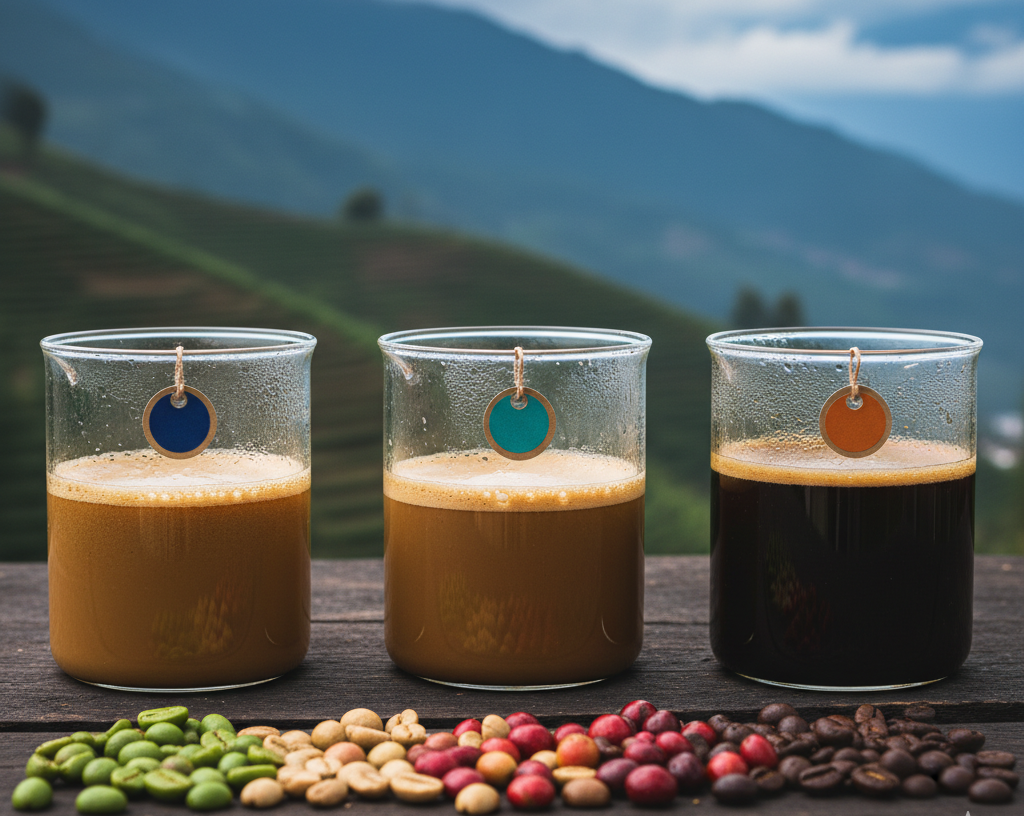
When a barista mentions that a coffee was grown at 1,900 meters above sea level, they're not just adding geographic color to a story. They're telling you something specific and predictable about what's in your cup. Of all the factors that influence coffee flavor — soil, varietal, processing, roasting — altitude is the single most reliable predictor of quality and flavor complexity available before you taste a coffee.
Understanding why altitude matters — and what specifically it does to a coffee bean during its development — gives you one of the most useful tools in navigating specialty coffee.
Table of contents
- The Simple Version: Altitude Slows Everything Down
- The Molecular Mechanisms: What's Actually Happening in the Bean
- The Altitude-Density Connection: Reading Quality in the Bean
- The Altitude Classification System
- The Paradox of Altitude: Why Stress Produces Quality
- The Diurnal Temperature Variation Effect
- Altitude and Acidity: Why High Grown Tastes Brighter
- Altitude vs Other Flavor Factors: How It Compares
- A Practical Altitude Guide to Flavor Expectations
- Why Altitude Alone Isn't Everything
- Frequently Asked Questions
- The Bottom Line
The Simple Version: Altitude Slows Everything Down
The relationship between altitude and coffee quality comes down to one core mechanism: higher altitude means cooler temperatures, and cooler temperatures slow the development of the coffee cherry.
At lower altitudes, warmer temperatures cause coffee cherries to ripen quickly — sometimes in 6 to 7 months. At higher altitudes, cooler air temperatures extend the ripening period to 9, 10, or even 11 months. This extended maturation window is where all the interesting chemistry happens.
Think of it like the difference between a tomato ripened quickly in a greenhouse versus one that develops slowly on the vine in summer sun. The slow-ripened tomato develops more sugar, more acid complexity, and more aromatic depth. The fast-ripened one gets to market sooner but tastes simpler. Coffee works exactly the same way — and the altitude is the thermostat that controls the speed.
☕ Recommended by cocondo.coffee

Cocondo Orgánico — The only certified organic coffee from Antioquia, Colombia
Reserve Your Bag →The Molecular Mechanisms: What's Actually Happening in the Bean
A 2024 study titled "The Growing Altitude Influences the Flavor Precursors, Sensory Characteristics and Cupping Quality of the Pu'er Coffee Bean," published in the journal Foods, examined coffee grown at multiple altitude bands and found specific molecular changes that explain altitude's flavor effects:
Higher Volatile Aromatic Compounds
High-altitude coffees contained significantly higher concentrations of volatile aromatic compounds — the molecules responsible for floral, fruity, and complex aromatic notes that you detect through retronasal olfaction while drinking. Slower cherry development allows more time for the enzymatic production of these aromatic precursors within the bean. The result is a more aromatic, more complex cup profile from identical processing and roasting conditions.
Lower Alkaloids (Less Bitterness)
The same 2024 study found that high-altitude coffees showed decreased levels of alkaloids — including caffeine and trigonelline — compounds associated with bitterness. This partly explains why high-altitude specialty coffees taste less harsh and bitter than lower-altitude commercial coffees even at comparable roast levels. Less caffeine-driven bitterness means the sweetness and acidity have more room to express themselves in the cup.
Higher Fatty Acid Content
High-altitude beans contained higher levels of fatty acids, which contribute to the smooth, rounded mouthfeel and enhanced aromatic texture of specialty coffees. Fatty acids act as carriers for aromatic volatile compounds — more fatty acids means more effective delivery of aroma to your palate. This partially explains the characteristic "smoothness" of well-grown high-altitude coffees that's difficult to achieve from lower-altitude material regardless of roasting skill.
More Complex Sugar Accumulation
Slower cherry development allows more complete and complex sugar formation in the bean. High-altitude cherries accumulate more diverse sugar compounds — not just more total sugar, but a richer range of different sugar molecules that interact differently during roasting. During the Maillard reactions and caramelization of roasting, a more diverse sugar profile produces a more complex range of flavor compounds in the final cup.
Higher Organic Acid Complexity
Slower maturation at altitude allows more balanced and complex organic acid development — citric, malic, tartaric, and other acids that create the bright, structured acidity of specialty coffee. At lower altitudes, faster ripening produces simpler acid profiles — often dominated by a single acid type — which taste sharper and less structured. High-altitude acidity typically has more layers: the citrus brightness of citric acid, the soft apple quality of malic acid, and the tartness of tartaric acid all present in better balance.
The Altitude-Density Connection: Reading Quality in the Bean
The most visible physical effect of altitude on coffee is bean density — and density is one of the most reliable quality indicators available to roasters and buyers.
At high altitude, cooler temperatures slow the coffee plant's metabolic rate. The cherry takes longer to develop, and the seed inside has more time to accumulate solids — proteins, sugars, lipids, and mineral compounds — resulting in a physically denser, harder bean.
You can often detect high-altitude beans physically:
- Hardness: High-altitude beans are noticeably harder — they resist crushing between fingers where lower-altitude beans give way more easily
- Center cut: The fissure running down the middle of the bean (the center cut) is tighter and narrower in high-altitude beans — the denser structure doesn't leave as much space
- Color: High-altitude green beans often have a blue-green or jade color; lower-altitude beans tend toward lighter, yellower greens
- Size: Counterintuitively, high-altitude beans are often smaller than low-altitude beans — denser, not larger. The cell structure is more compact.
Why density matters for roasting: Denser beans require more heat energy to roast and are more resistant to over-roasting. They have a longer window between underdeveloped and burnt — giving the roaster more control. They also better preserve flavor compounds during storage after roasting, because the denser cell structure creates a more effective barrier against oxidation. This is partly why freshly roasted high-altitude specialty coffee retains its character longer than lower-altitude commercial beans.
The Altitude Classification System
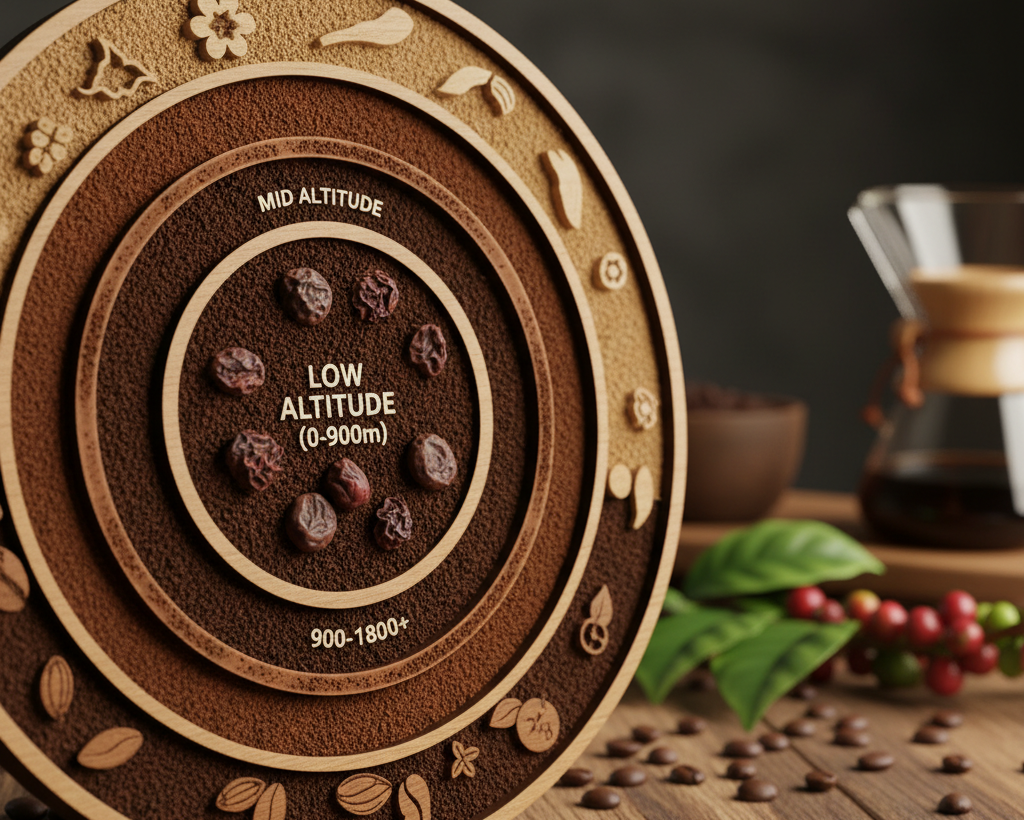
The coffee industry uses altitude to formally classify bean quality, with different systems used in different regions. The most widely used in Central America (and referenced globally) is:
Strictly Hard Bean (SHB) / Strictly High Grown (SHG)
Above approximately 1,370 masl (4,500 feet) — the highest quality designation. Beans grown in this range are the densest, most complex, and most sought-after. The "strictly" indicates no exceptions — every bean in the lot must meet this altitude threshold. Most of the world's finest specialty coffees come from SHB/SHG territory. Colombian Nariño (1,700–2,300 masl) and Ethiopian highland coffees (1,500–2,200 masl) typically fall comfortably in this category.
Hard Bean (HB) / High Grown (HG)
Approximately 1,200–1,370 masl (3,900–4,500 feet) — good quality range with solid flavor development and meaningful acidity. Specialty-grade coffees from these altitudes are common and often excellent value. Colombian Antioquia's lower-altitude farms (around 1,200–1,400 masl) sit in this range.
Medium Hard Bean / Medium Altitude
Approximately 900–1,200 masl — moderate quality, less complex, lower acidity. The transition zone between specialty and commercial grade. Some good coffees here, particularly from origins with other favorable conditions (soil, microclimate).
Soft Bean (SB) / Low Grown
Below approximately 900 masl — commercial grade territory. Fast development, simple flavor, lower acidity, higher yields. Brazilian Robusta, much Indonesian Robusta, and commodity Arabica typically come from these altitudes.
The Paradox of Altitude: Why Stress Produces Quality
Here's a counterintuitive dimension of altitude's effect that most guides don't address: altitude actually stresses the coffee plant — and that stress contributes to quality.
At higher elevations, plants face:
- Cooler temperatures: Below the optimal range for rapid growth, forcing slower metabolic processes
- Lower oxygen partial pressure: Thinner air means the plant's cells must work harder for the same metabolic functions
- Higher UV radiation: Less atmospheric filtering at altitude means more direct UV exposure
- Greater temperature variation: Cool nights following warm days create significant diurnal swings
In response to these stresses, plants produce more protective compounds — including polyphenols (the antioxidant chlorogenic acids) and secondary metabolites that function as UV screens and antimicrobial agents. Many of these stress-response compounds are also flavor-active in the cup.
Plants at altitude also produce more of their own natural sugars as cryoprotection — a kind of biological antifreeze that helps cell membranes survive cold nights. These sugars accumulate in the cherry and ultimately in the bean, directly contributing to the natural sweetness of high-altitude coffee.
This stress-quality relationship is similar to what viticulture researchers observe in grapes: vines grown on poor, rocky soils with limiting water and nutrient conditions often produce more complex, interesting wines than vines grown in optimal conditions with abundant water and rich soil. Managed stress produces quality. This is partly why the relationship between altitude and coffee quality is so consistent across different soils, varietals, and origins.
The Diurnal Temperature Variation Effect
Beyond average altitude temperature, one of the most important but least-discussed altitude effects is diurnal temperature variation — the difference between daytime highs and nighttime lows.
High-altitude coffee-growing regions typically have warm, sunny days followed by cool nights. This pattern — common in Colombia's coffee belt, Ethiopia's highlands, and Guatemala's mountains — creates a daily cycle that drives flavor development:
- Warm days: Drive photosynthesis and sugar production — the plant generates energy and builds sugars during the warm daylight hours
- Cool nights: Slow respiration — the plant burns through fewer of its accumulated sugars overnight because the cool temperature reduces its metabolic demand
- Net effect: More sugars accumulate in the cherry over time — the plant earns (warm day photosynthesis) more than it spends (cool night respiration)
Large diurnal temperature swings are one of the most reliable predictors of exceptional cup quality. Some of Colombia's most celebrated growing regions — Nariño, where temperature swings of 15°C or more between day and night are common at 2,000+ masl — consistently produce some of the highest-scoring Colombian coffees precisely because of this daily accumulation mechanism.
Altitude and Acidity: Why High Grown Tastes Brighter
The 2021 systematic review in Frontiers in Plant Science confirmed that higher elevations, cooler temperatures, and reduced light exposure consistently led to improved cup quality — specifically greater acidity and sweetness. The relationship between altitude and acidity is direct and well-documented.
The mechanism operates through two pathways:
Pathway 1 — Organic acid development: At altitude, coffee cherries develop a richer, more complex organic acid profile through the slower metabolic processes that allow acid compounds to accumulate rather than being metabolized away. Citric acid (responsible for bright, clean brightness), malic acid (apple-like softness), and tartaric acid (wine-like structure) all develop more fully during extended maturation.
Pathway 2 — Reduced degradation: At higher temperatures (lower altitude), certain flavor-active acids undergo thermal degradation — they break down in the heat. Cooler altitude temperatures preserve these acids more effectively through the cherry's development period.
This is why the acidity of high-altitude specialty coffee feels structured and pleasant — multiple different acids in balanced proportions — while lower-altitude commercial coffee's acidity (when present) can feel flat or harshly one-dimensional. It's not just about acid quantity; it's about acid quality and diversity.
Altitude vs Other Flavor Factors: How It Compares
Altitude is powerful, but it interacts with other factors. Here's how it compares and competes:
Altitude + Soil
Altitude without good soil produces interesting but potentially thin coffee. Volcanic soils (common in Colombia, Guatemala, Costa Rica) at high altitude provide the mineral nutrition to support the complex flavor precursor development that altitude's slow maturation enables. The combination — high altitude + volcanic soil — is responsible for many of the world's most celebrated coffees.
Altitude + Varietal
Different varietals express altitude's effects differently. Gesha at 1,900 masl produces extraordinary floral complexity. Caturra at the same altitude produces excellent acidity and balance but less florality. Castillo at 1,800 masl produces reliable, clean specialty coffee. Altitude amplifies the genetic potential of the varietal — it doesn't override it.
Altitude + Processing
The flavor potential that altitude creates can be enhanced or undermined by processing. High-altitude cherries naturally processed will produce intensely fruity, complex coffee — the altitude's flavor precursors amplified by the fruit contact. High-altitude washed coffees will produce clean, transparent expressions of altitude's acid and aromatic complexity. Low-altitude cherries well-processed will produce better coffee than high-altitude cherries poorly processed — altitude sets the ceiling, processing determines whether you reach it.
Altitude + Shade
Shade-grown coffee at high altitude combines two separate slow-development mechanisms — altitude (cooler air temperatures) and shade (reduced direct solar radiation both cools and slows maturation). The combination produces the slowest-maturing cherries of any growing system, and consistently the most complex flavor development. The best specialty coffees in the world almost invariably come from shade-grown, high-altitude farms.
A Practical Altitude Guide to Flavor Expectations
Here's how to use altitude information on a coffee bag to predict flavor:
Below 900 masl
Expect: Lower acidity, heavier body, earthier or nuttier notes, simpler flavor profile. Smooth and approachable but not complex. Common origins at this altitude: Brazilian lowlands, much Indonesian Robusta, Indian plains.
900–1,200 masl
Expect: Moderate acidity, medium-full body, chocolate and caramel notes developing. More interesting than very low altitude but not yet reaching specialty complexity. Common origins: Brazilian Minas Gerais highlands, some Honduras and Guatemala mid-altitude farms.
1,200–1,500 masl
Expect: Clear specialty character — structured acidity, caramel sweetness, stone fruit notes, medium body. The entry into genuine complexity. Common origins: Colombian Antioquia lower elevations, Costa Rican mid-altitude, Central American specialty. This is where Cocondo's Titiribí farms in Antioquia operate — with excellent results from careful organic farming amplifying the altitude's natural quality potential.
1,500–1,800 masl
Expect: Strong specialty profile — bright acidity, citrus and fruit notes emerging alongside chocolate and caramel, complex aromatics. High quality territory. Common origins: Colombian Huila and upper Antioquia, Ethiopian Sidama, Guatemalan highlands.
1,800–2,100 masl
Expect: Exceptional specialty character — intense acidity, floral and tropical fruit notes, complex layered aromatics, long finish. These are the cups that stop you mid-sip. Common origins: Colombian Nariño, Ethiopian Yirgacheffe, Kenyan highlands, Panamanian Boquete.
Above 2,100 masl
Expect: Maximum aromatic complexity and acidity intensity. Gesha territory. Often intensely floral, tea-like, or tropical fruit-forward in ways that feel almost unbelievable. Limited production due to extreme growing conditions. Common origins: Colombian Nariño highest farms, Ethiopian ultra-high altitude, Yemen Mokha.
Why Altitude Alone Isn't Everything
Important honest caveat: altitude is a powerful predictor but not an absolute guarantee. Several factors can override altitude's quality potential:
- Poor harvest practices: Underripe cherry harvested at high altitude still tastes underdeveloped. Altitude creates potential; selective picking at perfect ripeness realizes it.
- Careless processing: Over-fermented or poorly dried high-altitude coffee tastes worse than well-processed low-altitude coffee. Processing quality matters more than altitude at the extremes.
- Inappropriate varietal: Not all varietals express altitude's potential equally. Robusta's genetic limitations produce simpler flavor regardless of altitude.
- Climate anomalies: Drought, frost, or unusual temperature patterns in a specific growing season can undermine even the most ideal altitude. Annual harvest variation reflects this.
- Soil deficiencies: Altitude without soil mineral content produces flavor precursors without the nutrients needed to develop them fully.
This is why the best coffee labels show altitude as one piece of a larger picture — alongside varietal, processing method, soil type, and farm name. Altitude is the strongest single predictor, but the complete picture requires all the pieces together.
Frequently Asked Questions
How does altitude affect coffee flavor?
Altitude affects coffee flavor primarily through temperature: higher altitude means cooler air, which slows cherry development from 6–7 months (low altitude) to 9–11 months (high altitude). This extended maturation allows more complex sugar accumulation, more diverse organic acid development, higher volatile aromatic compound production, and the formation of denser beans with more concentrated flavor compounds. A 2024 study in the journal Foods confirmed that higher-altitude coffees scored better in cupping evaluations, showed lower alkaloids (less bitterness), higher volatile aromatics (more complexity), and higher fatty acid content (better mouthfeel).
What altitude is best for coffee?
The optimal altitude for specialty coffee quality is generally considered to be above 1,200 masl, with the best lots consistently coming from 1,500–2,100 masl. In the Central American classification system, coffees grown above approximately 1,370 masl are classified as Strictly Hard Bean (SHB) or Strictly High Grown (SHG) — the highest quality designation. Above 1,800 masl, coffees often show exceptional complexity and the intense floral and fruit notes that define the world's most celebrated specialty lots.
Why is high altitude coffee better?
High altitude coffee is generally better because slower cherry development at cooler temperatures allows more complete flavor precursor development — more complex sugars, more diverse organic acids, more volatile aromatic compounds. The resulting beans are denser, harder, and contain a richer range of compounds that produce more complex, interesting cups after roasting. Additionally, altitude stress causes the plant to produce more protective compounds (polyphenols, secondary metabolites) that are also flavor-active. The 2021 Frontiers in Plant Science systematic review confirmed that higher elevations consistently produce coffees with greater acidity and sweetness.
Does altitude affect caffeine in coffee?
Yes — inversely. The 2024 Foods study found that high-altitude coffees show decreased alkaloid levels, including caffeine. This is partly why high-altitude specialty coffees can taste less harsh and bitter than lower-altitude commercial coffees: less caffeine content reduces the direct bitterness contribution that caffeine makes to flavor. However, the difference is relatively modest in absolute terms and varies by varietal — it's a contributing factor to quality perception rather than the primary driver.
What does "high grown" mean on a coffee bag?
"High Grown" (HG) refers to coffee grown above approximately 1,200 masl in the altitude classification system used in Central America and widely referenced globally. "Strictly High Grown" (SHG), also called "Strictly Hard Bean" (SHB), is the highest designation, referring to coffee grown above approximately 1,370 masl. These designations signal denser beans, more complex flavor development, and generally higher specialty quality potential than "Medium Grown" or lower designations.
Is Colombian coffee high altitude?
Yes — Colombia's geography makes it one of the most altitude-advantaged coffee-growing countries in the world. Most Colombian specialty coffee grows between 1,200 and 2,300 masl, with different departments occupying different altitude bands. Nariño (1,800–2,300 masl) produces some of Colombia's most complex, high-acid specialty lots. Huila (1,500–2,000 masl) is famous for complex, fruit-forward specialty. Antioquia (1,200–2,100 masl depending on farm) covers a broad altitude range — its higher farms at 1,500–1,800 masl produce the balanced chocolate-and-caramel profile that defines Colombian specialty coffee's most accessible and beloved expression.
The Bottom Line
Altitude is the most reliable single predictor of coffee flavor complexity and quality available before tasting. Higher altitude means cooler temperatures, slower cherry development, denser beans, more complex flavor precursors, and ultimately a more interesting, more balanced, more aromatic cup. The science confirming this is now robust — from population-level cupping data to molecular analysis of individual bean compounds.
When you see altitude information on a specialty coffee bag — particularly anything above 1,500 masl — you're looking at a bean that spent up to 11 months slowly accumulating the sugars, acids, and aromatic compounds that make specialty coffee worth the attention it rewards. The altitude didn't add those qualities to the bean. It gave the bean time to develop them itself.
Colombian specialty coffee from high-altitude farms in regions like Nariño, Huila, and Antioquia represent the practical expression of altitude's quality potential. The organic farms in Antioquia's Titiribí area — operating at 1,200 to 1,800 masl, with volcanic soil, significant shade canopy, and careful selective picking — combine altitude's slow-development quality potential with the biological richness of organic farming practices that further enhance flavor precursor development. Altitude is the starting point. Everything else is about honoring what altitude makes possible.
If you'd like to read other articles similar to How Altitude Affects Coffee Flavor: Why High-Grown Coffee Tastes Different you can visit the category The Art and Science of Coffee: Guides, Reviews, and Expert Tips.
Does Coffee Affect Cortisol Levels? The Science Behind Caffeine and Your Stress Hormone

Is Coffee Good for Depression Risk? What the Research Actually Shows

Is Coffee Bad for Anxiety? What the Science Actually Shows

The 5 Elements of Coffee Tasting Every Coffee Lover Should Know
What Is Green Coffee? How Raw Beans Differ From Roasted — and What That Means for Your Health
How Is Coffee Decaffeinated? The 4 Methods Explained — Including the One You Should Avoid

What Is Coffee Degassing? Why Fresh Roasted Beans Release CO2 — and Why It Matters
What Is a Coffee Cooperative? How They Help Farmers — and Why They Matter for Your Cup
What Is a Coffee Cherry? The Fruit Behind Every Cup You Drink
Leave a Reply
Related post