

What Is Coffee Degassing? Why Fresh Roasted Beans Release CO2 — and Why It Matters

You've probably heard that coffee should be fresh. But here's something fewer people know: coffee that's too fresh can produce a worse cup than coffee that's been resting for a few days. The reason is a process called degassing — and understanding it reveals something fundamental about how roasted coffee works and why timing your brew matters more than most people realize.
Table of contents
- What Is Coffee Degassing?
- How Much CO2 Is Actually Produced During Roasting?
- Why Does CO2 Affect Brewing?
- The Degassing Timeline: How Long Does It Take?
- The Counterintuitive Truth: Light Roasts Need More Time Than Dark Roasts
- How Processing Method Affects Degassing
- How Grinding Affects Degassing: The Exponential Effect
- Degassing and Temperature: The Shelf Life Equation
- What Degassing Looks Like: The Visual Guide
- Degassing Across Brewing Methods: Different Sensitivities
- The Optimal Resting Window: Method-Specific Guide
- Does Degassing Affect Whole Beans and Ground Coffee Differently?
- Frequently Asked Questions
- The Bottom Line
What Is Coffee Degassing?
Coffee degassing is the natural process by which freshly roasted coffee beans release carbon dioxide (CO2) and other gases that were produced and trapped inside during roasting.
When green coffee beans are roasted, they undergo a series of intense chemical reactions — most importantly pyrolysis (the thermal decomposition of organic compounds), the Maillard reaction (browning reactions between amino acids and sugars), and caramelization. These reactions produce hundreds of aromatic flavor compounds and flavor precursors that make roasted coffee taste the way it does.
They also produce significant amounts of carbon dioxide gas. As heat builds during roasting, CO2 forms inside the cellular structure of the bean and much of it becomes physically trapped — compressed into the bean's dense, roasted cell walls and microporous structure. The beans absorb and hold this CO2 throughout the remainder of the roasting process and into cooling.
☕ Recommended by cocondo.coffee

Cocondo Orgánico — The only certified organic coffee from Antioquia, Colombia
Reserve Your Bag →The moment roasting ends and the beans begin cooling, degassing begins. CO2 starts escaping from the bean's surface — slowly at first, then more rapidly, then tapering off over days and weeks until the beans approach equilibrium with their environment. This release is what "degassing" refers to.
Achilles Coffee Roasters describes it precisely: "Degassing acts as an invisible clock governing coffee freshness." The rate at which CO2 releases, the amount remaining in the beans at any given point, and how that changes over time determine key aspects of how the coffee will behave during brewing and what it will taste like.
How Much CO2 Is Actually Produced During Roasting?
The quantity of CO2 produced during roasting is surprisingly large. Research indicates that roasting can increase a green bean's CO2 content from near-zero to anywhere between 6,000 to 10,000 ppm — enough gas that, if you've ever seen a fresh bag of coffee inflate in transit, that's exactly why. The beans continue releasing gas after bagging, creating pressure inside sealed packaging.
This is the entire reason quality specialty coffee packaging uses one-way CO2 valves — the small circular vents on the side of most specialty coffee bags. These valves allow CO2 to escape from the bag while preventing oxygen from entering. Without them, either:
- The bag would inflate and potentially burst from CO2 pressure, or
- The roaster would need to wait until degassing is mostly complete before sealing — meaning significant aroma loss before the coffee ever reaches you
The valve is elegant engineering: it maintains a low-oxygen environment (preventing oxidation) while allowing the natural CO2 release to continue after packaging. Seeing a one-way valve on a coffee bag is one of the clearest quality signals available — it indicates the roaster cares about freshness and has invested in proper packaging infrastructure.
Why Does CO2 Affect Brewing?
CO2 is hydrophobic — it repels water. When you pour hot water onto coffee grounds that still contain significant trapped CO2, the escaping gas creates a physical barrier that prevents water from fully and evenly saturating the grounds. Water flows around gas pockets rather than uniformly through the coffee bed — a phenomenon called channeling.
The practical effects of excessive CO2 during brewing:
- Uneven extraction: Some grounds are over-extracted while others are barely extracted — producing a simultaneously sour and bitter cup that's difficult to diagnose and impossible to fix through technique alone
- Excessive blooming: Very fresh coffee produces such vigorous CO2 release during the bloom phase that the water is physically pushed away from the grounds before proper saturation can occur
- Inconsistent espresso shots: In espresso, excessive CO2 causes channeling through the puck — water finds CO2-created paths of least resistance rather than flowing uniformly through all the coffee. The result is a shot that runs fast, tastes sour, and has poor extraction regardless of grind or pressure settings.
- Metallic or sharp off-notes: In the first 24 to 48 hours after roasting, the CO2 release is so aggressive that it actively contributes harsh, metallic, or sharp flavors to the cup — the CO2 itself is detectable as an unpleasant gas note
Counterintuitively, some CO2 is beneficial:
- The bloom reaction (where CO2 causes coffee to swell and bubble) indicates freshness and helps prepare the coffee bed for even extraction
- CO2 in the bean acts as a mild preservative — slowing oxidation of aromatic compounds and extending the freshness window
- In espresso, CO2 contributes to crema formation — the emulsified foam that defines a well-pulled shot
The goal is not to eliminate CO2 before brewing — it's to find the window where CO2 has stabilized enough not to interfere with extraction, but hasn't depleted so completely that the bean's aromatic compounds have begun oxidizing.
The Degassing Timeline: How Long Does It Take?
Degassing doesn't happen at a constant rate. It follows a characteristic pattern:
First 24 Hours: Rapid Release
The most aggressive degassing occurs in the first 24 hours after roasting. Some research suggests that 40% or more of total stored CO2 is released in this initial period alone. The beans are actively venting gas — you can literally hear faint hissing from freshly roasted beans in a sealed container, and bags inflate visibly within hours of packaging fresh-roasted coffee.
Brewing in this window almost always produces poor results — the CO2 interference with extraction is severe, and the cup often tastes harsh, metallic, or aggressively acidic.
Days 2 to 5: Active Degassing
CO2 release slows significantly but remains active. The bag's one-way valve is still releasing gas regularly. Brewing is possible for some methods (particularly immersion methods like French press that are less sensitive to channeling) but pour-over and espresso still benefit from more rest.
Days 5 to 21: The Sweet Spot Window
CO2 has stabilized to a level where it aids rather than hinders extraction. The bloom is healthy and indicates freshness without overwhelming the water-grounds contact. Aromatic compounds are at their most vibrant — they haven't yet oxidized significantly, and the CO2 remaining in the bean is still providing some protection. This is the peak flavor window for most coffees across most brewing methods.
Days 21 to 42: Gradual Decline
CO2 continues depleting, providing progressively less protection against oxidation. Flavor complexity begins declining — still good coffee, but noticeably less vibrant than in the peak window. Ground coffee degrades much faster in this window.
Beyond 6 Weeks: Significant Oxidation
Most of the protective CO2 is gone. Aromatic compounds are oxidizing at an accelerating rate. Flavor becomes progressively flatter, staler, and eventually cardboard-like. The coffee is still safe to drink but has lost most of what made it worth buying as specialty.
The Counterintuitive Truth: Light Roasts Need More Time Than Dark Roasts
This is the finding that most people find surprising — and it's consistently observed by roasters and baristas across the specialty coffee world.
Dark roasts degas faster than light roasts. Light roasts actually need more rest time before brewing, not less.
The mechanism explains why: during roasting, higher temperatures fracture and open the cell structure of the bean more aggressively. Dark roast beans have a more porous, brittle structure with many small cracks and open pathways through which CO2 can escape quickly. The elevated roasting temperatures have essentially already done much of the degassing work during the roasting process itself — gas escapes rapidly in the roaster and continues escaping quickly after.
Light roast beans maintain a denser, more intact cellular structure. They have fewer open pathways for CO2 to escape, so gas is released more slowly over a longer period. A light roast still contains significant trapped CO2 a week after roasting; the same beans roasted dark may have largely degassed in 3 to 5 days.
The practical resting recommendations by roast level:
- Dark roast: 3 to 7 days minimum — degasses quickly due to porous structure. Many dark roasts are optimal at 5 to 10 days.
- Medium roast: 5 to 10 days minimum — balanced degassing rate. Optimal window typically 7 to 14 days post-roast.
- Light roast (filter/pour-over): 7 to 14 days minimum — dense structure slows CO2 release. Often most expressive at 10 to 21 days post-roast.
- Light roast (espresso): 14 to 21+ days — espresso's high pressure and fine grind make it most sensitive to CO2 interference. Many specialty espresso roasters recommend 2 to 4 weeks rest for light roasts used as espresso.
How Processing Method Affects Degassing
It's not just roast level — how the coffee was processed before roasting also affects its degassing behavior:
- Natural (dry) processed coffees: Typically need slightly longer rest than washed coffees — approximately 3 to 5 days before the CO2 settles enough for good extraction. The extended drying time during natural processing may result in slightly different CO2 distribution within the bean.
- Washed coffees: Generally degas a bit faster — the controlled, shorter processing creates a more uniform bean structure that allows more even CO2 release.
- Honey processed: Similar to washed, though some variation depending on how much mucilage was retained.
How Grinding Affects Degassing: The Exponential Effect
Grinding dramatically accelerates degassing — and understanding why is crucial for home brewing.
When you grind whole beans, you're fracturing thousands of intact cells simultaneously — dramatically increasing the surface area exposed to air and creating direct pathways to the CO2 trapped inside. The CO2 that would have taken days to escape from whole beans can vent in minutes from ground coffee.
Achilles Coffee Roasters notes: "CO2 that would have taken days to escape from a whole bean can vent in minutes [after grinding]. This is why freshly ground coffee often smells so intensely aromatic and why gas release becomes visually obvious during blooming."
The aromatic intensity you notice immediately after grinding is directly related to this rapid volatile release — aromatic compounds escape along with the CO2. This is precisely why grinding immediately before brewing (rather than in advance) preserves so much more flavor — you're capturing the moment of maximum volatile aromatic release and directing it into your cup rather than into the air.
Pre-ground coffee that's been sitting in a container for even a few hours has already lost much of this volatile aromatic richness. The CO2 has escaped, taking many of the most delicate aroma compounds with it.
Degassing and Temperature: The Shelf Life Equation
Coffee journalist Antony Watson's research, published in SCA Magazine, identified that a 10°C increase in storage temperature results in approximately a 50% reduction in coffee's shelf life — primarily by accelerating degassing and the oxidation that follows.
This explains why:
- Coffee stored in a cool pantry stays fresh significantly longer than coffee on a warm kitchen counter near the stove
- Summer months produce more rapid flavor loss than winter months at equivalent storage conditions
- Vacuum-sealed, temperature-controlled storage can extend coffee's usable freshness window dramatically — a Black Pole Coffee experiment found that well-roasted, properly packaged coffee stored in sealed conditions produced a "balanced, clean, and smooth cup" even after 12 months
The temperature-degassing relationship is also why some roasters recommend freezing coffee for long-term storage — at freezer temperatures, the degassing process essentially stops, preserving the bean's CO2 content and aromatic compounds for months or even years. (With the critical caveat that temperature cycling and moisture introduction from repeated opening are the primary risks of freezing — as covered in the 4 enemies of coffee article.)
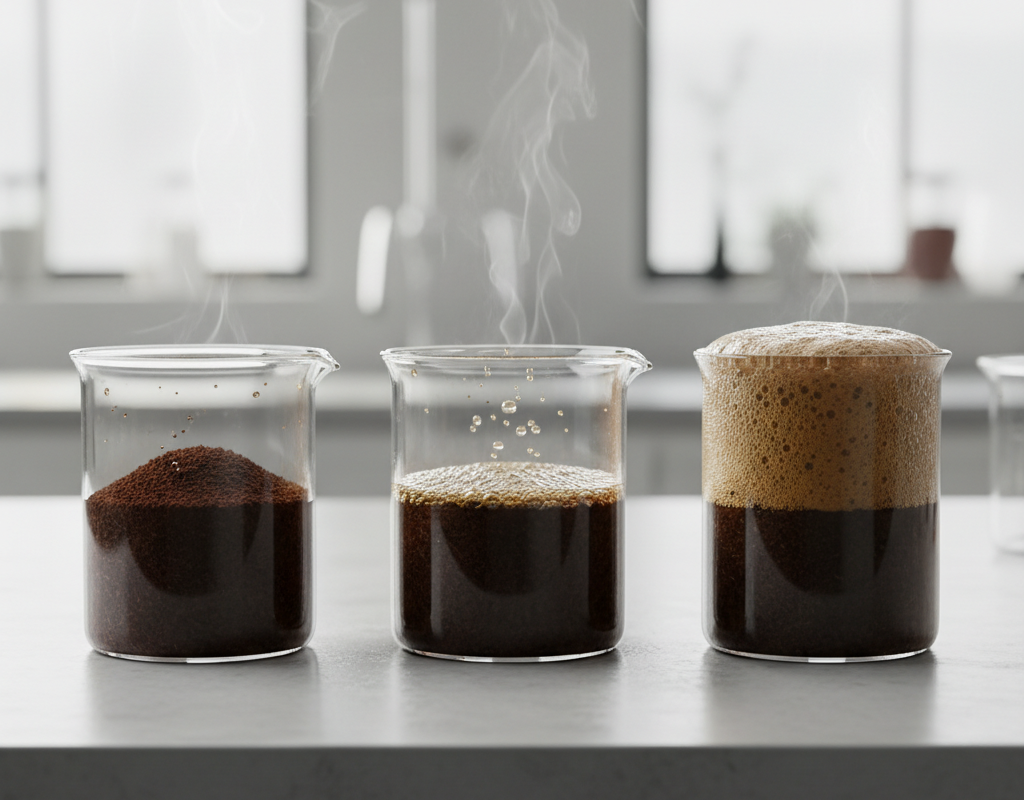
What Degassing Looks Like: The Visual Guide
You can observe degassing directly at multiple points in the coffee journey:
The Inflated Bag
A specialty coffee bag that arrives slightly puffed is actively degassing. This is a positive freshness signal — the beans were packaged while still releasing CO2, which the one-way valve is allowing to escape. A completely flat bag may indicate older coffee or very thorough pre-packaging degassing.
The Coffee Bloom
The bloom — the swelling and bubbling that occurs when hot water first contacts coffee grounds — is the most visible manifestation of degassing during brewing. Fresh coffee produces a dramatic, dome-like bloom that rises significantly above the filter bed. Stale coffee barely blooms. The vigor of the bloom is coffee's most direct visual freshness indicator at the brewing stage.
The Sound of Freshness
Put your ear close to a freshly roasted, sealed container of coffee. If it's very fresh, you may hear faint hissing — the audible sound of CO2 escaping through the one-way valve or around the lid. This rarely-mentioned phenomenon is a genuine quality signal for roasters monitoring their freshly packaged product.
Espresso Crema
In espresso, CO2 contributes directly to crema formation and quality. Coffee within its optimal degassing window produces rich, persistent, tiger-striped crema — the CO2 is present in sufficient quantity to emulsify with the coffee oils under pressure. Over-fresh coffee (too much CO2) produces inconsistent crema with large bubbles. Over-rested coffee produces thin, quickly dissipating crema with insufficient CO2 to maintain structure.
Degassing Across Brewing Methods: Different Sensitivities
Not all brewing methods are equally sensitive to CO2 levels. Understanding which methods need more rested coffee helps you decide how long to wait:
- Espresso: Most sensitive — high pressure espresso amplifies every extraction variable including CO2. Channeling from CO2 interference produces the most dramatic quality drops. Requires the most rest, especially for light roasts.
- Pour-over: Highly sensitive — water flows through the coffee bed by gravity, making it vulnerable to CO2 channeling. The bloom is most important here as a degassing step before main extraction.
- AeroPress: Moderately sensitive — the pressure during pressing helps overcome some CO2 resistance, making it more forgiving of slightly fresher coffee than pour-over.
- French press: Least sensitive to CO2 — immersion brewing means all grounds are in full water contact throughout, reducing the channeling problem. More forgiving of fresher coffee, though still benefits from at least 3 to 5 days rest.
- Cold brew: Very forgiving — the extremely slow cold extraction over 12 to 24 hours allows CO2 to degas naturally during brewing. Cold brew works reasonably well even with very fresh coffee that would be problematic for hot methods.
The Optimal Resting Window: Method-Specific Guide
Based on roast level and brewing method, here's the research-informed practical guide for when to brew:
| Roast Level | French Press | Pour-Over | Espresso |
|---|---|---|---|
| Dark Roast | 3–5 days | 5–7 days | 5–10 days |
| Medium Roast | 5–7 days | 7–14 days | 7–14 days |
| Light Roast | 7–10 days | 10–21 days | 14–28 days |
These are general guidelines. Individual coffees, varietals, and processing methods can shift these windows. Your palate is always the final arbiter — taste the same coffee on different days and notice how it changes.
Does Degassing Affect Whole Beans and Ground Coffee Differently?
Yes — dramatically. This distinction is one of the most practically important in all of home brewing:
Whole beans: Degas slowly through the intact cell structure — releasing CO2 over days and weeks. The gradual, controlled release preserves the balance between CO2 protection and extraction readiness.
Ground coffee: Degasses almost immediately after grinding — the broken cell structure offers no resistance to gas escape. Ground coffee left exposed to air loses its CO2 protection within minutes to hours, accelerating oxidation dramatically. Pre-ground coffee you buy in supermarkets may have been ground weeks or months ago — it has essentially no CO2 left and has been oxidizing without protection throughout that time.
This asymmetry is the primary reason grinding immediately before brewing produces such dramatically better results than grinding in advance. It's not just about preventing staling — it's about timing the degassing precisely so CO2 is present in exactly the right quantity at the moment of extraction.
Frequently Asked Questions
What is coffee degassing?
Coffee degassing is the natural process by which freshly roasted coffee beans release carbon dioxide (CO2) that was produced and trapped inside during roasting. The chemical reactions of roasting — particularly pyrolysis and Maillard reactions — generate significant CO2 that becomes compressed within the bean's cellular structure. After roasting, this CO2 slowly escapes over days and weeks. The rate of release depends primarily on roast level, bean density, and storage temperature.
How long should coffee degas before brewing?
The optimal resting window depends on roast level and brewing method. As a general guide: dark roasts need 3 to 7 days; medium roasts need 5 to 14 days; light roasts need 7 to 21 days. Espresso requires the most rest (particularly light roasts — up to 14 to 28 days). French press is the most forgiving method and works well with shorter rest times. The bloom test is the most practical field indicator — coffee that produces a healthy, moderate dome of bubbles is in its optimal degassing window.
Why does freshly roasted coffee taste bad?
Coffee brewed immediately after roasting often tastes harsh, metallic, or aggressively acidic because excessive CO2 interferes with extraction. The CO2 is hydrophobic — it repels water and prevents even saturation of the grounds, causing channeling and uneven extraction. Additionally, in the first 24 to 48 hours after roasting, CO2 itself contributes harsh, gassy off-notes to the cup. Most of the chemical reactions from roasting also need time to stabilize before the beans express their best flavor profile.
Is fresh coffee always better?
Not immediately after roasting — this is one of the most important counterintuitive truths in coffee. Coffee brewed too soon after roasting (within 24 to 48 hours) often tastes worse than the same coffee brewed 7 to 10 days after roasting, because excessive CO2 interference dominates the extraction. "Fresh" in coffee means within the optimal degassing window (roughly 5 to 21 days post-roast for most coffees) — not the day of roasting. After the peak window, freshness does decline through oxidation. The sweet spot is the peak window, not the earliest possible moment after roasting.
What is the one-way valve on coffee bags?
The one-way valve (the small circular vent on specialty coffee bags) allows CO2 to escape from the bag while preventing oxygen from entering. Without it, freshly roasted coffee would inflate and eventually burst sealed packaging from CO2 pressure. The valve maintains a low-oxygen environment that slows oxidation while allowing natural degassing to continue after packaging. Its presence is a clear quality signal — it indicates the coffee was packaged fresh and the roaster invested in proper freshness infrastructure.
Why does light roast need to degas longer than dark roast?
Dark roasts have a more porous, open cell structure because higher roasting temperatures fracture cell walls more aggressively. This porous structure allows CO2 to escape quickly — dark roasts largely degas in 3 to 7 days. Light roasts maintain a denser, more intact cellular structure that slows CO2 escape — gas is released more gradually over 7 to 21 days. Paradoxically, the denser light roast bean structure that makes it harder to extract also makes it harder for CO2 to escape, requiring longer rest before brewing.
The Bottom Line
Coffee degassing is the invisible chemistry that happens between roasting and brewing — and understanding it changes how you think about coffee freshness. The goal isn't the freshest possible coffee; it's coffee in its optimal degassing window, where CO2 has stabilized enough for even extraction while the bean's aromatic compounds are still vibrant and protected.
For most coffees and most brewing methods, that window is roughly 5 to 21 days after roasting — with earlier in the range for darker roasts and immersion methods, later for lighter roasts and pressure-based espresso. The bloom is your real-time feedback tool: a healthy, moderate bloom indicates you're in the right window; an explosive, overwhelming bloom means a few more days of rest would help.
The practical implications are simple: buy coffee with a roast date, not just a best-by date. Check the date before brewing. If it arrived the same day it was roasted, wait. Grind immediately before brewing. Store in an airtight container with a one-way valve in a cool, dark place.
And start with beans worth this level of care. The degassing window only matters if there are complex aromatic compounds worth protecting. Freshly roasted, specialty-grade Colombian coffee from high-altitude farms — with its rich volatile aromatic profile from slow cherry development — has dramatically more to lose from premature or delayed brewing than commercial blends that were already oxidizing on a warehouse shelf. Respect the window, and the beans reward it.
If you'd like to read other articles similar to What Is Coffee Degassing? Why Fresh Roasted Beans Release CO2 — and Why It Matters you can visit the category The Art and Science of Coffee: Guides, Reviews, and Expert Tips.
Does Coffee Affect Cortisol Levels? The Science Behind Caffeine and Your Stress Hormone

Is Coffee Good for Depression Risk? What the Research Actually Shows

Is Coffee Bad for Anxiety? What the Science Actually Shows
The 5 Elements of Coffee Tasting Every Coffee Lover Should Know
What Is Green Coffee? How Raw Beans Differ From Roasted — and What That Means for Your Health
How Is Coffee Decaffeinated? The 4 Methods Explained — Including the One You Should Avoid
What Is a Coffee Cooperative? How They Help Farmers — and Why They Matter for Your Cup

How Altitude Affects Coffee Flavor: Why High-Grown Coffee Tastes Different
What Is a Coffee Cherry? The Fruit Behind Every Cup You Drink
Leave a Reply
Related post