

The 5 Elements of Coffee Tasting Every Coffee Lover Should Know

When coffee professionals evaluate a cup — whether buying green coffee at origin, dialing in a roast profile, or scoring a competition entry — they don't just think "this is good" or "this is bad." They think in a structured framework that breaks the coffee experience into distinct, evaluable components. Learning that framework transforms how you experience every cup you drink.
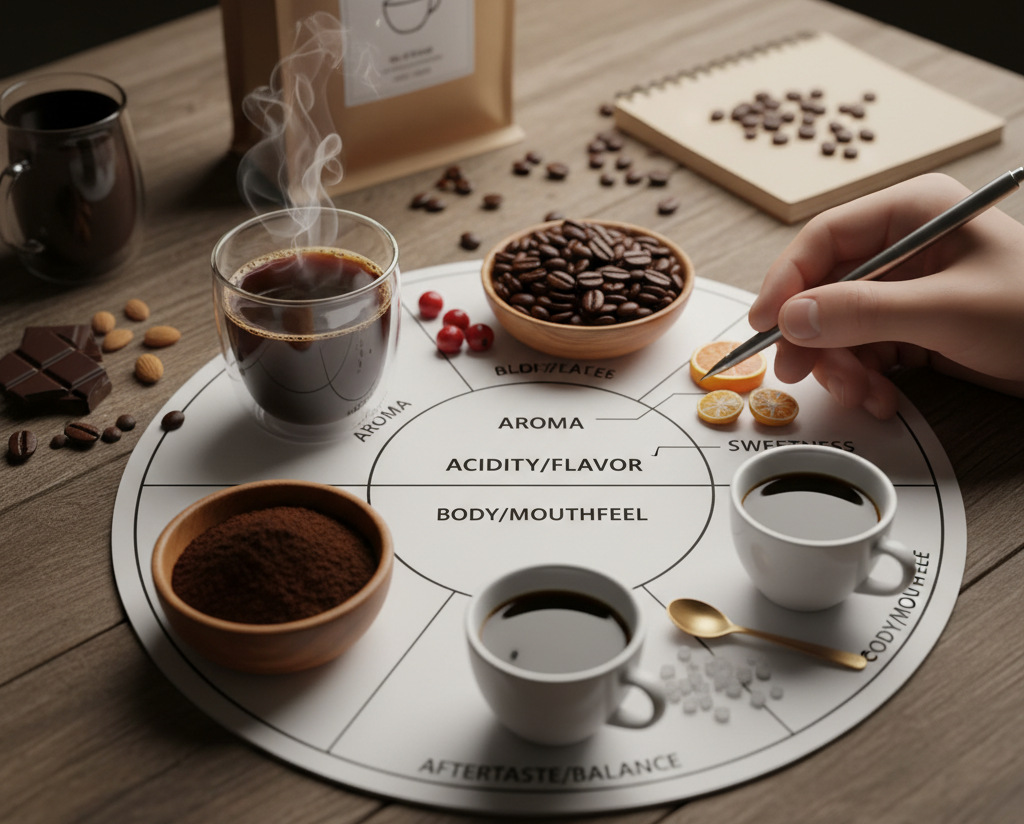
The five core elements of coffee tasting — aroma, acidity, body, sweetness, and aftertaste — are the building blocks of every professional coffee evaluation and the most practical tool available to the everyday coffee enthusiast. Understanding them gives you vocabulary, a diagnostic tool for your brewing, and a navigation system for finding the coffees you love.
Table of contents
- The Framework: Five Elements vs Ten SCA Attributes
- Element 1: Aroma — The Gateway to Flavor
- Element 2: Acidity — The Brightness of Coffee
- Element 3: Body — The Weight of Coffee
- Element 4: Sweetness — The Natural Sugar in Coffee
- Element 5: Aftertaste — The Finish That Reveals Quality
- How the Five Elements Work Together: The Concept of Balance
- Using the Five Elements to Choose Coffee You'll Love
- A Practical Tasting Exercise: The Five Elements in 10 Minutes
- Frequently Asked Questions
- The Bottom Line
The Framework: Five Elements vs Ten SCA Attributes
Before diving into each element, a note on framing. The Specialty Coffee Association's full cupping protocol uses ten evaluated attributes: fragrance/aroma, flavor, aftertaste, acidity, body, balance, sweetness, uniformity, clean cup, and overall. These are rigorously defined and used by Q Graders worldwide to produce the scores that determine whether a coffee qualifies as specialty grade (80+ points) and at what price it trades.
The five elements framework — aroma, acidity, body, sweetness, and aftertaste — is a distillation of the most practically useful attributes for everyday coffee drinkers and home brewers. It covers everything that determines whether a cup is enjoyable and why, without the technical complexity of uniformity scoring, defect evaluation, or the precise 6-to-10 scoring increments used by professional cuppers. It's the version that makes the framework immediately actionable rather than requiring years of calibration training before it becomes useful.
In April 2025, the Coffee Quality Institute (CQI) sold its licensing rights for administering Q Grader certification to the Specialty Coffee Association — consolidating the coffee quality evaluation ecosystem under one organization. The SCA's new Coffee Value Assessment (CVA Standard 102-2024), introduced in 2024, updated and expanded the cupping evaluation framework. Throughout this article we'll reference both the accessible five-element framework and the professional SCA standards that underpin it.
☕ Recommended by cocondo.coffee
Cocondo Orgánico — The only certified organic coffee from Antioquia, Colombia
Reserve Your Bag →Element 1: Aroma — The Gateway to Flavor
What It Is
Aroma is the olfactory component of coffee tasting — what you smell. But it's more complex than a single smell: professional coffee evaluation distinguishes between two distinct aromatic stages, each revealing different aspects of the coffee's character:
- Fragrance: The aroma of dry, freshly ground coffee before any water is added. Fragrance reveals the volatile aromatics that are most delicate and most quickly lost — the first thing you should evaluate before brewing begins. Fresh, quality coffee has a vibrant, complex fragrance; stale coffee smells flat, muted, or cardboard-like even before brewing.
- Aroma: The smell of brewed coffee — both the steam rising from the cup and the aroma released during the bloom when hot water first contacts the grounds. The bloom aroma is particularly valuable: it's the most intense aromatic moment of the brewing process, where CO2 escaping from fresh grounds carries volatile aromatic compounds in a concentrated burst.
These two aromatic evaluations — fragrance (dry) and aroma (wet) — are scored separately in the SCA CVA Standard 102-2024 because they reveal different things. A coffee might have exceptional dry fragrance but weaker aroma after brewing, suggesting aromatic volatiles that escape during grinding but don't survive extraction. Or a coffee might have subtle dry fragrance but a surprising, complex wet aroma — suggesting aromatic precursors that activate through heat and water contact.
What Drives Aroma
Coffee's aromatic complexity comes from over 800 volatile organic compounds, many of which form during roasting through Maillard reactions and caramelization. Different compounds evaporate at different temperatures and rates — which is why coffee's aroma changes as it cools. At 70°C, you're smelling different compounds than at 50°C or room temperature. This is why professional tasters evaluate aroma at multiple temperature points: different characteristics emerge at each stage.
Origin and processing have profound effects on aroma. Ethiopian washed coffees at light roast express the jasmine and bergamot aromatics from their specific varietal chemistry and high-altitude growing conditions. Colombian medium roasts express warm caramel and chocolate aromatics from their sugar and Maillard compound development. Natural processed coffees often have the most intensely aromatic profiles — the extended fruit contact during processing produces ester compounds that make the fragrance of a good Ethiopian natural genuinely striking.
How to Evaluate It
Smell the grounds immediately after grinding — before brewing. Take two or three deliberate inhalations with your mouth slightly open (this drives more volatile molecules through your retronasal passage). Then smell the steam rising from the brewed cup before your first sip. Finally, when you slurp coffee from a spoon (as professional cuppers do), the forced inhalation aerosols the coffee and sends another burst of volatile aromatics through the retronasal passage.
Ask yourself: Is the aroma complex or simple? Does it remind you of fruit, flowers, chocolate, caramel, or something roasty? Does it change as the coffee cools? Is it vibrant and clean, or flat and vague?
A coffee with exceptional aroma creates an expectation for what the cup will taste like. When the taste matches and extends the aromatic impression, that's integrated quality. When the aroma promises something the taste doesn't deliver, something went wrong in processing, roasting, or brewing.
Element 2: Acidity — The Brightness of Coffee
What It Is
Acidity is the one element most frequently misunderstood by new coffee drinkers, because the word carries baggage from everyday usage where "acid" typically means something harsh or unpleasant.
In coffee tasting, acidity describes a positive quality — the bright, lively, refreshing character that makes coffee feel alive rather than flat. Royal Coffee's scoring guide describes it as "brightness when pleasant, sour when overpowering." Good coffee acidity is the same quality that makes a ripe apple feel crisp and refreshing, or that makes a glass of good wine feel vibrant rather than dull. It's a sensation of liveliness and structure.
The SCA CVA Standard 102-2024 defines acidity as "the perception of sour taste provoked by the brew, which may vary in intensity and character." The distinction between "pleasant acidity" and "unpleasant sourness" is one of quality and balance — not simply the presence of acids, but whether they're present in a structured, integrated way that enhances the cup's complexity rather than dominating it harshly.
The Types of Acidity
Coffee contains multiple organic acids, each with a distinctive character that trained tasters can distinguish:
- Citric acid: Bright, clean, citrus-adjacent. The most desirable acidity in light roast specialty coffee — especially prominent in Ethiopian and Kenyan origins. Feels like lemon or lime without the sourness.
- Malic acid: Soft, apple-like. Rounder and gentler than citric acid. Common in Colombian and Guatemalan coffees. Creates the pleasant "green apple" quality in some medium roasts.
- Tartaric acid: Wine-like. Adds structure and complexity — gives coffee a wine-adjacent quality. Common in naturally processed coffees and some Kenyan lots.
- Chlorogenic acids: The primary health-relevant antioxidant acids. Present in all coffee; more prominent in lighter roasts where they haven't been as extensively degraded by heat. Contribute to overall brightness.
- Acetic acid: Vinegar-adjacent. Small amounts contribute complexity; large amounts from over-fermentation produce harsh sourness — a processing defect rather than a desirable quality.
- Quinic acid: Formed from chlorogenic acid degradation at high temperatures and during extended brewing. Responsible for the harsh, stomach-turning quality of coffee left too long on a warming plate. A negative indicator.
How to Evaluate It
Acidity is most perceptible when coffee first hits your palate — it's the first impression, the initial "brightness" you feel before the middle notes develop. It's also most clearly evaluated as the coffee cools, since heat partially masks acid perception.
Ask yourself: Does the coffee have a lively quality, or does it feel flat? Is the acidity pleasant (like biting into a ripe fruit) or harsh (like something unripe or fermented)? Can you identify a type of acidity — citrus, apple-like, wine-adjacent? Is the acidity in proportion to the sweetness and body, or does it dominate the cup?
A well-balanced acidity that lifts the other flavor elements is one of the clearest markers of quality in specialty coffee. Its absence — a flat, dull cup with no brightness — typically indicates low-altitude origin, very dark roasting, or stale beans. Its excess — harsh, puckering sourness — indicates under-extraction, poor processing, or very acidic origins like Kenya that don't suit all palates.
Element 3: Body — The Weight of Coffee
What It Is
Body describes the physical sensation of coffee in your mouth — its weight, texture, viscosity, and the tactile impression it leaves on your palate. It's sometimes called mouthfeel, and the SCA CVA 2024 standard uses "mouthfeel" as the updated term for this attribute, defining it as "the tactile perception of the brew while it is in the mouth, excluding temperature perception. It encompasses the brew's weight and viscosity, its texture, and other tactile properties such as astringency."
Body has nothing to do with flavor per se — it's purely physical. A light-bodied coffee can taste exceptional; a heavy-bodied coffee can taste mediocre. But body contributes significantly to the overall experience and satisfaction of a cup. It's the difference between drinking water (light body) and whole milk (heavy body) — both can be enjoyable, but they feel completely different in the mouth.
The Body Spectrum
- Light body: Thin, delicate, almost tea-like. The coffee feels clean and transparent in the mouth. Common in light roast Ethiopian washed coffees. Some people find light body refreshing; others find it unsatisfying.
- Medium body: The middle ground — present but not heavy. A comfortable mouthfeel that doesn't distract from flavor. Most Colombian and Central American medium roasts sit here.
- Full body: Rich, substantial, coating. The coffee feels heavy and stays with you after swallowing. Common in French press (unfiltered oils contribute body), dark roasts, Brazilian coffees, and espresso.
- Syrupy: Beyond full — thick, viscous, almost like the coffee is coating every surface of your mouth. The highest intensity of body, common in excellent cold brew, top-quality espresso, and some naturally processed coffees.
What Creates Body
Body comes primarily from dissolved solids, natural oils, and colloids in the brewed coffee. Several factors influence it:
- Brewing method: Unfiltered methods (French press, espresso, moka pot) retain oils and more dissolved solids — heavier body. Paper-filtered methods (pour-over, Aeropress with paper) remove oils — lighter, cleaner body.
- Coffee-to-water ratio: Higher ratios produce more concentrated (stronger) coffee with more perceived body.
- Processing method: Natural processed coffees typically have heavier body than washed coffees from the same origin — the extended fruit contact during processing contributes additional compounds.
- Origin and altitude: Lower-altitude origins (Brazil, Sumatra) often produce heavier-bodied coffees than high-altitude origins (Ethiopian, Kenyan) — slower maturation at altitude can produce denser beans but lighter flavor profiles.
- Roast level: Darker roasts tend toward heavier body as compounds develop and the bean's cellular structure becomes more porous.
How to Evaluate It
Evaluate body by pressing your tongue against the roof of your mouth while coffee is present and noticing the weight and coating sensation. A light-bodied coffee will feel thin, like water; a full-bodied coffee will feel substantial, like the coffee is pushing back against your palate.
Also notice texture — is the body smooth and silky, or does it feel slightly gritty or rough? Quality body is smooth and pleasant; astringency (a harsh drying, puckering sensation from excessive tannins) is considered a body defect even if the body itself is full.
Ask yourself: How heavy does this feel in my mouth? Does it coat my palate? Is the texture smooth or rough? Does the body complement the flavor, or does it feel out of proportion?
Element 4: Sweetness — The Natural Sugar in Coffee
What It Is
Sweetness in coffee evaluation refers to natural sweetness from the coffee itself — not added sugar. This is the presence of caramel compounds, sugar-derived Maillard products, and fruit-adjacent sweet notes that develop from the coffee's natural sugar content through roasting. When someone says "this coffee is sweet," they mean it has a pleasant, sugar-like quality in the mid-palate that requires nothing added.
The SCA CVA Standard 102-2024 defines sweetness as "the perception of gustatory or retronasal sweetness provoked by the brew." It's both a taste sensation (your tongue detecting sweetness) and a retronasal smell sensation (sweet aromatic compounds reaching your olfactory system through the back of your mouth).
Natural coffee sweetness is one of the clearest markers of quality — it requires high-quality, fully ripe cherry (with complete sugar development), careful processing (to preserve those sugars), skillful roasting (to caramelize sugars into sweet flavor compounds without burning them), and proper extraction (to dissolve those compounds without going so far that bitterness overtakes them). You can't fake it with technique. If the sweetness isn't in the bean, it won't be in the cup.
Types of Sweetness in Coffee
- Caramel sweetness: Warm, butterscotch-adjacent. The most common coffee sweetness — from caramelization of sucrose during roasting. Very prominent in Colombian and Costa Rican medium roasts.
- Brown sugar sweetness: Deeper, more complex than caramel — with a molasses-adjacent richness. Common in medium-dark roasts and naturally processed coffees.
- Fruit sweetness: Berry-adjacent, tropical fruit-adjacent. From fermentation esters and the natural sugars of certain varietals. Most pronounced in naturally processed Ethiopian and Colombian coffees.
- Honey sweetness: Floral, slightly thick sweetness. Common in honey-processed coffees and certain high-altitude washed lots.
- Clean sugar sweetness: Neutral, refined — like dissolving white sugar in water, uncomplicated but pleasant. Often the baseline sweetness of a clean, well-extracted washed coffee.
How to Evaluate It
Sweetness is most perceptible in the mid-palate — after the initial acidity impression and before the finish. It's also particularly clear as the coffee cools to around 55°C (130°F), when the heat that partially masks sweetness perception has dissipated.
Ask yourself: Is there a pleasant sweetness in this coffee, or does it taste flat and neutral? What type of sweetness is it — caramel, fruit, brown sugar? Does the sweetness balance the acidity and bitterness, or is one overpowering the others? Does the sweetness persist into the finish?
A coffee with good natural sweetness is one of the most satisfying cups you can drink without adding anything to it. The absence of sweetness — a flat, one-dimensional cup that lacks any sugar-like quality — is often the most reliable indicator that something went wrong: stale beans, over-roasting, poor cherry selection at harvest, or over-extraction in brewing.
Element 5: Aftertaste — The Finish That Reveals Quality
What It Is
Aftertaste — also called the finish — is the sensory impression that remains in your mouth after swallowing coffee. Royal Coffee's scoring guide defines it as "the length of flavor qualities emanating from the back of the palate and remaining after the coffee is expectorated or swallowed."
The aftertaste is where quality coffee often reveals itself most clearly. A mediocre cup drops off immediately after swallowing — the flavor is gone almost instantly, leaving nothing pleasant behind. A quality cup has an aftertaste that lingers for 20, 30, or even 60 seconds after swallowing, evolving through flavors that weren't fully apparent during the primary sip. The best cups leave you with a pleasant warmth, a gentle sweetness, or a floral whisper that makes you want another sip before the previous one has fully faded.
The SCA CVA Standard 102-2024 includes "aftertaste" as a scored attribute for the Affective Assessment specifically — it's evaluated separately from the primary flavor because the flavors that emerge after swallowing are often physiologically distinct from those during the sip.
The Science of the Finish
The aftertaste happens because aromatic volatile compounds continue to evaporate from the residual coffee film on your palate, throat, and retronasal passage even after the coffee itself has been swallowed. Different compounds evaporate at different rates — meaning the aftertaste often reveals flavor notes that were masked during the primary sip by the more dominant, faster-evaporating compounds.
This is why professional tasters wait 10–15 seconds after swallowing before evaluating aftertaste — and why they evaluate the same coffee multiple times as it cools, since different compounds express themselves at different temperatures.
Positive vs Negative Aftertastes
Positive aftertastes:
- Long and sweet: Caramel, chocolate, or fruit sweetness that lingers. The most desirable finish for most coffee drinkers.
- Clean and pleasant: A neutral or gently pleasant residue — no harshness, no specific sweetness, but nothing to make you reach for water.
- Floral finish: A delicate jasmine or rose quality that emerges in the finish of some exceptional light roast Ethiopian coffees — one of the most beautiful experiences in specialty coffee.
- Spice finish: A gentle warmth of cinnamon or cardamom in the finish — common in some anaerobic and natural process lots.
Negative aftertastes:
- Short/dropping off: No lingering flavor — the coffee simply disappears. Not necessarily unpleasant, but indicates limited complexity.
- Bitter finish: Harsh bitterness that lingers. From over-extraction, very dark roasting, or stale beans — the late-stage compounds (quinic acid, tannins) outlasting the pleasant ones.
- Sour finish: Lingering sharpness or acetic quality — indicates under-extraction or processing defects.
- Astringent finish: A dry, puckering sensation. From tannins — indicates over-extraction, certain very dark roasts, or specific brewing defects.
How to Evaluate It
After swallowing (or spitting during professional cupping to limit caffeine intake), close your mouth and wait 10–15 seconds. Notice what remains. Open your mouth slowly and exhale — the breath carries residual aromatics that contribute to the retronasal experience of the finish. Evaluate at 10 seconds, 30 seconds, and 60 seconds — noting how the finish evolves and when it fades.
Ask yourself: Does the coffee leave a pleasant impression after swallowing, or does it disappear immediately? Is there sweetness, bitterness, or sourness in the finish? Does it evolve — does something different emerge after 30 seconds? Is the finish long (exceptional) or short (common)? Would you want another sip immediately based on the finish?
How the Five Elements Work Together: The Concept of Balance
The five elements don't exist in isolation — they interact to create the complete experience of the cup. The most important interaction is balance: the degree to which acidity, sweetness, body, and flavor integrate harmoniously without any single element overpowering the others.
A beautifully balanced cup has acidity that lifts and brightens without dominating, sweetness that rounds and enriches without cloying, body that supports without overwhelming, and a flavor that expresses complexity without confusion. The aftertaste of a balanced cup typically reflects its best qualities — the sweetness or gentle floral note that appears in the finish is the balancing element confirming itself.
Imbalances are equally informative:
- Acidity dominates without sweetness: Under-extracted, very light roast, or high-acid origin (Kenya, Nariño) at an extreme of its natural profile
- Bitterness dominates without sweetness: Over-extracted, very dark roasted, or stale beans
- Heavy body without complexity: Lower altitude, commercial grade, or poorly processed coffee
- Sweetness without structure: Over-ripe cherry, over-fermented processing, or overly dark roasting that caramelizes sugars beyond complexity
The interaction between the five elements is why the same origin can taste completely different depending on roast level, processing, and brewing method — each variable shifts the balance between elements.
Using the Five Elements to Choose Coffee You'll Love
Once you internalize the five elements, choosing coffee becomes much more precise than "I like dark roast" or "I prefer smooth coffee." You can express genuine preferences:
- "I want high acidity, medium body, and a long floral finish" → Ethiopian Yirgacheffe washed, light roast, pour-over
- "I want high sweetness, medium-full body, mild acidity" → Colombian medium roast (Antioquia, Huila), or Brazilian natural
- "I want maximum body, low acidity, long rich finish" → Sumatran medium-dark, French press
- "I want intense fruit sweetness, wine-like finish, heavy body" → Ethiopian or Colombian natural process
- "I want clean clarity, balanced acidity and sweetness, delicate aroma" → Colombian or Guatemalan washed, medium roast, pour-over
These preferences translate directly to purchasing decisions — once you know you love high acidity with floral aroma and a long finish, you can confidently reach for an Ethiopian light roast. Once you know you prioritize natural sweetness and full body, Brazilian naturals and Colombian medium roasts reliably deliver that profile.
A Practical Tasting Exercise: The Five Elements in 10 Minutes
The best way to internalize the five elements is through deliberate, structured tasting:
- Grind fresh coffee. Smell the dry grounds immediately — fragrance evaluation. Take notes.
- Brew using pour-over or AeroPress (the clearest expression of all five elements). During the bloom, smell the wet aroma — aroma evaluation.
- Let cool to approximately 65°C (150°F). Take your first deliberate sip, slurping forcefully to coat your entire palate. Focus on acidity — is there brightness? What type?
- Second sip at 60°C (140°F). Focus on body — how heavy does it feel? What's the texture?
- Third sip at 55°C (130°F). Focus on sweetness — is there caramel, fruit, brown sugar? Where does it appear in the sip?
- After swallowing, wait 15 seconds. Focus on aftertaste — what lingers? How long? Is it pleasant?
- Overall impression: Are the elements balanced? Which dominates? What would you call this cup's defining character?
Run this exercise with two different coffees simultaneously — ideally from different origins or processing methods — and the differences between elements become dramatically clearer than tasting either alone.
Frequently Asked Questions
What are the five elements of coffee tasting?
The five core elements of coffee tasting are aroma (the fragrance of dry grounds and the smell of brewed coffee), acidity (the brightness or lively quality that makes coffee vibrant), body (the physical weight and texture in the mouth), sweetness (the natural sugar-derived quality requiring no added sugar), and aftertaste (the lingering impression after swallowing). Together they form a complete framework for evaluating any cup of coffee — from a casual home brew to a professional cupping session.
What are the basic elements of coffee tasting?
The most fundamental elements — those present in every coffee evaluation regardless of the specific framework used — are flavor (the overall taste impression), acidity (brightness), body (mouthfeel), and aftertaste (the finish). Aroma is sometimes discussed separately from flavor; sweetness and balance are additional attributes in more comprehensive frameworks. The SCA's full Coffee Value Assessment (CVA Standard 102-2024) scores eight attributes: fragrance, aroma, flavor, aftertaste, acidity, sweetness, mouthfeel, and overall impression.
What is the most important element of coffee tasting?
No single element is universally most important — they're interdependent and interact to create the complete cup experience. However, sweetness is often cited by professional cuppers as the most revealing quality indicator: natural sweetness requires exceptional cherry selection, careful processing, skillful roasting, and proper extraction. You can't add or fake it with technique. When all four of these conditions are met and the cup has genuine natural sweetness, the other elements tend to follow in good proportion. Balance — the harmonious integration of all five elements — is what ultimately determines whether a coffee is exceptional.
How do you evaluate coffee body?
Evaluate body by pressing your tongue against the roof of your mouth while coffee is present and noticing the weight and coating sensation. Light-bodied coffee feels thin and almost watery; full-bodied coffee feels substantial and stays with you. Also evaluate texture — smooth and silky (positive) versus rough or astringent (negative). Body is influenced primarily by brewing method (unfiltered = more body), coffee-to-water ratio, processing method (natural = more body than washed), and the origin's natural lipid and dissolved solid content.
What is a good coffee aftertaste?
A good coffee aftertaste is long (lasting 20–60 seconds after swallowing), pleasant (no harsh bitterness or sourness), and often reveals complexity not fully apparent during the primary sip. The most desirable finishes are sweet (caramel, chocolate, or fruit sweetness lingering after swallowing), clean (neutral and unobtrusive), or floral (a delicate jasmine or rose quality appearing in the finish of some exceptional light roast coffees). A short, dropping-off aftertaste indicates limited complexity; a bitter or astringent lingering aftertaste indicates over-extraction, very dark roasting, or stale beans.
How does the SCA evaluate coffee quality?
The SCA evaluates coffee quality through the Coffee Value Assessment (CVA Standard 102-2024, updated from the previous 2004 Cupping Form). Q Graders — certified professional tasters — score eight attributes on a 9-point impression of quality scale: fragrance, aroma, flavor, aftertaste, acidity, sweetness, mouthfeel, and overall. Coffees scoring 80 or above are classified as specialty grade — representing the top 5% of coffees worldwide. In April 2025, the Coffee Quality Institute transferred Q Grader certification licensing to the SCA, consolidating coffee quality evaluation under one organization.
The Bottom Line
The five elements of coffee tasting — aroma, acidity, body, sweetness, and aftertaste — give you a complete, practical framework for experiencing any coffee more fully. They're the vocabulary that transforms "I like this" from a vague impression into a useful description: "high floral aroma, bright citric acidity, light body, honey sweetness, long clean finish."
Learning to taste deliberately using this framework doesn't require professional training or expensive equipment. It requires attention, practice, and coffees worth paying attention to. Specialty-grade single-origin coffee — particularly from origins known for expressive, complex profiles like Colombian Antioquia, Ethiopian Yirgacheffe, or Kenyan Nyeri — gives you all five elements to work with in their most developed form. Commercial blends typically express two or three at most.
The five elements are a key — and the best coffees in the world are locks worth opening.
If you'd like to read other articles similar to The 5 Elements of Coffee Tasting Every Coffee Lover Should Know you can visit the category The Art and Science of Coffee: Guides, Reviews, and Expert Tips.
Does Coffee Affect Cortisol Levels? The Science Behind Caffeine and Your Stress Hormone

Is Coffee Good for Depression Risk? What the Research Actually Shows

Is Coffee Bad for Anxiety? What the Science Actually Shows
What Is Green Coffee? How Raw Beans Differ From Roasted — and What That Means for Your Health
How Is Coffee Decaffeinated? The 4 Methods Explained — Including the One You Should Avoid
What Is Coffee Degassing? Why Fresh Roasted Beans Release CO2 — and Why It Matters
What Is a Coffee Cooperative? How They Help Farmers — and Why They Matter for Your Cup
How Altitude Affects Coffee Flavor: Why High-Grown Coffee Tastes Different
What Is a Coffee Cherry? The Fruit Behind Every Cup You Drink
Leave a Reply
Related post