

What Is a Coffee Cherry? The Fruit Behind Every Cup You Drink
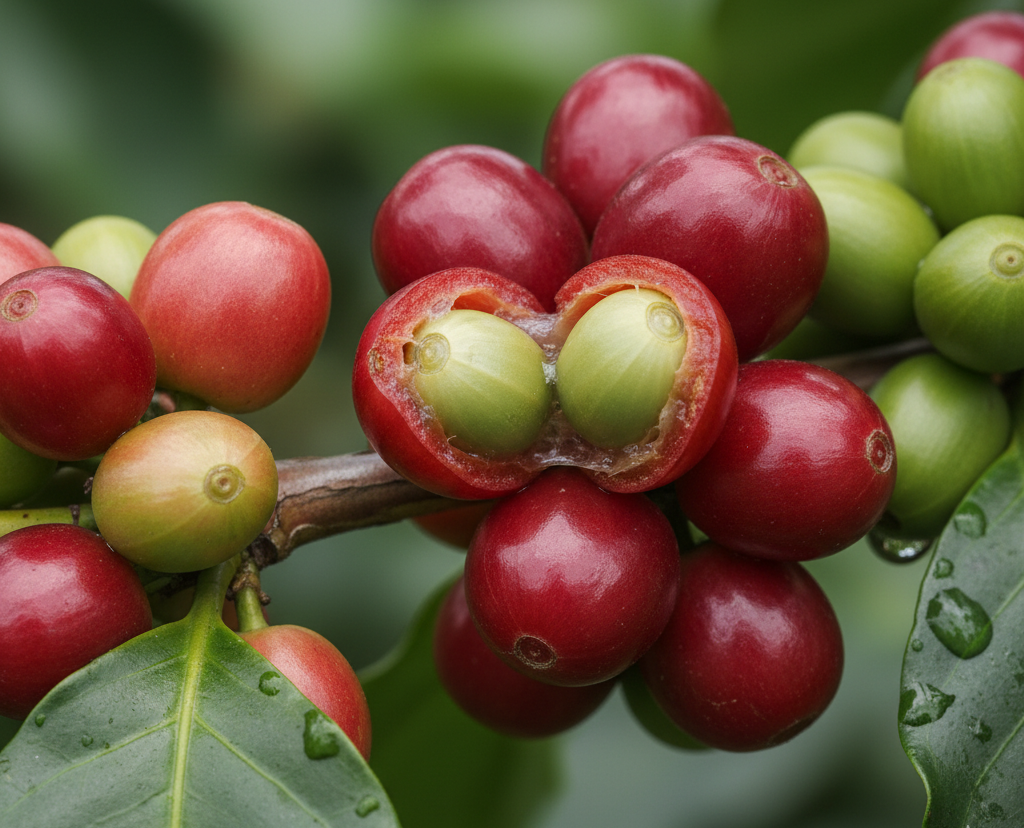
Most people who drink coffee every day have never seen what it looks like before it becomes a bean. The answer is surprising: coffee starts life as a small, bright red fruit — a cherry — hanging in clusters from the branches of a tree. What you grind and brew each morning are the seeds of that fruit, transformed by processing, drying, and roasting into the familiar brown bean.
Understanding the coffee cherry — its anatomy, its lifecycle, how it ripens, and how each of its layers contributes to the flavor in your cup — gives you a fundamentally different perspective on coffee. It's not a manufactured product. It's an agricultural one, with all the complexity, seasonal variation, and biological specificity that implies.
Table of contents
- What Is a Coffee Cherry?
- The Anatomy of a Coffee Cherry: Six Layers
- The Peaberry: When a Cherry Grows Only One Bean
- The Coffee Cherry's Lifecycle: From Flower to Harvest
- Cherry Color and Ripeness: The Complexity Most Buyers Never See
- The Relationship Between Cherry Quality and Cup Quality
- What Happens to the Cherry After the Beans Are Removed?
- Coffee Cherry vs Coffee Berry: What's the Difference?
- Frequently Asked Questions
- The Bottom Line
What Is a Coffee Cherry?
A coffee cherry is the fruit produced by the Coffea plant. It is technically a drupe — a stone fruit, like a peach, plum, or cherry — with a fleshy outer layer surrounding a hard seed. The "coffee bean" you know is actually the seed inside this fruit, not a bean in any botanical sense.
Coffee cherries typically measure about 1.5 to 2 cm in diameter — roughly the size of a large grape. They grow in dense clusters along the branches of the coffee tree, called "coffee cherry clusters" or "pillows" in some origins. A single productive branch can hold dozens of cherries at various stages of ripeness simultaneously — from green and immature to fully ripe red or yellow — which is one reason selective hand-picking is labor-intensive but essential for quality.
The name "cherry" refers to their appearance when ripe: most Arabica varieties turn a deep, bright red — strikingly similar to a cherry fruit. Some varieties ripen to yellow, orange, or even pink (Pink Bourbon), depending on their genetic makeup.
☕ Recommended by cocondo.coffee

Cocondo Orgánico — The only certified organic coffee from Antioquia, Colombia
Reserve Your Bag →The Anatomy of a Coffee Cherry: Six Layers
The coffee cherry has a surprisingly complex layered structure — six distinct layers from the outside in, each with a specific biological function and each playing a role in how the final coffee tastes. From outermost to innermost:
Layer 1: The Exocarp (Outer Skin)
The exocarp is the outermost layer — the fruit's skin. In coffee, this thin, firm skin (also called the "pulp skin" or just "skin") is what changes color as the cherry ripens: green when immature, yellow or red when ripe, then dark purple or blackish if overripe.
The color change is driven by anthocyanins — the same pigment compounds that make blueberries blue, red cabbage purple, and autumn leaves red. As the cherry ripens, chlorophyll breaks down and anthocyanins accumulate, producing the vivid red or yellow color that signals harvest-readiness.
Why it matters: Skin color is the primary visual cue farmers use for harvest timing. Picking at full red ripeness (or full yellow, for yellow varieties) is critical — underripe cherries contain less sugar, more harsh acids, and fewer flavor precursors than fully developed fruit. Overripe cherries have begun fermenting, introducing off-flavors. Selective picking — choosing only fully ripe cherries — is one of the most important quality decisions in coffee production.
Layer 2: The Mesocarp (Pulp)
Beneath the skin is the mesocarp — the fleshy fruit pulp. In a coffee cherry, this layer is relatively thin compared to a peach or mango, but it's packed with natural sugars and has a distinctive flavor: typically described as sweet, reminiscent of watermelon, hibiscus, or tropical fruit. It's genuinely edible and pleasantly sweet when eaten fresh.
The pulp is where most of the cherry's sugar content resides. During natural and honey processing, the pulp (or its remnants) stays in contact with the bean during drying — and those sugars migrate into the bean, fundamentally transforming its flavor profile. The intensely fruity, sweet character of Ethiopian natural process coffees is largely the direct result of the pulp's sugars being absorbed into the seed during weeks of contact.
Cascara — The Cherry Drink: In Yemen and increasingly worldwide, dried coffee pulp is used to make cascara — a tea-like beverage brewed from the dried husks of the coffee cherry. Cascara (from the Spanish word for "husk") has a distinctive fruity, slightly floral, mildly caffeinated taste — nothing like coffee itself. It was traditionally consumed in Yemen (where it's called "qishr") for centuries. In specialty coffee circles it's become a trendy byproduct product, using material that would otherwise be discarded. Cascara contains caffeine from residual beans and the cherry tissue, as well as antioxidants and chlorogenic acids.
Layer 3: The Mucilage (Honey Layer)
Directly beneath the pulp is the mucilage — a thick, sticky, sugar-rich gel that clings to the parchment layer beneath it. This layer is often called the "honey layer" in processing discussions because of its viscous, sweet character and because honey-processed coffees retain varying amounts of it during drying.
The mucilage is arguably the most flavor-consequential layer of the entire cherry. It contains the highest sugar concentration of any cherry layer and is the primary site of fermentation activity during processing. The specific yeasts and bacteria that act on the mucilage during fermentation produce the flavor-active compounds — organic acids, esters, alcohols — that migrate into the bean and become detectable in the final cup.
JayArr Coffee's anatomy guide describes this precisely: "The fruitiness comes directly from the mucilage layer — the sugar-rich gel between the skin and the parchment." Understanding which layers are removed and when during processing (washed removes it; natural retains it through drying; honey partially retains it) directly explains why these methods produce such different flavor profiles from identical beans.
The mucilage doesn't dissolve easily in water — it requires either fermentation (which breaks it down enzymatically) or mechanical scrubbing to remove. This biological reality is what drove the development of different processing methods in different climates: where water is abundant, wet fermentation to remove mucilage is practical; where water is scarce and sun is plentiful, drying the whole cherry allows time to naturally break down the mucilage.
Layer 4: The Parchment (Endocarp)
Inside the mucilage is the parchment — a papery, dry shell that encases the bean. Botanically, this is the endocarp — the inner wall of the fruit's ovary. In coffee, it's a thin but rigid protective layer that serves as the final physical barrier between the fruit's external environment and the seed.
The parchment protects the developing bean from physical damage, maintains moisture balance during drying, and provides structural support. When coffee is dried "in parchment" (as washed coffees are), the parchment remains on the bean through the drying and resting phases until it's mechanically hulled off just before export. Green coffee with the parchment still attached is called "pergamino" in Colombia — you'll sometimes see specialty lots offered as pergamino coffee to preserve freshness during transit.
The drying stage in parchment is particularly important for flavor development — the controlled moisture equalization that occurs during parchment drying produces a more even, stable flavor profile than beans dried without it.
Layer 5: The Silver Skin (Spermoderm)
Beneath the parchment is the silver skin — a very thin, papery membrane that adheres tightly to the seed itself. Botanically it's called the spermoderm or testa. It's the remnant of the seed coat.
Most of the silver skin is removed during milling (along with the parchment) before export as green coffee. However, traces of it remain on the bean through roasting — you can see it as the thin, pale wispy material that floats off during roasting (called "chaff") and collects in the chaff collector of most home and commercial roasters.
The silver skin has minimal impact on flavor in the finished cup but serves as a protective layer during the bean's development.
Layer 6: The Endosperm (The Bean Itself)
At the center of all these protective layers is the endosperm — what we call the "coffee bean." Botanically, this is the seed's stored energy reserve: a dense, complex structure of proteins, carbohydrates, lipids, organic acids, alkaloids (caffeine, trigonelline), and hundreds of flavor precursor compounds.
In its green, unroasted state, the endosperm has almost none of the flavor characteristics of roasted coffee. Green beans taste grassy, vegetal, and slightly astringent. The transformation into the aromatic, complex coffee we drink happens entirely during roasting — when heat triggers Maillard reactions and caramelization that convert those flavor precursors into the hundreds of aromatic compounds that define roasted coffee's character.
A typical coffee cherry contains two beans, positioned face-to-face (flat sides together) — which is why coffee beans have one flat side and one curved side. The flat sides are where they were pressed against each other inside the cherry. The curved side is the outer surface that faced the parchment layer.
The Peaberry: When a Cherry Grows Only One Bean
In approximately 5 to 10% of coffee cherries, only one seed develops instead of two. When a single seed develops alone inside the cherry, with no twin to press against, it grows into a fully round, oval shape — called a peaberry.
The biological cause is either fertilization of only one ovule in the cherry's two-ovule ovary, or the failure of one seed to develop after fertilization. The result is a distinctly round, dense bean rather than the flat-sided standard bean.
Peaberries are routinely sorted out from normal beans during the milling and grading process and sold separately, usually at a premium. The rationale for the premium varies:
- Theory 1 (nutrients): A single seed receives all the nutrients the cherry would have distributed between two seeds — producing a denser, more flavor-concentrated bean. This is the most commonly cited reason for peaberry premiums.
- Theory 2 (roasting): The round shape of peaberries allows them to tumble more evenly in a roaster drum, potentially producing more uniform heat distribution and more consistent roasting.
- Reality: Cupping evidence is mixed. Some peaberry lots score significantly higher than their parent lots; others score similarly. The premium is partly real quality potential and partly the economics of sorting (separating peaberries requires significant labor). Tanzania peaberry is one of the most celebrated examples — often producing a distinctly bright, concentrated cup compared to standard Tanzanian beans from the same farm.
The Coffee Cherry's Lifecycle: From Flower to Harvest
The coffee cherry's journey from flower to harvest-ready fruit is a months-long process that directly determines the quality of what ends up in your cup:
Flowering
Coffee trees bloom with small, white, intensely fragrant flowers — often described as smelling like jasmine or orange blossom. The flowers open for only a few days, during which pollination must occur. In most coffee-growing regions, flowering is triggered by the end of the dry season and the first rains — a reliable seasonal signal that coordinates flowering across an entire region.
The brief window of flowering is one reason why coffee harvests can vary dramatically between years — too little rain, too much heat, or poorly timed rainfall can affect pollination and consequently the number and quality of cherries that develop.
Cherry Development — The Critical 9 to 11 Months
After pollination, the ovary develops into the coffee cherry over approximately 9 to 11 months for Arabica (Robusta develops slightly faster at 6 to 8 months). During this extended development period, the cherry progresses through distinct stages:
- Pin stage (0–3 months): Tiny green pins emerge at the site of each flower. Very vulnerable to pests and disease at this stage.
- Rapid growth (3–5 months): The cherry expands to near-final size but remains hard and green. Internal structure develops — the two seeds form and begin accumulating flavor precursors.
- Maturation (5–9 months): The cherry softens, begins color change, and sugar accumulates in the pulp and mucilage. This is the critical flavor development phase — altitude, temperature, and rainfall patterns during this stage directly determine the sweetness, acidity, and aromatic complexity of the final bean.
- Full ripeness (9–11 months): Cherry reaches full red or yellow color, maximum sugar content, and peak aromatic precursor development. Ready for harvest.
The 9 to 11 month development cycle for Arabica is one reason high-altitude, cool-temperature growing conditions produce more complex coffee — cooler temperatures slow cherry development, extending the maturation phase and allowing more complete accumulation of sugars and flavor compounds.
Harvest
Coffee harvesting methods range from artisanal to industrial:
- Selective hand-picking: Pickers move through the farm multiple times during harvest season, selecting only fully ripe cherries and leaving underripe and overripe ones for future passes. The highest quality method — and the most labor-intensive. Standard practice in specialty coffee production in Colombia, Ethiopia, Kenya, and Central America.
- Strip picking: Entire branches are stripped of all cherries in one pass — ripe, underripe, and overripe together. Faster and cheaper, but produces mixed-ripeness lots requiring more sorting at the mill. Common in large Brazilian farms where mechanization is more practical.
- Mechanical harvesting: Large machines shake or vibrate trees, causing all cherries to fall. Used in flat terrain like Brazil's Cerrado. Very efficient for scale but impossible in steep mountain terrain and produces significant mix of ripeness stages.
Selective hand-picking is the reason Colombian specialty coffee from farms like those in Antioquia commands premium prices — the multiple passes through each plant during a season involve far more labor than any mechanical alternative, but produce a fundamentally different quality baseline.
Cherry Color and Ripeness: The Complexity Most Buyers Never See
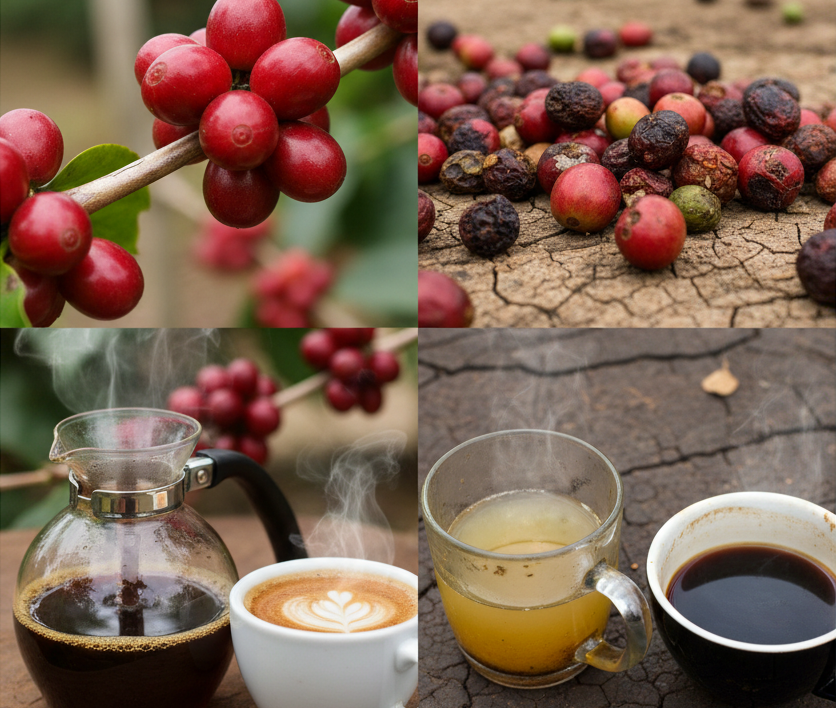
The classic image of coffee harvest is uniformly red cherries, neatly ripe and ready. The reality on any given day in a coffee farm is dramatically more complex:
- Green cherries: 3 to 6+ months from ripeness — starchy, underdeveloped, harsh
- Yellow cherries: Several weeks from peak — developing but not ready
- Orange cherries: Getting close — a few days to a week from peak
- Deep red cherries: Peak ripeness — maximum sweetness, full flavor development
- Purple/dark cherries: Slightly overripe — beginning to ferment on the tree
- Black/dried cherries: Fully overripe or dried on the tree — significant defect risk
At peak harvest, all of these stages exist simultaneously on the same tree — sometimes on the same branch. Selective pickers make real-time quality decisions with every cherry they pick. The best picking crews pass through each plant 3 to 6 times during a harvest season, selecting only at the perfect red moment each time.
Different varieties complicate this further. Yellow Bourbon ripens to yellow, never red. Pink Bourbon ripens to pink. Some varieties go through red before turning dark. The picker needs to know the specific variety they're harvesting to assess ripeness correctly — one reason farm-level varietally specific picking requires genuine expertise.
The Relationship Between Cherry Quality and Cup Quality
Here's the foundational truth of coffee quality: everything good about your cup of coffee begins in the cherry. No processing method, no roasting skill, and no brewing technique can create quality that wasn't present in the cherry from the start.
The cherry determines:
- Maximum sugar content: The raw material for caramelization during roasting — where sweetness in the cup comes from
- Organic acid profile: Which acids are present and in what concentrations — the brightness and acidity structure in the cup
- Aromatic precursor concentration: The chemical building blocks for the hundreds of aromatic compounds that form during roasting
- Flavor complexity potential: How many different flavor-active compounds the bean contains — the ceiling of what roasting and brewing can achieve
This is why defect-free, fully ripe cherry selection is the most important quality intervention in the entire chain. A skilled roaster and barista can express the full potential of an exceptional cherry — but they cannot create potential that isn't there. Conversely, the best cherry in the world can be ruined by poor processing, careless roasting, or bad brewing — but those are recoverable failures if the raw material was excellent to begin with.
What Happens to the Cherry After the Beans Are Removed?
Processing removes the bean from the cherry — but generates significant byproduct material from the cherry's outer layers. What happens to this material varies by farm and region:
- Coffee pulp / wet processing wastewater: The skin and pulp removed during washed processing is high in organic matter and acidic. When released directly into waterways, it causes environmental damage. Better-managed farms compost the pulp as organic fertilizer or use anaerobic digesters to produce biogas.
- Cascara: In natural process farms particularly, dried cherry husks are collected and sold as cascara for brewing into the tea-like drink. Growing demand for cascara has created a new revenue stream from material that was previously waste.
- Coffee flour: Some producers are experimenting with grinding dried coffee pulp into "coffee flour" — a food ingredient with approximately 7% caffeine content that can be used in baking. Still a niche product but growing.
- Specialty food and cosmetics: Coffee cherry extract and coffee cherry juice are being developed as food and cosmetic ingredients by companies working in the specialty ingredients space. High antioxidant content makes the cherry material genuinely valuable beyond the bean.
Coffee Cherry vs Coffee Berry: What's the Difference?
Nothing — the terms are completely interchangeable. "Coffee cherry" is the more widely used term in specialty coffee circles; "coffee berry" is the more technically accurate botanical term (drupes can be called berries in some botanical classification systems). Some processing-related products use "berry" specifically — "coffee berry extract," for example, or the Coffee Berry Borer (a major pest that bores into the cherry to lay eggs). In everyday usage, cherry and berry mean the same thing.
Frequently Asked Questions
What is a coffee cherry?
A coffee cherry is the fruit of the coffee plant (Coffea). It is a small drupe — a stone fruit like a peach or plum — that typically ripens to bright red or yellow depending on the variety. Inside each cherry are two seeds facing each other with their flat sides pressed together. These seeds are what we call "coffee beans." The beans are processed to remove the surrounding fruit layers, dried, and eventually roasted to produce the coffee we brew. Most people never see the cherry stage because all this happens at origin before export.
What does a coffee cherry taste like?
Fresh coffee cherry pulp is sweet and fruity — often described as tasting like watermelon, hibiscus, or a mild tropical fruit. It has a light floral quality and gentle sweetness. The flavor is nothing like roasted coffee. Cascara — a tea brewed from dried coffee cherry husks — captures some of this character: fruity, lightly floral, mildly caffeinated. The sweet, fruity flavor of the fresh cherry is the source of the natural sugars that, during processing, migrate into the bean and contribute to coffee's natural sweetness after roasting.
How long does a coffee cherry take to grow?
After flowering, Arabica coffee cherries take approximately 9 to 11 months to fully ripen — one of the longest fruit development cycles of any commercially grown crop. Robusta develops somewhat faster at 6 to 8 months. This extended development period is one reason high-altitude, cooler-temperature coffee is more complex — the slower development allows more complete accumulation of sugars and flavor precursors. A coffee tree itself takes 3 to 4 years from planting to first produce fruit.
What is a coffee peaberry?
A coffee peaberry is a coffee cherry in which only one seed developed instead of the usual two. The single seed, with no twin to press against, grows into a fully rounded, oval shape rather than the flat-on-one-side shape of standard beans. Peaberries occur in approximately 5 to 10% of cherries. They're sorted out during milling and often sold separately at a premium — partly because the round shape may roast more evenly, and partly because a single seed may receive more of the cherry's nutrients. Tanzania peaberry is one of the most celebrated examples.
What is cascara?
Cascara (from the Spanish word for "husk") is a beverage brewed from the dried skin and pulp of coffee cherries — the byproduct material removed during processing. It has been consumed in Yemen for centuries as "qishr." Cascara tastes nothing like coffee — it's fruity, floral, and tea-like with mild caffeine. It's increasingly popular in specialty coffee culture as a sustainable use of cherry material that would otherwise be discarded. The flavor depends on the coffee variety's cherry characteristics and the drying conditions.
Why do coffee farmers hand-pick cherries?
Selective hand-picking — where only fully ripe cherries are picked on each pass — produces significantly higher quality coffee than strip-picking or mechanical harvesting. Coffee trees don't ripen all cherries simultaneously; different cherries on the same branch may be at different stages. Hand-pickers select only deep red (or yellow) cherries at peak ripeness, leaving underripe and overripe ones for future passes. Underripe cherries have lower sugar content and produce harsh, underdeveloped flavor; overripe cherries have started fermenting on the tree and introduce off-flavors. The multiple-pass selective harvest method is standard in specialty coffee production across Colombia, Ethiopia, Kenya, and Central America.
The Bottom Line
The coffee cherry is the origin of everything good — and everything bad — about the coffee in your cup. Its layers contain the sugars that become sweetness, the acids that become brightness, and the flavor precursors that become the aromatic complexity you experience in every sip. Understanding the cherry doesn't just satisfy curiosity — it explains the entire logic of coffee production: why selective picking matters, why processing methods produce such different flavors, why ripeness is so critical, and why there's no substitute for exceptional raw material.
Every cup of coffee you drink is the culmination of a 9 to 11 month biological process — a fruit developing slowly on a tree in the tropics, accumulating complexity through altitude, soil, and careful farming. The roaster and barista at the end of that chain are revealing what the cherry put there. The best they can do is honor it. The worst they can do is waste it.
When you choose single-origin specialty coffee from a specifically named farm — particularly one in a high-altitude region like Colombia's Antioquia, where organic farming practices, shade growing, and selective picking are standard — you're choosing coffee whose cherry was given every possible advantage during those 9 to 11 months of development. That's the difference between a bag with a story and a commodity without one.
If you'd like to read other articles similar to What Is a Coffee Cherry? The Fruit Behind Every Cup You Drink you can visit the category The Art and Science of Coffee: Guides, Reviews, and Expert Tips.
Does Coffee Affect Cortisol Levels? The Science Behind Caffeine and Your Stress Hormone

Is Coffee Good for Depression Risk? What the Research Actually Shows

Is Coffee Bad for Anxiety? What the Science Actually Shows
The 5 Elements of Coffee Tasting Every Coffee Lover Should Know
What Is Green Coffee? How Raw Beans Differ From Roasted — and What That Means for Your Health
How Is Coffee Decaffeinated? The 4 Methods Explained — Including the One You Should Avoid
What Is Coffee Degassing? Why Fresh Roasted Beans Release CO2 — and Why It Matters
What Is a Coffee Cooperative? How They Help Farmers — and Why They Matter for Your Cup
How Altitude Affects Coffee Flavor: Why High-Grown Coffee Tastes Different
Leave a Reply
Related post