

What Is the 15-15-15 Coffee Rule? The Freshness Timeline Every Coffee Lover Should Know
If you've ever wondered why coffee at a good specialty café tastes completely different from the same beans brewed at home — brighter, sweeter, more complex — the 15-15-15 coffee rule is probably the biggest part of the answer.
It's one of the simplest and most useful frameworks in all of coffee. Once you understand it, you'll never look at a bag of beans, a grinder, or a cup of coffee quite the same way again.
Table of contents
- What Is the 15-15-15 Coffee Rule?
- Where Did the 15-15-15 Rule Come From?
- The Science Behind Each "15"
- The Fourth Fifteen: 15 Seconds for Espresso
- Is the 15-15-15 Rule Absolute? When You Can Bend It
- How the 15-15-15 Rule Explains the Café vs Home Brew Gap
- How to Apply the 15-15-15 Rule in Real Life
- Frequently Asked Questions
- The Bottom Line
What Is the 15-15-15 Coffee Rule?
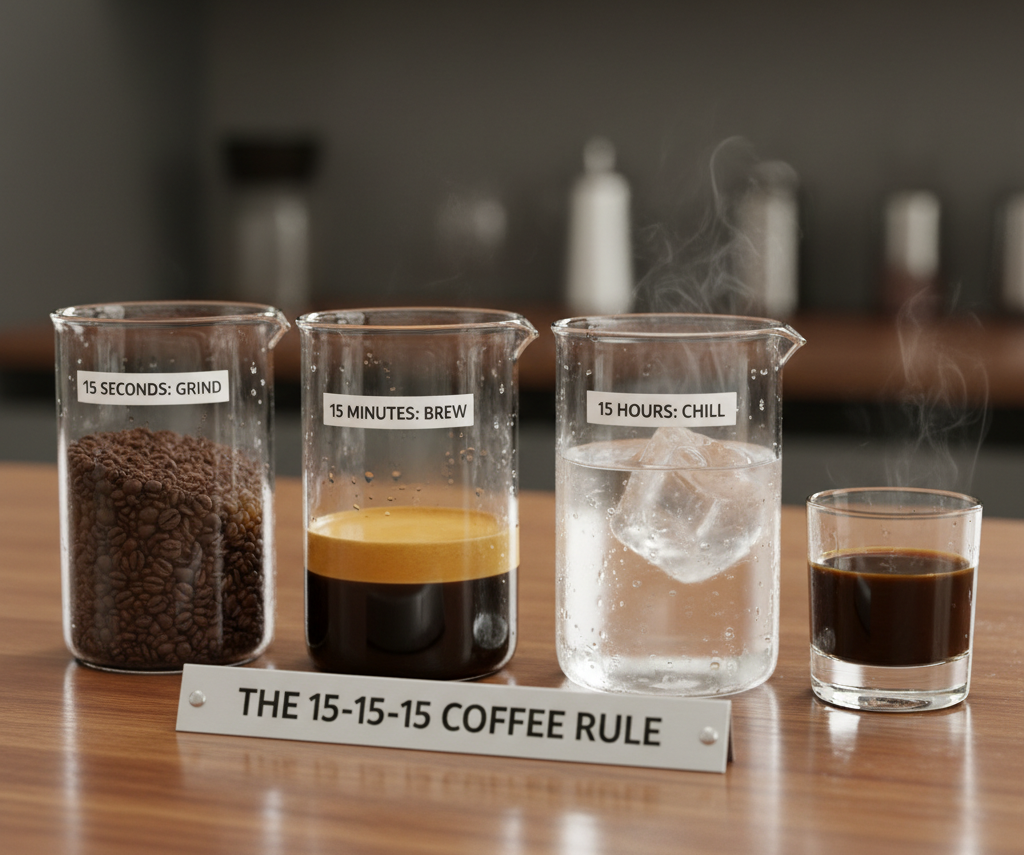
The 15-15-15 rule is a freshness guideline that defines three critical time windows in a coffee bean's journey from farm to cup:
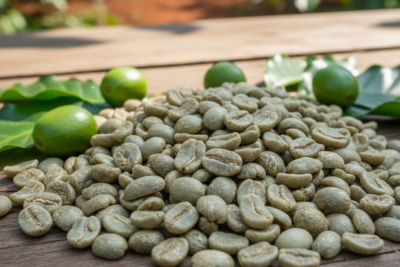
- 15 months: Green (unroasted) coffee beans maintain their quality for approximately 15 months from the harvest date. After that, they begin losing moisture and flavor potential even before roasting.
- 15 days: Roasted coffee beans are at their peak flavor within 15 days of the roast date. After this window, the delicate aromatic oils and compounds that define the coffee's character begin degrading noticeably.
- 15 minutes: Ground coffee starts losing its aromatic intensity rapidly once exposed to air. Ideally, you should brew within 15 minutes of grinding to capture the full flavor the bean has to offer.
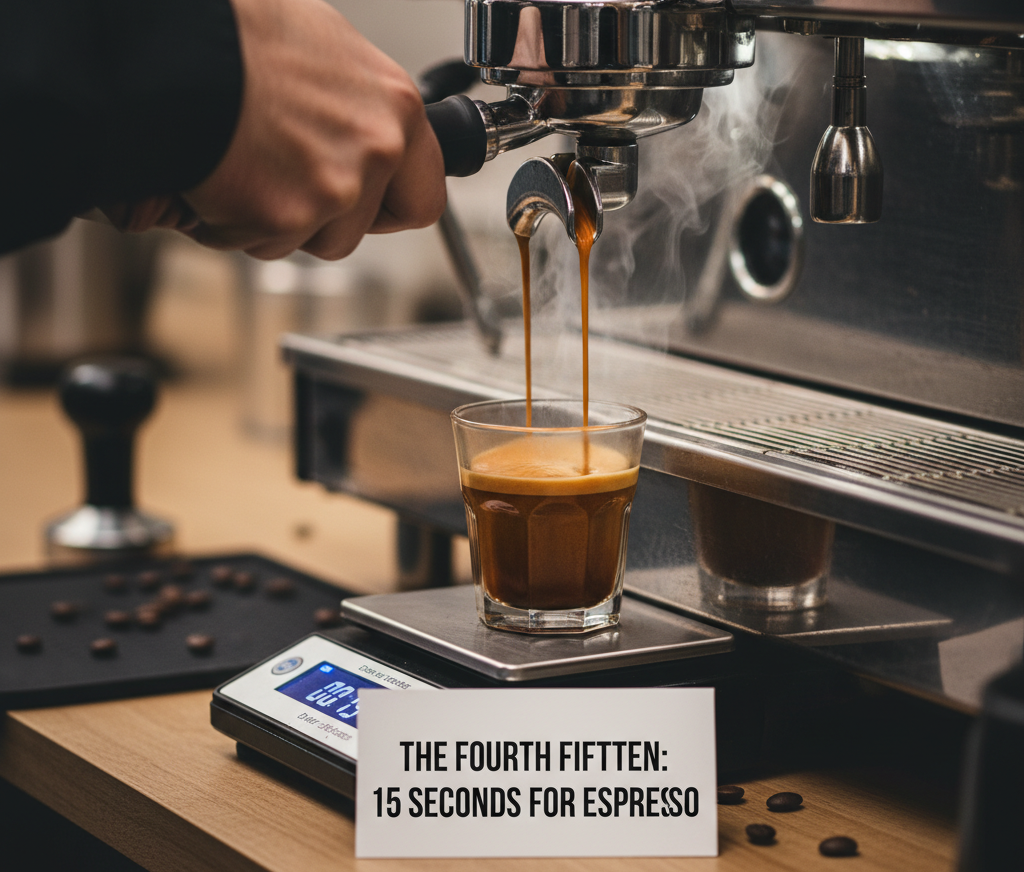
Some baristas add a fourth fifteen to the framework: 15 seconds for espresso — the time within which a freshly pulled shot should ideally be consumed before the crema dissipates and the temperature drops enough to change the flavor profile. This extended version is sometimes called the "Rule of Four Fifteens" in professional barista circles.
Think of it as a cascade of freshness windows, each one exponentially shorter than the last as the coffee moves through its stages of transformation.
☕ Recommended by cocondo.coffee
Cocondo Orgánico — The only certified organic coffee from Antioquia, Colombia
Reserve Your Bag →Where Did the 15-15-15 Rule Come From?
The rule is widely attributed to a barista known online as "Psyd" — real name Chris Babbie — who originally shared the framework on the coffee-enthusiast forum Home-Barista back in 2009. It's sometimes called Babbie's Rule of Fifteens in coffee geek circles. From that forum, it spread through the specialty coffee community and eventually became standard knowledge among serious home brewers and professional baristas alike.
It's worth noting that the rule was never meant as a rigid scientific law — more as a memorable framework that captures real chemistry in an easy-to-remember format. As the Home-Barista community has discussed at length, the numbers are approximations that work well as general guidance, not exact chemical cutoffs. Coffee doesn't turn to dust at minute 16. But the underlying science is real and well-documented.
The Science Behind Each "15"
Why 15 Months for Green Beans?
Green coffee beans are significantly more stable than roasted beans — they're essentially seeds, and their low moisture content (around 10–12%) and intact cellular structure protect the flavor precursors inside. But they're not indestructible.
Over 15 months, green beans gradually lose moisture and the organic compounds that, during roasting, will become the sugars, acids, and aromatic molecules that define the coffee's flavor profile. Beans roasted from old green stock tend to produce flat, woody, or papery cups — the roasting process can't create flavors that aren't in the bean to begin with. This is why the green bean stage matters even if most coffee drinkers never interact with it directly.
When you buy specialty coffee with exceptional flavor notes — the kind that tastes genuinely vibrant and complex — part of the reason is that those beans were roasted from high-quality green stock used within its optimal window.
Why 15 Days for Roasted Beans?
This is where the chemistry becomes most relevant to everyday coffee drinkers. The moment roasting ends, two simultaneous processes begin:
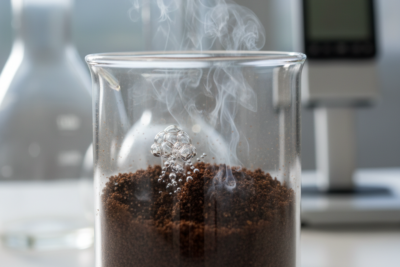
Degassing: During roasting, carbon dioxide (CO2) becomes trapped inside the bean structure. Immediately after roasting, beans begin releasing this CO2 — a process that continues for days. During the first 24 hours, up to 40% of the stored CO2 is released. This is why freshly roasted specialty coffee bags have one-way valves: to let the CO2 out without letting oxygen in.
Here's something counterintuitive: coffee that's too fresh can actually taste worse, not better. In the first 2 to 5 days after roasting, so much CO2 is still being released that it interferes with extraction — it physically pushes water away from the grounds during brewing, causing uneven extraction and a metallic or sour taste. Jee Choe, coffee and tea sommelier behind Oh, How Civilized, notes that coffee tastes best after at least a week after the roast date, once the initial degassing has stabilized and aromatic oils are at their most vibrant.
The optimal window for most specialty coffees is roughly day 5 to day 21 after roasting. Day 15 is the midpoint of this window — not the cutoff, but a useful reference point for when freshness is reliably in the peak zone.
Oxidation: Simultaneously, the aromatic oils in the beans begin reacting with oxygen in the air, degrading into less flavorful compounds. This process is slow enough in whole beans stored in sealed packaging to be manageable, but it's irreversible — every day, some flavor compounds are lost permanently.
After 15 days without careful storage, the degradation becomes increasingly noticeable in the cup. After 30+ days, what was a vibrant, complex coffee may taste significantly flatter and more one-dimensional.
Why 15 Minutes for Ground Coffee?
Grinding is the most dramatic freshness event in a coffee bean's life. When a whole bean is ground, its surface area increases by roughly 10,000 times. Every interior cell that was previously protected is suddenly exposed to oxygen, moisture, heat, and light all at once. The aromatics that took weeks of careful storage to protect begin escaping within seconds.
Research confirms this dramatically: ground coffee can lose up to 60% of its aromatic compounds within 15 minutes of grinding. The compounds that give specialty coffee its brightness, its floral notes, its citrus or berry character — those are the most volatile and the first to go.
What remains after those aromatics escape are the heavier, more stable compounds — which tend toward bitterness and flatness. This is why pre-ground coffee, even freshly purchased from a quality roaster, tastes less vibrant than the same coffee ground immediately before brewing. And why coffee ground the day before and left in a container overnight can taste noticeably duller the next morning.
The 15-minute window isn't a precise scientific threshold — it's a practical guideline that captures the most critical phase of aromatic loss. The ideal is to grind immediately before brewing, measured in seconds rather than minutes. But 15 minutes is a reasonable outer boundary for maintaining most of the coffee's character.
The Fourth Fifteen: 15 Seconds for Espresso
In professional espresso practice, there's an additional rule that extends the framework. A freshly pulled espresso shot should ideally be consumed within 15 seconds — before the crema begins to dissipate and the shot cools enough to change its flavor profile.
Espresso crema is a complex emulsion of CO2 bubbles, coffee oils, and melanoidins. It's not just decorative — it traps aromatic compounds and provides the textural experience that defines a great espresso. As crema dissipates, those trapped aromatics escape, and the shot simultaneously oxidizes and cools, changing its flavor profile from sweet and complex to increasingly bitter and flat.
This is also why stirring your espresso before drinking — a technique used by some specialty coffee professionals — can actually improve the experience: it integrates the crema back into the liquid before it fully dissipates, redistributing those aromatic oils throughout the shot rather than letting them escape into the air.
Is the 15-15-15 Rule Absolute? When You Can Bend It
The Home-Barista community — where the rule originated — has had long, nuanced discussions about exactly this question. The answer is: the rule is a guideline, not a law. Here's when the flexibility applies:
The 15-Day Rule Can Flex to 30 Days (With Good Storage)
With genuinely excellent storage — a vacuum-sealed, opaque, airtight container in a cool, dry cabinet — whole bean specialty coffee can maintain very good quality well beyond 15 days. Many experienced home brewers find their coffee still excellent at 3 to 4 weeks post-roast. The 15-day number represents the peak window, not the expiration date. Coffee doesn't become undrinkable at day 16; it just begins its decline from peak quality.
The 15-Minute Rule Can Flex in Some Scenarios
Ground coffee immediately vacuum-sealed and frozen can preserve freshness for several days — a technique used when hosting guests or traveling. Grinding into an airtight container and refrigerating overnight is not ideal but may be necessary for practical reasons. The rule is most relevant for the open-air situation where ground coffee is simply left out — that's where 15 minutes makes a dramatic difference.
There's also an interesting exception for very fresh coffee (roasted within 1–2 days): grinding and letting the grounds "breathe" for 30 minutes before brewing can sometimes improve the cup by accelerating the degassing process, smoothing out the metallic acidity that comes from excessive CO2. Think of it as controlled rest rather than degradation.
The 15-Second Espresso Rule Is the Strictest
This one genuinely doesn't flex much. Espresso chemistry changes rapidly once pulled. A shot left for 2 minutes is noticeably different from one drunk at 15 seconds — and not in a good direction. This is one reason specialty cafes serve espresso immediately and don't prepare shots in advance.
How the 15-15-15 Rule Explains the Café vs Home Brew Gap
If you've ever noticed that your coffee at a good specialty café tastes dramatically better than the same beans at home, the Rule of Fifteens explains most of the gap:
- The café likely received beans roasted within the past week, not sitting in a warehouse for months
- Their grinder runs on demand — your beans are ground seconds before brewing
- The shot or pour-over is served immediately
- Their equipment is calibrated and consistent
Most home coffee situations violate at least one of the fifteen windows — beans purchased weeks after roasting, ground in advance for convenience, or brewed coffee left sitting on a warming plate for an hour. Each violation compounds the flavor loss. Following the rule, even imperfectly, measurably improves the result.
How to Apply the 15-15-15 Rule in Real Life
- Always check the roast date, not the best-by date. A best-by date tells you when coffee becomes undrinkable. A roast date tells you when it's actually at its best. If a coffee bag doesn't show a roast date, that's a red flag — it likely means the roaster doesn't want you to know how old it is. Buy from roasters who are transparent about roast dates.
- Buy in quantities you'll finish in 2 to 3 weeks. A 500g bag for one person who drinks two cups a day will last about 3 weeks — comfortably within the peak freshness window. Don't buy 1kg bags just because they're on sale if they'll sit for months.
- Grind immediately before brewing, every time. Yes, it takes an extra 30 seconds. Yes, it makes a significant difference. A basic hand grinder costs less than a single bag of specialty coffee and will outlast most electric appliances.
- Brew only what you'll drink now. Don't brew a full pot if you'll only drink two cups. Brewed coffee held on a warming plate continues degrading rapidly. A thermal carafe can hold brewed coffee reasonably well for 30 to 60 minutes without a warming element.
- For espresso, drink it immediately. The 15-second guideline is strict for good reason. Pull the shot, drink the shot.
Frequently Asked Questions
What is the 15-15-15 coffee rule?
The 15-15-15 coffee rule is a freshness guideline stating that green coffee beans should be used within 15 months of harvest, roasted beans should be used within 15 days of roasting, and ground coffee should be brewed within 15 minutes of grinding. Some baristas add a fourth 15 — espresso should be consumed within 15 seconds of pulling. The rule was popularized by barista Chris "Babbie" Babbie on the Home-Barista forum in 2009 and is now widely used in specialty coffee circles.
What is the 15-day coffee rule specifically?
The 15-day portion of the rule refers to the window after roasting during which coffee beans are at their peak flavor quality. The optimal window is generally considered to be day 5 to day 21 post-roast, with day 15 as a useful midpoint reference. Before day 5, excessive CO2 degassing can interfere with extraction. After day 21 to 30, oxidation becomes increasingly noticeable in the cup. Coffee doesn't expire at day 15 — it simply begins declining from peak quality.
Does the 15-minute grinding rule really matter?
Yes — significantly. Grinding increases coffee's surface area by approximately 10,000 times, exposing interior compounds to oxygen all at once. Ground coffee can lose up to 60% of its aromatic compounds within 15 minutes of grinding in open air. The most volatile aromatic compounds — those responsible for brightness, floral notes, and fruity character — are the first to escape. What remains after they're gone tends toward bitterness and flatness. Grinding immediately before brewing is one of the highest-impact improvements most home brewers can make.
What is the rule of four fifteens in coffee?
The rule of four fifteens extends the standard 15-15-15 framework to add a fourth window: espresso should be consumed within 15 seconds of pulling. This fourth fifteen captures the rapid changes that occur in espresso chemistry as the shot cools, the crema dissipates, and the trapped aromatic compounds escape. It's particularly relevant for espresso lovers who want to experience the full complexity of a well-pulled shot.
What is the 15-minute rule for coffee?
The 15-minute rule refers specifically to the grinding window — the recommendation to brew coffee within 15 minutes of grinding to preserve maximum freshness and aromatic complexity. It's the most actionable part of the 15-15-15 rule for most home brewers, since it requires only the habit of grinding immediately before brewing rather than in advance.
The Bottom Line
The 15-15-15 coffee rule is elegant in its simplicity: 15 months for green beans, 15 days for roasted beans, 15 minutes for ground coffee. Each number captures a real chemical reality — the progressive vulnerability of coffee as it moves from raw seed to roasted bean to ground powder to brewed cup.
You don't have to be obsessive about following it to the second. But understanding the rule changes how you shop for coffee, how you store it, and how you brew it. And those changes, applied consistently, produce a noticeably better cup — every single day.
The rule also highlights something worth thinking about when you're buying coffee: the beans most worth protecting are the ones that came from somewhere worth knowing about. Single-origin specialty coffee from high-altitude farms — like organically grown Colombian beans from the Antioquia region — has the kind of complex aromatic profile that makes the 15-minute grind window and the 15-day freshness window actually matter. Cheap commercial blends don't have much aromatic complexity to lose in the first place. Great beans do. Treat them accordingly.
If you'd like to read other articles similar to What Is the 15-15-15 Coffee Rule? The Freshness Timeline Every Coffee Lover Should Know you can visit the category The Art and Science of Coffee: Guides, Reviews, and Expert Tips.
Does Coffee Affect Cortisol Levels? The Science Behind Caffeine and Your Stress Hormone

Is Coffee Good for Depression Risk? What the Research Actually Shows

Is Coffee Bad for Anxiety? What the Science Actually Shows
The 5 Elements of Coffee Tasting Every Coffee Lover Should Know
What Is Green Coffee? How Raw Beans Differ From Roasted — and What That Means for Your Health
How Is Coffee Decaffeinated? The 4 Methods Explained — Including the One You Should Avoid
What Is Coffee Degassing? Why Fresh Roasted Beans Release CO2 — and Why It Matters
What Is a Coffee Cooperative? How They Help Farmers — and Why They Matter for Your Cup
How Altitude Affects Coffee Flavor: Why High-Grown Coffee Tastes Different
Leave a Reply
Related post