

What Is Shade-Grown Coffee? Why It Tastes Better and Matters for the Planet
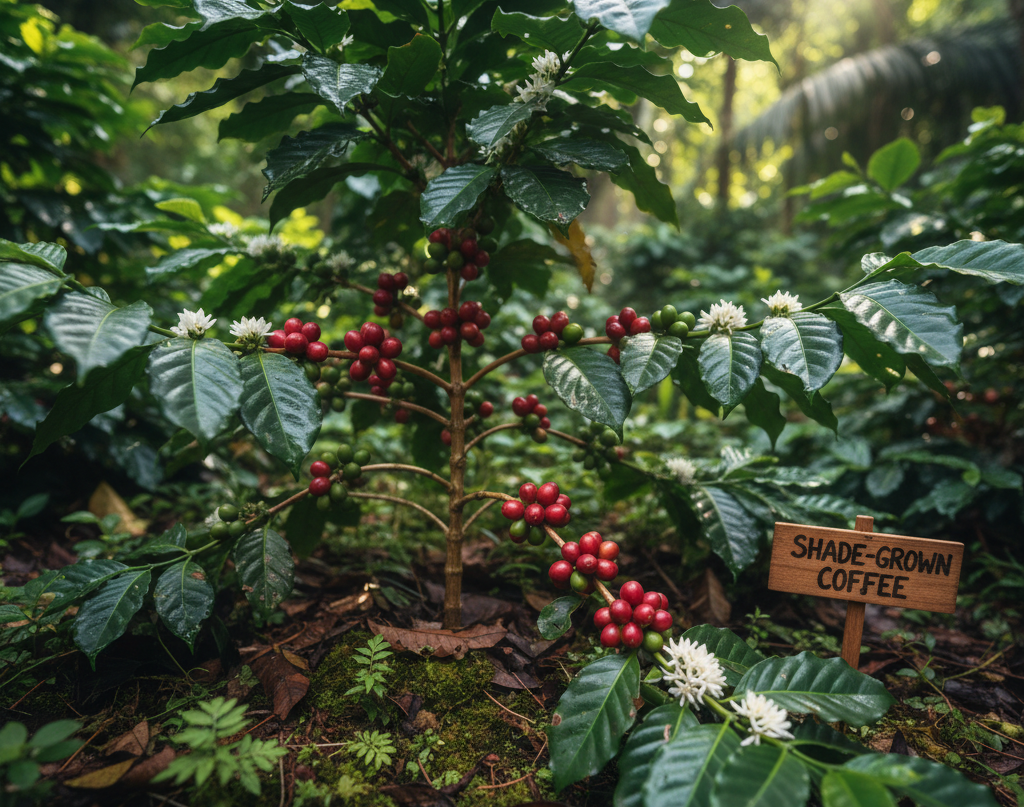
For most of coffee's history, it grew the way it evolved — under a canopy of trees. The coffee plant is naturally an understory species, native to the highland forests of Ethiopia where it developed in dappled shade beneath taller trees. That's the environment it's adapted to. And for centuries, farmers around the world grew coffee that way.
Then, in the 1970s, most of that changed. And the shift had consequences — for ecosystems, for wildlife, for farmers, and for the coffee in your cup — that are still playing out today.
Understanding shade-grown coffee means understanding what happened when the industry moved away from it, why that matters, and why the traditional approach produces better coffee in addition to a better world.
Table of contents
- What Is Shade-Grown Coffee?
- The History: How Coffee Farming Changed in the 1970s
- How Shade Growing Affects Coffee Flavor: The Bean Density Connection
- The Environmental Case: Numbers That Matter
- Types of Shade-Grown Coffee Systems
- Shade-Grown Coffee Certifications: How to Know What You're Buying
- Shade-Grown Coffee vs Sun-Grown Coffee: The Practical Comparison
- Shade-Grown Coffee in Colombia: Why It Matters Here Specifically
- Frequently Asked Questions
- The Bottom Line
What Is Shade-Grown Coffee?
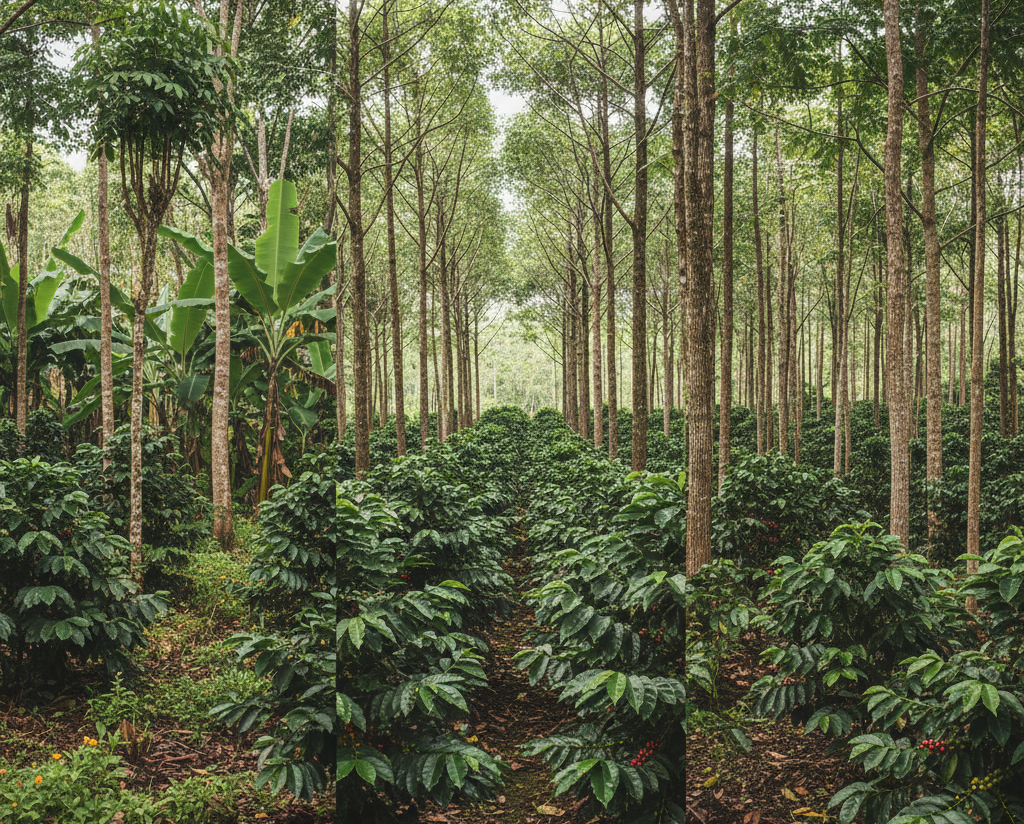
Shade-grown coffee is exactly what it sounds like: coffee cultivated under a canopy of trees rather than in open, sun-exposed fields. In traditional shade-grown systems, coffee plants grow beneath a multi-layered forest structure — typically a mix of taller native trees, fruit trees, banana plants, and other vegetation that creates a diverse, forest-like environment above and around the coffee.
This isn't just aesthetic. The tree canopy performs multiple simultaneous functions:
- Regulates temperature — keeping the coffee plants cooler in hot conditions and warmer during cold snaps
- Reduces direct sunlight — slowing the development of coffee cherries and allowing slower, more complete sugar and acid development
- Provides natural fertilizer — falling leaves decompose into nutrient-rich compost that feeds the soil
- Retains soil moisture — reducing irrigation needs and preventing drought stress on the coffee plants
- Prevents soil erosion — tree roots stabilize slopes and prevent topsoil loss during heavy rains
- Supports biodiversity — providing habitat for birds, bats, insects, and other wildlife that perform essential ecological functions including pest control and pollination
The contrast is sun-grown coffee: varieties specifically bred to tolerate — and thrive in — full direct sunlight, grown in open monoculture plantations where native trees have been cleared.
☕ Recommended by cocondo.coffee

Cocondo Orgánico — The only certified organic coffee from Antioquia, Colombia
Reserve Your Bag →The History: How Coffee Farming Changed in the 1970s
The story of how most coffee went from shade to sun is a story of agricultural modernization with unintended consequences.
In the 1970s, a devastating fungal disease called coffee leaf rust (Hemileia vastatrix) spread through Latin American coffee-growing regions, threatening crops and farmer livelihoods. In response, international development agencies — particularly USAID — funded a large-scale agricultural modernization program encouraging farmers to switch to new, high-yielding coffee varieties specifically bred to grow in full sun.
These sun-tolerant varieties, combined with chemical fertilizers and pesticides, promised dramatically higher yields per hectare. And they delivered — in the short term. From an economic efficiency standpoint, a sun-grown coffee plantation produces significantly more coffee per acre per year than a traditional shade system.
By the late 1990s, an estimated 40 to 69% of Latin American coffee lands had been converted from shade to sun cultivation. In Colombia, where shade-growing had been essentially universal, conversion rates in some regions approached 90% for high-production commercial farming operations.
The ecological consequences became apparent within decades. The forests that had canopied those farms were gone. The birds that had nested and fed in them disappeared. The soil, no longer held together by tree roots and enriched by leaf litter, became increasingly dependent on synthetic inputs. Water runoff increased. Biodiversity collapsed in converted areas.
The Smithsonian Migratory Bird Center — which had been tracking migratory bird populations — issued a formal call in 1996 for the coffee industry to return to shade-grown farming. The data they had collected was alarming: roughly 20% decline in migratory bird populations since 1972, substantially linked to the conversion of shade coffee farms to sun plantations across the wintering grounds where North American migratory birds historically spent the winter.
How Shade Growing Affects Coffee Flavor: The Bean Density Connection
The environmental case for shade-grown coffee is compelling. But for most coffee drinkers, the more immediately relevant question is: does it actually taste better?
The evidence suggests yes — and the mechanism is well understood.
Slower Maturation = More Complex Development
Under a shade canopy, coffee cherries develop more slowly than they do in full sun. This extended maturation period — typically 30 to 50% longer than sun-grown equivalents — allows more complete and complex development of the compounds that define coffee's flavor:
- Natural sugars: Shade-grown cherries accumulate more natural sugars as they ripen slowly — these sugars caramelize during roasting to produce the sweetness and caramel notes that define quality coffee
- Balanced organic acids: The slower, more even ripening process allows acids (citric, malic, tartaric) to develop in better proportion to sugars, producing brighter but balanced acidity rather than sharp, harsh sourness
- Aromatic compounds: The longer development time allows a more complex array of aromatic precursors to form in the bean — the compounds that, when roasted, become the fruity, floral, and chocolatey notes that define specialty coffee
Bean Density as a Quality Marker
The slower maturation process produces another measurable quality indicator: higher bean density. Shade-grown beans have more time to accumulate solids as they develop — producing a denser, harder bean compared to the lighter, more porous beans of fast-matured sun-grown coffee.
Bean density is directly associated with cup quality in coffee science. Denser beans:
- Have a higher concentration of flavor-active compounds per gram
- Roast more evenly (heat penetrates uniformly through a consistent density)
- Produce a fuller-bodied, more complex cup at equivalent extraction parameters
- Preserve roasted flavor compounds longer — denser structure resists oxidation better
This is why high-altitude coffee — which develops more slowly due to cooler temperatures — is consistently rated higher quality than low-altitude coffee from the same origin. Shade growing produces a similar effect through a different mechanism: both slow the cherry's development, allowing more complete accumulation of quality-determining compounds.
Lower Acidity and Caffeine (Potentially)
Some research suggests shade-grown coffee may have slightly lower acidity and slightly lower caffeine content than sun-grown equivalents from the same cultivar. The mechanisms are related to the same slower-maturation dynamic — the cherry's chemistry develops differently under cooler, more shaded conditions. However, these differences are subtle and vary significantly by cultivar, altitude, and processing method. Don't choose shade-grown coffee expecting dramatically lower caffeine — the difference is modest.
The more reliable flavor expectations: more sweetness, more complexity, more layered flavor notes, and better body compared to fast-grown sun coffee from the same origin.
The Environmental Case: Numbers That Matter
For those who want to understand the environmental stakes concretely, the data from ecological research is striking.
Bird Biodiversity
The Smithsonian's National Zoo and Conservation Biology Institute has conducted extensive research on bird populations in shade-grown versus sun-grown coffee systems. Key findings:
- Coffee plantations in southern Mexico (Chiapas) with shade canopies offer habitat for 180 species of birds (46 of them migratory) — a richness rivaled only by natural forest habitats in the region
- Bird-Friendly certified farms in the Venezuelan Andes support up to 14 times the density of migratory birds compared to local primary forest — because the combination of coffee understory and diverse shade tree canopy creates an unusually rich food and habitat environment
- Sun-grown coffee monocultures support dramatically fewer bird species — in some cases as few as 5 to 20 species compared to 100+ in shade systems
Since approximately 1972, migratory bird populations across North and South America have declined by roughly 20% — a decline substantially driven by the loss of shade coffee habitat on wintering grounds in Mexico, Central America, and Colombia, where billions of North American migratory birds historically overwintered.
Carbon Sequestration
Shade-grown coffee farms function as significant carbon sinks. Studies show that farms with over 60% shade cover are carbon positive — they store more carbon than they release. Each hectare of dense shade-grown coffee can sequester the carbon equivalent of removing multiple cars from the road annually. Sun-grown coffee monocultures, by contrast, are net carbon emitters once the forest they replaced is accounted for.
Soil Health
Shade trees continuously enrich the soil through falling leaves that decompose into organic matter, root systems that prevent erosion and aerate compacted soil, and mycorrhizal fungi networks that transfer nutrients between trees and coffee plants. Sun-grown coffee farms, stripped of this natural input system, become progressively more dependent on synthetic fertilizers — which deplete soil health further over time in a negative feedback loop.
Water Quality and Watershed Protection
The tree canopy on shade-grown farms intercepts rainfall, slowing its path to the ground and allowing more water to percolate into the soil rather than running off. This reduces sediment runoff into waterways, protects downstream water quality, and recharges groundwater that communities depend on. Colombia's coffee-growing regions, which sit in critical watershed areas for multiple major rivers, are particularly dependent on these functions.
Types of Shade-Grown Coffee Systems
Not all shade-grown coffee is equal — the type and density of shade canopy varies significantly across different farming systems:
Rustic / Traditional Polyculture
The most ecologically valuable approach — coffee planted directly into existing forest, with minimal modification to the native tree canopy. The farm functions essentially as a managed forest. This is how coffee has been grown in Ethiopia and parts of Colombia and Central America for centuries. Extremely high biodiversity, but lower yields and more difficult to certify commercially.
Traditional Polyculture
Managed shade system with multiple native and non-native tree species — typically 10 to 30+ tree species including fruit trees, timber trees, and nitrogen-fixing trees. Coffee grows beneath a deliberately managed multi-layer canopy. High biodiversity, good flavor complexity, more manageable than rustic systems. This is what most quality shade-grown specialty coffee producers use.
Commercial Polyculture
Simplified shade system with fewer tree species — often 3 to 10 species, dominated by leguminous nitrogen-fixing trees like Inga. Moderate biodiversity. Commercially viable while maintaining meaningful shade coverage. Less ecologically complex than traditional polyculture but dramatically better than sun-grown systems.
Monoculture Shade
Single species of shade tree (often Grevillea or a single Inga variety) over coffee monoculture. Provides some shade benefits — temperature regulation, some erosion control — but minimal biodiversity value. Better than full sun but not what "shade-grown" implies in quality specialty coffee contexts.
Shade-Grown Coffee Certifications: How to Know What You're Buying
Because "shade-grown" has no legal definition in most markets, it can be used loosely on coffee packaging. Specific certifications provide more reliable assurance:
Bird-Friendly® (Smithsonian Migratory Bird Center)
The most rigorous and scientifically credible shade-grown certification. Requirements include:
- Full organic certification (USDA or equivalent) — a prerequisite
- Minimum 40% canopy cover
- Minimum 11 native tree species (recent standards require 12+)
- Minimum 40-foot canopy height
- Multiple canopy layers
- Annual third-party verification
Only approximately 1% of global coffee production meets Bird-Friendly standards — making it genuinely rare and meaningful when you see it. If a coffee carries the Bird-Friendly seal, the shade requirements are real, scientifically measured, and independently verified.
Rainforest Alliance
Requires shade canopy as part of its certification standards — minimum 40% canopy coverage in most regions, native tree species, and multiple canopy layers. Also includes social sustainability criteria. More widely available than Bird-Friendly, though less strict on specific biodiversity requirements.
Organic + Shade Claims
Many small specialty roasters source shade-grown coffee from farms they know personally through direct trade relationships — even without formal Bird-Friendly certification. When a roaster can tell you specifically which farm, the tree species composition, and the canopy cover percentage, that direct knowledge is often more meaningful than a certification alone. Look for roasters who can speak in detail about their sourcing.
Shade-Grown Coffee vs Sun-Grown Coffee: The Practical Comparison
- Flavor complexity: Shade-grown generally higher — slower maturation develops more complex flavor compounds
- Sweetness: Shade-grown generally higher — more complete sugar development
- Acidity character: Shade-grown typically more balanced — acids develop more evenly relative to sugars
- Bean density: Shade-grown typically higher — correlates with cup quality
- Yield per hectare: Sun-grown much higher — 2 to 3 times or more for high-yielding modern varieties
- Chemical inputs required: Shade-grown dramatically less — natural systems reduce pest pressure and fertilizer needs
- Biodiversity supported: Shade-grown dramatically higher — forests vs monocultures
- Carbon impact: Shade-grown positive (carbon sink) — sun-grown typically negative
- Price: Shade-grown typically higher — lower yields, more complex farming, specialty positioning
Shade-Grown Coffee in Colombia: Why It Matters Here Specifically
Colombia's coffee-growing regions are particularly important in the shade-versus-sun debate for several reasons:
Colombia sits within the Tropical Andes Biodiversity Hotspot — one of the most biologically diverse regions on the planet, hosting approximately 15% of all plant species on Earth on just 1% of the world's land surface. The coffee-growing departments — Antioquia, Huila, Nariño, Caldas, Risaralda, Quindío — sit within or adjacent to this hotspot, making the farming practices on those lands directly relevant to the survival of globally significant species.
Colombian specialty coffee at its finest — from small farms in regions like Titiribí in Antioquia — is typically shade-grown under native and semi-native tree species, at altitudes between 1,400 and 2,100 meters, often organically managed. This combination of shade, altitude, and careful farming is precisely what produces the complex, sweet, clean cups that distinguish Colombian specialty coffee from commercial-grade production.
The farms that produce the best specialty Colombian coffee are, almost without exception, shade-grown farms. The flavor you taste in a high-quality Colombian cup is inseparable from the farming system that produced it.
Frequently Asked Questions
What is shade-grown coffee?
Shade-grown coffee is cultivated under a canopy of diverse trees rather than in open, sun-exposed fields. The tree canopy slows the development of coffee cherries, allowing more complete development of natural sugars and aromatic compounds — producing beans with higher density, more complex flavor, and greater sweetness compared to sun-grown coffee. Shade-grown farms also provide critical habitat for birds and wildlife, sequester carbon, improve soil health, and require fewer synthetic inputs than sun-grown monocultures.
Does shade-grown coffee taste better?
Generally yes — the slower cherry maturation under shade canopy produces denser beans with higher concentrations of flavor-active compounds. This translates to more sweetness, greater flavor complexity, more balanced acidity, and better body compared to sun-grown coffee from the same origin. The most consistently high-scoring specialty coffees are nearly always shade-grown, and the correlation between shade cultivation and cup quality is well-documented in coffee science.
How is shade-grown coffee different from regular coffee?
Most commercial coffee today is sun-grown — cultivated in full-sun monocultures using high-yielding varieties specifically bred for open conditions. Shade-grown coffee uses traditional or semi-traditional methods where coffee grows beneath a diverse tree canopy. The differences are significant: slower cherry development, higher bean density, more complex flavor, dramatically higher biodiversity support, lower chemical input requirements, and positive carbon sequestration compared to the carbon-neutral-to-negative footprint of sun-grown systems.
Is shade-grown coffee the same as organic coffee?
Not necessarily — though the two often overlap. Shade-grown refers specifically to the growing environment (under tree canopy vs. full sun). Organic refers to the absence of synthetic pesticides and fertilizers. Many shade-grown farms are also organically managed — the natural systems of shade farming (birds controlling pests, leaf litter fertilizing soil) reduce chemical dependency significantly. But shade-grown is not automatically organic, and organic is not automatically shade-grown. The Bird-Friendly certification requires both.
How do I know if my coffee is shade-grown?
Look for the Bird-Friendly® certification seal — the most rigorous and independently verified shade-grown certification. Rainforest Alliance certification includes shade requirements. Beyond certifications, specialty roasters with direct trade relationships to specific farms can often confirm shade-growing practices even without formal certification. If a coffee bag shows a farm name, specific region, and mentions traditional or agroforestry growing practices, that's a good indicator of shade cultivation.
Why did coffee farms switch from shade to sun growing?
In the 1970s, a coffee leaf rust epidemic prompted international development organizations (particularly USAID) to fund large-scale conversion of Latin American coffee farms to high-yielding sun-tolerant varieties. These varieties produced significantly more coffee per hectare, which was economically compelling for farmers facing disease risk and price pressure. The conversion was widespread — estimates suggest 40 to 69% of Latin American coffee farms converted by the late 1990s. The ecological consequences — massive biodiversity loss, deforestation, decline in migratory bird populations — became apparent within decades.
The Bottom Line
Shade-grown coffee is not a marketing buzzword — it's a description of a farming system with real, measurable consequences for coffee flavor, ecosystem health, and biodiversity. The same canopy of trees that shelters migratory birds, sequesters carbon, and prevents soil erosion also slows the development of coffee cherries in a way that produces denser, sweeter, more complex beans.
The best flavor and the best environmental outcome are the same thing in this case — which is rarer than it sounds in agricultural choices. When a coffee is shade-grown, organically managed, and sourced from a high-altitude farm where the farmer can tell you what trees grow above the coffee plants, you're experiencing coffee the way it has been grown for centuries, in the environment it evolved in.
That's not nostalgia. It's the expression of what coffee genuinely is when given the conditions it needs to be at its best.
If you'd like to read other articles similar to What Is Shade-Grown Coffee? Why It Tastes Better and Matters for the Planet you can visit the category The Art and Science of Coffee: Guides, Reviews, and Expert Tips.
Does Coffee Affect Cortisol Levels? The Science Behind Caffeine and Your Stress Hormone

Is Coffee Good for Depression Risk? What the Research Actually Shows

Is Coffee Bad for Anxiety? What the Science Actually Shows

The 5 Elements of Coffee Tasting Every Coffee Lover Should Know
What Is Green Coffee? How Raw Beans Differ From Roasted — and What That Means for Your Health
How Is Coffee Decaffeinated? The 4 Methods Explained — Including the One You Should Avoid

What Is Coffee Degassing? Why Fresh Roasted Beans Release CO2 — and Why It Matters
What Is a Coffee Cooperative? How They Help Farmers — and Why They Matter for Your Cup

How Altitude Affects Coffee Flavor: Why High-Grown Coffee Tastes Different
Leave a Reply
Related post