

What Is the Coffee Flavor Wheel? How to Use It Like a Pro (Even as a Beginner)
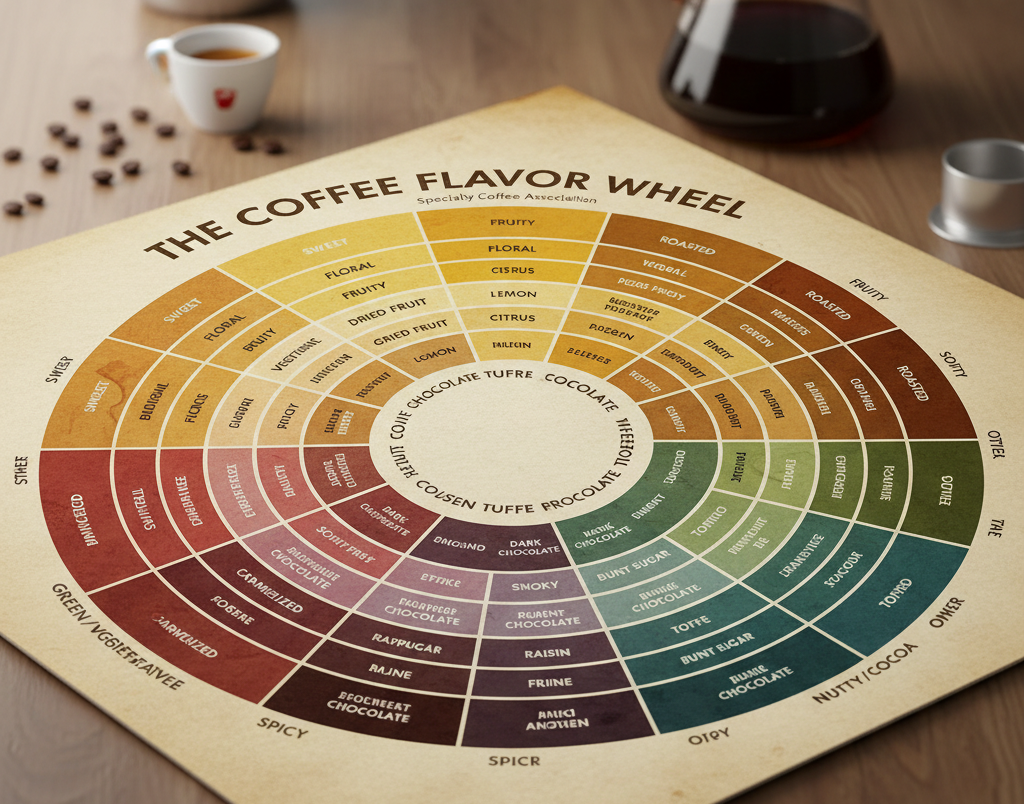
If you've ever read a coffee bag that described the contents as tasting like "jasmine, bergamot, and lemon curd" and wondered whether the roaster was pulling your leg — the Coffee Flavor Wheel is the tool that makes those descriptions possible. It's the universal language of coffee tasting, and understanding it changes how you experience every cup you drink.
Here's what the wheel actually is, where it came from, how it's structured, and — most practically — how to use it at home to start tasting coffee in a way that makes those flavor descriptions actually make sense.
Table of contents
- What Is the Coffee Flavor Wheel?
- The History: From Ted Lingle's Sketch to a Global Standard
- The World Coffee Research Sensory Lexicon: The Science Behind the Wheel
- How to Read the Wheel: The Color and Gap System
- How to Actually Use the Coffee Flavor Wheel at Home
- The 9 Main Flavor Categories on the Wheel
- Criticisms and Limitations of the Flavor Wheel
- Why the Flavor Wheel Matters for Everyday Coffee Drinkers
- Frequently Asked Questions
- The Bottom Line
What Is the Coffee Flavor Wheel?
The Coffee Taster's Flavor Wheel is a circular visual reference tool that maps over 110 distinct flavors, aromas, and sensory attributes that can be found in coffee. Created by the Specialty Coffee Association (SCA) in collaboration with World Coffee Research (WCR), it provides a standardized vocabulary for describing coffee — allowing professionals and enthusiasts around the world to communicate about flavor with precision rather than vague impressions.
Think of it as coffee's equivalent of a wine aroma wheel or a beer flavor wheel — a systematic tool that transforms subjective sensory experiences into objective, communicable descriptions. When a barista says a coffee has "blueberry and dark chocolate notes," they're drawing from the same vocabulary framework that the wheel provides.
The wheel is organized in concentric rings:
☕ Recommended by cocondo.coffee
Cocondo Orgánico — The only certified organic coffee from Antioquia, Colombia
Reserve Your Bag →- Center (innermost ring): Broad flavor categories — fruity, floral, sweet, nutty/cocoa, spicy, roasted, green/vegetative, sour/fermented, and others
- Middle rings: Subcategories that narrow the description — for example, "fruity" breaks into "berry," "dried fruit," "other fruit," and "citrus fruit"
- Outer ring (most specific): Precise descriptor references — "berry" becomes "blackberry," "raspberry," "blueberry," or "strawberry"; "citrus fruit" becomes "grapefruit," "orange," "lemon," or "lime"
The colors on the wheel are intentional — they mirror the visual associations of the flavors they represent. Red sections contain red-fruit descriptors. Yellow sections contain citrus. Brown sections contain roasted and chocolate notes. This color coding helps tasters who can "see" a flavor before they can name it.
The History: From Ted Lingle's Sketch to a Global Standard
The origin of the wheel is a good story, and understanding it gives you a better appreciation of what the wheel actually represents.
In 1995, Ted Lingle — then Executive Director of the Specialty Coffee Association of America (SCAA) — sketched the first version of the flavor wheel by hand. Before it existed, there was no common language for describing coffee. Professionals described cups as "nice," "bright," or "smooth" without any shared agreement on what those words meant. Different tasters used different terms for the same flavor. Communication between roasters, buyers, and baristas was inconsistent and often meaningless.
Lingle divided the original wheel into two sub-wheels: "Tastes and Aromas" (desirable attributes) and "Taints and Faults" (defects and off-flavors). It was a major step forward — coffee finally had something resembling a shared language.
But by 2009, the industry had outgrown it. The specialty coffee market had expanded dramatically, with buyers tasting coffees from Ethiopia, Colombia, Indonesia, and dozens of other origins that the 1995 wheel had never contemplated. Common flavors like blueberry and jackfruit — intensely present in some Ethiopian naturals — were simply absent from the original wheel. Many of its terms were technical and obscure ("carvacrol," "cineolic") with no practical reference points for working baristas or curious consumers.
At the SCAA Symposium in 2009, industry professionals collectively called for a reinvention.
The result was a seven-year collaboration between the SCA, World Coffee Research, and sensory scientists at Kansas State University — who spent over 100 hours evaluating 105 coffee samples from 13 countries with professional sensory panelists, researchers, and industry veterans. This work produced the World Coffee Research Sensory Lexicon — a 110-attribute reference library in which every single flavor descriptor is tied to a specific, reproducible real-world reference.
In 2016, the revised Coffee Taster's Flavor Wheel launched — more colorful, more comprehensive, more global, and grounded in sensory science in a way the original never was. It is now the most widely used flavor reference tool in the coffee industry worldwide and has been translated into Chinese, Korean, Portuguese, and Spanish.
The World Coffee Research Sensory Lexicon: The Science Behind the Wheel
The wheel is the visual tool. The Sensory Lexicon is the scientific foundation beneath it — and understanding the relationship between them helps you use the wheel more effectively.
Every attribute on the wheel has a corresponding entry in the Lexicon with three components:
- Attribute name: The descriptor on the wheel — for example, "Blackberry"
- Definition: A precise sensory description — "Sweet, dark, fruity, slightly sour, somewhat woody aromatic associated with blackberries"
- Reference: A specific, widely available food product used to calibrate tasters. For "Blackberry," the reference is a specific commercially available blackberry jam. For "Strawberry," it's frozen Dole strawberries. For "Dark Chocolate," it's a specific Nestlé product.
This reference system is what makes the wheel a scientific standard rather than just an artistic impression. Professional Q Graders (certified coffee quality assessors) calibrate themselves against these references — they'll have a small container of blackberry jam present while tasting a coffee with blackberry attributes, comparing their sensory impression against the physical reference.
The Lexicon also rates each attribute on an intensity scale of 1 to 15, allowing tasters to communicate not just the presence of an attribute but its strength. A coffee with "medium-intensity blueberry" is very different from one with "high-intensity blueberry," even if both technically qualify for the same descriptor.
How to Read the Wheel: The Color and Gap System
Two design elements of the wheel that most beginners miss are the cell gaps and the color matching.
Cell Gaps
Look carefully at the outer ring of the wheel. Some attribute cells are directly touching — no gap between them. Others have small spaces separating them. This is not an accident. When two cells are directly adjacent with no gap, the professional tasters who developed the wheel considered those attributes closely related — they often appear together or are easily confused. When there's a gap, the attributes are distinct and less frequently associated.
This gap system is useful for calibration — if you're trying to distinguish between two similar flavors (say, "lemon" vs "lime"), the gap tells you whether professionals typically find them similar or distinct. Closely gapped cells may need more reference training to differentiate; widely gapped cells should be clearly distinguishable to any reasonably trained taster.
Color Matching
The wheel's colors were carefully chosen to match the visual associations of the flavors they represent. Red hues correspond to red fruits and berries. Yellow and green hues to citrus and herbal notes. Brown and dark tones to roasted, chocolate, and earthy qualities. Purple for floral and certain berry notes.
The SCA notes that visual sense is "strongly connected with our other senses, and the way foods look give us important cues to how they are likely to taste." When you can't quite name a flavor but you can say "it's something in the red/purple range," you can scan the corresponding colors on the wheel to find your descriptor.
How to Actually Use the Coffee Flavor Wheel at Home
Here's the part most articles either skip or make unnecessarily complicated. Using the wheel as a home brewer doesn't require professional training or access to the full Sensory Lexicon. Here's the practical approach:
Step 1: Brew Carefully and Taste Mindfully
The wheel rewards attention. Brew a coffee you're curious about using a clean, neutral method (pour-over or Aeropress are ideal — they show origin character more clearly than French press or espresso). Make sure your cup is clean, your water is fresh, and your equipment is free of residual flavors from previous brews. Let the coffee cool to about 60 to 70°C (140 to 160°F) before tasting — at this temperature, flavors are most expressive. Too hot and the heat overwhelms everything; too cool and certain volatile aromatics have already escaped.
Step 2: Smell Before You Sip
Your nose detects flavor more richly than your tongue. Inhale deeply over the cup before drinking. The SCA's official guide recommends observing the coffee at three stages: fragrance just after grinding, aroma when hot water first hits the grounds (the bloom), and aroma from the brewed cup. At home, you can observe the cup before and after sipping.
Ask yourself: does the aroma remind you of fruit? Flowers? Something roasted? Chocolate? You're not trying to be specific yet — just orient yourself to the general territory.
Step 3: Start in the Center, Work Outward
Take a sip and let it coat your entire mouth — don't just sip the front of your tongue. Start with the innermost ring of the wheel: which broad category does this coffee sit in? Fruity? Roasted? Nutty? Sweet? You don't need to identify multiple categories simultaneously — pick the most prominent one first.
Once you've identified a broad category (say, "fruity"), move one ring outward: is the fruitiness reminiscent of berries, citrus, dried fruit, or something else? If you land on "citrus," move one more ring out: is it grapefruit, orange, lemon, or lime?
The wheel functions like a funnel — broad impressions at the center, refined specificity at the edge. You're drilling down from general to specific, one ring at a time.
Step 4: Use Real Food References to Calibrate
This is the most practically powerful technique most home brewers never try. Before tasting a coffee whose notes you want to understand, find and smell or taste the actual food reference.
If a coffee is described as having "blackberry notes," put a bit of blackberry jam in a small dish next to your cup before tasting. Smell the jam. Taste a tiny bit. Then taste your coffee. Do you recognize that compound? Even a faint echo of it? This is calibration — training your sensory memory to recognize specific attributes in the abstract context of a coffee cup.
Other easy home references to keep on hand:
- Citrus: Smell a piece of lemon or lime peel
- Dark chocolate: A piece of 70%+ cacao dark chocolate
- Caramel/brown sugar: A small amount of caramel sauce or brown sugar
- Berry: A few fresh or frozen berries, or a berry jam
- Floral: Smell a fresh jasmine or rose if available
- Roasted/smoky: Toast a piece of bread until just slightly dark
Step 5: Note the Aftertaste
After swallowing, wait 10 to 15 seconds. The flavors you perceive after swallowing are called the finish or aftertaste — and they often reveal attributes that weren't apparent during the primary sip. Some coffees have a long, pleasant finish (chocolate, spice, sweetness lingering for 30+ seconds). Others drop off immediately. A good specialty coffee typically has a finish you want to sit with for a moment.
Step 6: Compare Two Coffees Side by Side
One of the most effective ways to train your palate with the wheel is to taste two coffees simultaneously — ideally from different origins or different processes. An Ethiopian natural (berry-forward, sweet, complex) compared to a Colombian washed (clean, chocolate, citrus-bright) teaches you more about both coffees in one tasting session than either would alone. Contrast sharpens perception.
The 9 Main Flavor Categories on the Wheel
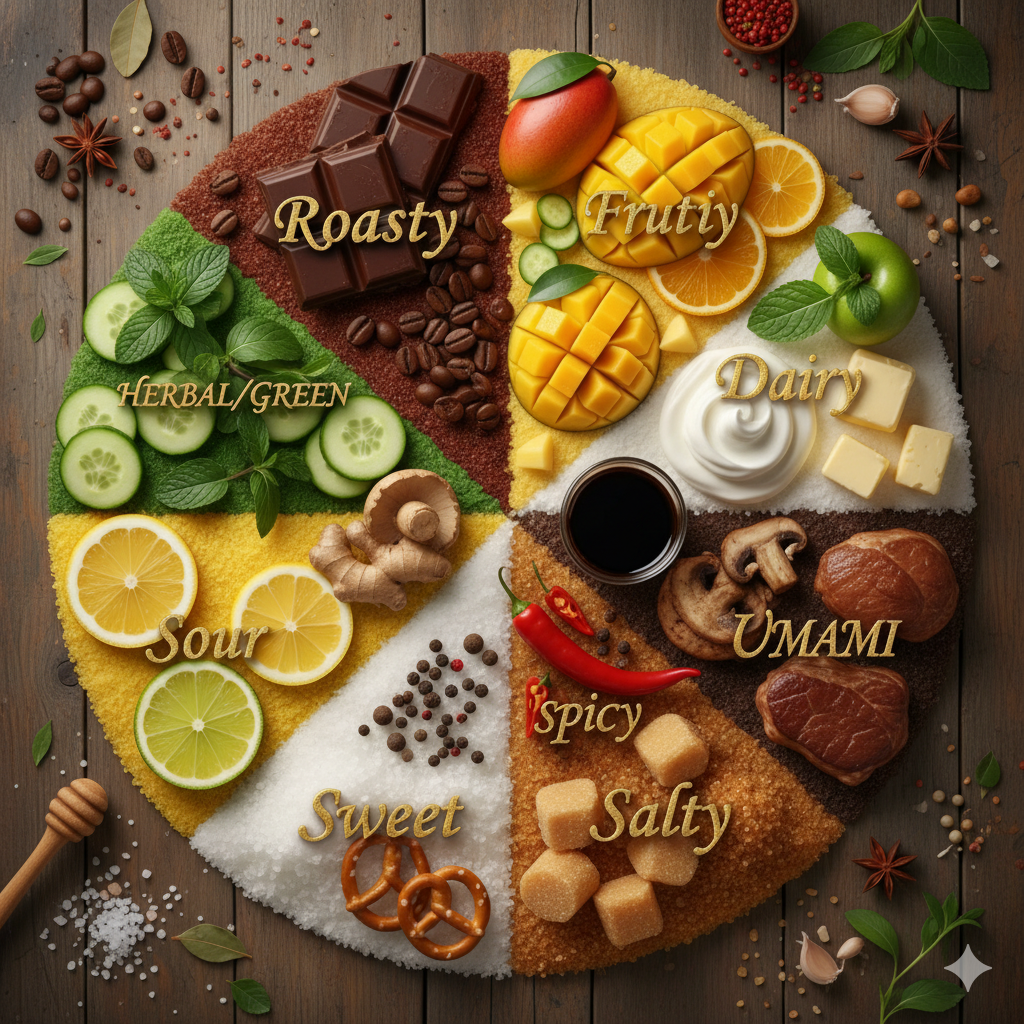
Here's a quick orientation to the wheel's primary sections — and the origins or processes most associated with each:
- Fruity: Berries, citrus, stone fruit, tropical. Most common in Ethiopian naturals and Kenyan washed coffees. The most celebrated and sought-after category in specialty coffee.
- Floral: Jasmine, rose, chamomile, lavender. Typically found in high-altitude light roasts, especially Ethiopian Yirgacheffe. Delicate and volatile — dissipates quickly as the cup cools.
- Sweet: Caramel, brown sugar, honey, molasses, vanilla. Common in medium-roast Colombian and Brazilian coffees. Often the dominant category in well-processed, freshly roasted specialty beans.
- Nutty/Cocoa: Chocolate, hazelnut, walnut, almond. Very common in Colombian and Brazilian medium-to-dark roasts. Some of the most accessible and widely enjoyed specialty notes.
- Spicy: Pepper, clove, anise, cinnamon. More common in Indonesian (Sumatran) coffees and certain dark roasts. Can also appear in anaerobic processed coffees.
- Roasted: Tobacco, cereal, burnt, smoky. The dominant category in dark roasts. When these notes are positive (toasted grain, dark chocolate), they're enjoyable; when negative (ashtray, rubber), they indicate poor roasting or very stale beans.
- Green/Vegetative: Fresh herb, grass, raw grain. Usually indicates under-developed roasting or beans that are too fresh (still heavily degassing). Occasionally desirable in very light roasts.
- Sour/Fermented: Includes both positive (wine-like, winey) and negative (vinegar, sour, acetic) attributes. Can be positive in naturally processed coffees; negative when indicating fermentation defects or under-extraction.
- Other: Chemical, papery, musty, medicinal — these are defect categories. Their presence indicates problems with the beans, processing, storage, or brewing rather than positive qualities to seek.
Criticisms and Limitations of the Flavor Wheel
Intellectual honesty requires acknowledging that the wheel, despite its value, has real limitations — some of which the specialty coffee community actively debates.
It's Culturally US-Centric
The Sensory Lexicon references are tied to specific commercial products — many of which are American brands (Nestlé Toll House chocolate chips, frozen Dole strawberries). These products are either unavailable or taste different in other countries, making precise calibration difficult for the global audience the SCA intends to serve. A barista in Colombia or Ethiopia may not have access to the exact reference products that define an attribute.
It Can Overwhelm Beginners
110 flavor attributes is a lot. Casually encountering the wheel for the first time can feel intimidating rather than inviting. The wheel works best as a tool you approach gradually — learning one section at a time rather than trying to memorize the whole thing before your next cup of coffee.
Flavor Perception Is Subjective
The wheel provides a shared vocabulary, but people genuinely perceive flavors differently due to genetics, cultural food experiences, taste receptor density, and smell sensitivity. What one taster calls "lemon," another may call "lime." What one perceives as "floral," another may describe as "perfume-y." The wheel normalizes communication but cannot eliminate the subjectivity of sensory perception.
It Doesn't Capture Everything
Body (mouthfeel), acidity character, sweetness intensity, and finish length are all critical components of a coffee's sensory experience that the wheel's flavor descriptors don't capture. The SCA's professional cupping form addresses these through separate scoring categories — the wheel is specifically a flavor and aroma tool, not a comprehensive quality assessment tool.
Why the Flavor Wheel Matters for Everyday Coffee Drinkers
You don't need to become a Q Grader to benefit from understanding the Coffee Flavor Wheel. Even a basic familiarity with its categories changes your relationship to coffee in practical ways:
- You understand coffee bag labels. When a bag says "notes of bergamot and dried cherry," you know where those descriptors come from and roughly what to expect in the cup — rather than wondering whether it's marketing fiction.
- You can communicate what you like. Instead of telling a barista or roaster "I want something good," you can say "I like coffees with chocolate and caramel notes, medium body, low acidity" — and get a recommendation that actually matches your preference.
- You start tasting more. The wheel gives you a framework that makes coffee tasting feel structured rather than random. Once you have vocabulary, your palate actively looks for attributes rather than passively receiving impressions.
- You make better purchasing decisions. Understanding which origins and processes produce which flavor profiles allows you to buy intelligently — choosing an Ethiopian natural for fruit and complexity, a Colombian washed for clean chocolate and balance, or a Brazilian for nutty sweetness.
Frequently Asked Questions
What is the coffee flavor wheel?
The Coffee Taster's Flavor Wheel is a circular visual tool developed by the Specialty Coffee Association (SCA) and World Coffee Research (WCR) that maps over 110 distinct flavors, aromas, and sensory attributes found in coffee. Organized in concentric rings from broad categories at the center to specific descriptors at the outer edge, it provides a standardized vocabulary for describing coffee that professionals and enthusiasts worldwide use to communicate about flavor precisely and consistently.
Who created the coffee flavor wheel?
The first version was created by Ted Lingle, then Executive Director of the SCAA, and published in 1995. The current version was released in 2016, developed collaboratively by the SCA, World Coffee Research (WCR), and sensory scientists at Kansas State University — the result of over 100 hours of research evaluating 105 coffee samples from 13 countries. It is the largest collaborative piece of coffee flavor research ever completed.
How many flavors are on the coffee flavor wheel?
The 2016 revised Coffee Taster's Flavor Wheel contains 110 flavor, aroma, and textural attributes. These range from broad categories like "fruity," "floral," and "roasted" in the center to highly specific descriptors like "blackberry," "jasmine," and "dark chocolate" at the outer edge. The exact count can vary slightly depending on how subcategories are counted.
How do you use the coffee flavor wheel?
Start at the center with broad impressions — does the coffee taste primarily fruity, roasted, sweet, or nutty? Then move outward ring by ring to refine your description — from "fruity" to "berry" to "blackberry." Use real food references alongside your tasting to calibrate your perceptions: smell blackberry jam when tasting a coffee described as having blackberry notes, or taste a piece of dark chocolate when exploring chocolate notes. Compare two different coffees side by side for the fastest palate development.
Where can I get the coffee flavor wheel?
The official Coffee Taster's Flavor Wheel is available as a printed poster through the SCA Store at sca.coffee. It is licensed under Creative Commons for non-commercial use, so educational blog posts and training materials can reproduce it with attribution. Low-resolution images are widely available online for reference purposes; for detailed study, the official poster is recommended.
The Bottom Line
The Coffee Flavor Wheel is the most important single tool in the specialty coffee industry — a shared language built on real science that allows everyone from professional Q Graders to curious home brewers to describe, communicate, and understand coffee flavor with precision.
You don't need to memorize all 110 attributes to benefit from it. Start with the nine broad center categories. Learn which origins produce which profiles. Use real food references to calibrate your perceptions. Taste two coffees side by side. Each cup you drink mindfully builds the sensory vocabulary that makes the wheel more useful over time.
The wheel becomes most meaningful when the coffee in your cup is worth analyzing. Specialty-grade single-origin coffee — particularly from origins known for complex, expressive profiles like Colombia's Antioquia or Ethiopia's Yirgacheffe — gives you more of the wheel to explore than commercial blends whose flavor profile rarely extends beyond "roasted" and "bitter." The wheel is a tool for navigating complexity. Find coffees with enough complexity to navigate, and the tool becomes genuinely rewarding.
If you'd like to read other articles similar to What Is the Coffee Flavor Wheel? How to Use It Like a Pro (Even as a Beginner) you can visit the category The Art and Science of Coffee: Guides, Reviews, and Expert Tips.
Does Coffee Affect Cortisol Levels? The Science Behind Caffeine and Your Stress Hormone

Is Coffee Good for Depression Risk? What the Research Actually Shows

Is Coffee Bad for Anxiety? What the Science Actually Shows
The 5 Elements of Coffee Tasting Every Coffee Lover Should Know
What Is Green Coffee? How Raw Beans Differ From Roasted — and What That Means for Your Health
How Is Coffee Decaffeinated? The 4 Methods Explained — Including the One You Should Avoid

What Is Coffee Degassing? Why Fresh Roasted Beans Release CO2 — and Why It Matters
What Is a Coffee Cooperative? How They Help Farmers — and Why They Matter for Your Cup
How Altitude Affects Coffee Flavor: Why High-Grown Coffee Tastes Different
Leave a Reply
Related post