

What Is the 80/20 Rule for Coffee? (It Means Three Different Things)
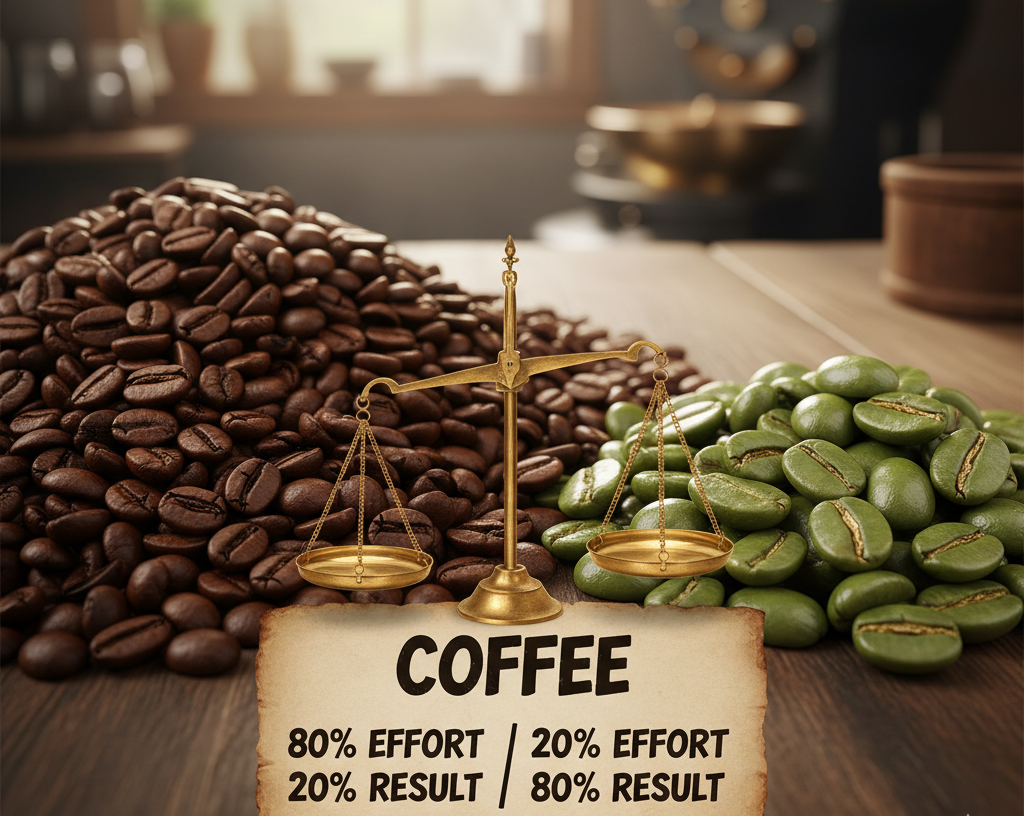
Search "80/20 rule for coffee" and you'll get different answers depending on who's writing. Some say it's about which brewing variables matter most. Some say it's an espresso blend ratio. Others apply it to business or lifestyle habits around coffee. They're all correct — and understanding all three versions gives you a more complete picture of how this simple principle applies to coffee than any single article typically provides.
Let's go through each one.
Table of contents
- What Is the 80/20 Rule (Pareto Principle) and How Does It Apply to Coffee?
- Version 1: The 80/20 Rule for Brewing Variables
- Version 2: The 80/20 Rule for Espresso Blends
- Version 3: The 80/20 Rule for Your Coffee Lifestyle
- Putting All Three Together: The 80/20 Coffee Mindset
- Applying the 80/20 Rule Practically: A Home Brewer's Checklist
- Frequently Asked Questions
- The Bottom Line
What Is the 80/20 Rule (Pareto Principle) and How Does It Apply to Coffee?
First, a quick grounding. The 80/20 rule — formally called the Pareto Principle — was developed by Italian economist Vilfredo Pareto at the University of Lausanne in 1896, when he observed that approximately 80% of Italy's land was owned by 20% of the population. Later adapted for business management by Joseph Juran in the 1940s, the principle has since been applied everywhere: 80% of a company's revenue comes from 20% of its customers; 80% of workplace accidents come from 20% of hazards; 80% of software bugs come from 20% of the code.
The core insight is that inputs and outputs are rarely distributed equally. A small number of causes tend to produce a disproportionately large share of the effects. Identifying and focusing on that critical 20% is more efficient than trying to optimize everything at once.
Applied to coffee, this principle shows up in three distinct and useful ways.
☕ Recommended by cocondo.coffee

Cocondo Orgánico — The only certified organic coffee from Antioquia, Colombia
Reserve Your Bag →Version 1: The 80/20 Rule for Brewing Variables
This is the most practically useful application of the rule for home brewers, and it comes from Matthew Perger — founder of Barista Hustle and 2012 World Barista Championship runner-up — who developed what he called the "80:20 Method" for coffee brewing.
Perger's observation: there are dozens of variables in coffee brewing — grind size, water temperature, dose, water quality, brew time, agitation, distribution, bloom time, ratio, filter type, and more. Obsessing over all of them simultaneously leads to analysis paralysis. Most home brewers never get a consistently good cup because they're adjusting too many things at once without understanding which variables actually move the needle.
His conclusion: roughly 80% of your coffee's quality is determined by 20% of the variables. Focus on those first and you'll be well above average. Everything else is fine-tuning.
The Critical 20% — Variables That Drive 80% of Cup Quality
1. Bean Quality and Freshness (The Biggest Single Factor)
No brewing technique, no matter how perfect, can compensate for poor or stale beans. This is the most important variable in the entire equation. Fresh, specialty-grade beans from a quality origin will produce a dramatically better cup with basic technique than stale commercial beans brewed with precision equipment.
The practical threshold: beans roasted within the past 5 to 21 days, stored properly in an airtight opaque container. If you only make one change to your coffee routine, make it this one. According to Perger and most professional baristas, bean quality and freshness alone account for the largest single contribution to cup quality.
2. Grind Size and Consistency
Grind size controls extraction rate. Too fine and you over-extract — producing harsh, astringent bitterness. Too coarse and you under-extract — producing weak, sour, underdeveloped coffee. Getting grind size right is the most direct lever you have over extraction.
Grind consistency matters equally. A burr grinder (whether hand or electric) produces a uniform particle size distribution. A blade grinder (the cheap spinning-blade type) produces inconsistent particles ranging from powder to chunks, which extract at wildly different rates simultaneously — producing a cup that's both over and under-extracted at the same time. The single best equipment investment most home brewers can make is upgrading from a blade grinder to a burr grinder. Even an entry-level burr grinder at $30 to $50 CAD produces dramatically more consistent results than a $20 blade grinder.
3. Water Quality and Temperature
Coffee is approximately 98% water. The quality of your water directly affects the quality of your cup — not subtly, but significantly. Chlorinated tap water imparts off-flavors. Water that's too hard (high mineral content) produces flat, chalky extraction. Water that's too soft under-extracts and tastes thin.
The Specialty Coffee Association recommends water with a Total Dissolved Solids (TDS) of 75 to 250 ppm and pH between 6 and 8 for optimal extraction. For most home brewers, filtered water (through a basic pitcher or tap filter) is sufficient to eliminate the worst offenders without needing lab-grade analysis.
Temperature is equally critical: the ideal range is 90 to 96°C (195 to 205°F). Water below this range under-extracts — producing sour, weak coffee. Water above it over-extracts — producing harsh, bitter coffee. If you don't have a temperature-controlled kettle, boiling water and waiting 30 to 60 seconds before pouring gets you close enough for most methods.
4. Coffee-to-Water Ratio
Using too little coffee produces a watery, under-extracted cup. Too much produces an overpowering, over-extracted one. The SCA's "Golden Ratio" baseline is approximately 1:15 to 1:17 (grams of coffee to grams of water) for most filter methods — roughly 60g of coffee per litre of water. Espresso uses a much tighter ratio, typically 1:2 (1g coffee to 2g espresso output).
Using a kitchen scale rather than eyeballing scoops is the simplest way to get this right consistently. A basic digital scale costs less than a bag of specialty coffee and eliminates one of the most common sources of inconsistency.
The Other 80% — Variables That Matter Less (Initially)
Once you have the critical 20% dialed in, these variables offer incremental improvements — but chasing them before the fundamentals are solid is where most home brewers waste their effort:
- Exact water TDS and mineral profile (important at competition level, marginal at home)
- Precise pour patterns and agitation techniques
- Pre-infusion timing to the second
- Filter paper brand and pre-rinsing technique
- Kettle gooseneck vs. standard spout
- Exact bloom duration beyond the 30-45 second range
- Brewing device brand (V60 vs Chemex vs Kalita Wave produce more similar results than their fans admit)
Perger's 80/20 method for finding the extraction sweet spot is elegantly simple. He calls it the "Lazy Barista Method" — keep everything else constant and adjust only one variable at a time:
- Cup tastes too bitter, harsh, or dry: Extract less → grind coarser, shorten brew time, or use less water
- Cup tastes too sour, weak, or watery: Extract more → grind finer, lengthen brew time, or use more water
- Cup tastes balanced, sweet, and clear: You've found your sweet spot — stop adjusting
This approach — focusing on the extraction sweet spot rather than chasing every minor variable — gets most home brewers to 80% of their coffee's potential remarkably quickly. The aim is to extract the coffee up to a point just before you get unpalatable dryness or bitterness — the sweetest spot, guaranteed every time.
Version 2: The 80/20 Rule for Espresso Blends
The second version of the 80/20 rule in coffee is specifically about espresso blend composition — and it refers to the classic Italian espresso blend ratio of 80% Arabica beans to 20% Robusta beans.
This is a deliberately engineered combination that takes advantage of the distinct properties of each species:
Why 80% Arabica?
Arabica (Coffea arabica) contains approximately 15 to 17% lipids and sugars, which produce the complex flavor notes — sweetness, acidity, fruit, floral, chocolate — that define quality espresso. Arabica is more aromatic, more nuanced, and generally considered higher quality. It's the flavor foundation of the blend.
Why 20% Robusta?
Robusta (Coffea canephora) contains roughly double the caffeine of Arabica and significantly more CO2 after roasting. Here's the critical function the 20% serves: 100% Arabica espresso often cannot produce the thick, stable, tiger-striped crema that defines traditional Italian espresso. Arabica's lower CO2 content and lower caffeine (which acts as a surfactant in crema formation) means the foam structure is weaker and dissipates quickly.
The 20% Robusta addition provides the CO2 and caffeine necessary to build a thick, lasting crema — and the higher caffeine content cuts through milk more effectively in cappuccinos and lattes. The Arabica provides the flavor complexity; the Robusta provides the structure and intensity.
This is why specialty coffee culture's blanket dismissal of Robusta as "cheap filler" is an oversimplification. In a properly engineered 80/20 blend using quality Robusta (washed, high-grade Indian or Vietnamese Robusta rather than commodity-grade beans), the combination produces something neither species achieves alone.
The practical application: if you're pulling espresso at home and struggling to get a thick, lasting crema from a 100% Arabica bean, the solution may be switching to an 80/20 Arabica-Robusta blend rather than obsessing over extraction parameters. The crema issue might be a species problem, not a technique problem.
Version 3: The 80/20 Rule for Your Coffee Lifestyle
The third version is less technical and more philosophical — but genuinely useful for people who want to enjoy coffee without turning it into an obsession.
Applied to daily habits and lifestyle: 80% of the time, drink your coffee clean and simple. 20% of the time, enjoy it however you want.
The logic: the health benefits of coffee — antioxidants, anti-inflammatory compounds, liver protection, brain health — are primarily present in black coffee or coffee with minimal additions. Every tablespoon of sugar, flavored syrup, or heavy cream you add changes the health and metabolic equation significantly.
But rigidity doesn't serve you either. Treating coffee as a health ritual that can never involve an occasional caramel latte or cream makes coffee into a stressful obligation rather than an enjoyable habit. The 80/20 lifestyle approach means:
- 80% of your cups: black or with a small amount of milk — capturing the full health benefits
- 20% of your cups: whatever you enjoy — a flavored drink, a sweetened latte, a dessert coffee — without guilt
This also applies to coffee spending. Some specialty coffee enthusiasts spend hundreds of dollars on equipment while buying mediocre beans. The 80/20 principle applied to your coffee budget says: invest in quality beans first, equipment second. Great beans brewed with basic equipment consistently outperform mediocre beans brewed with expensive equipment. Yet most people do it backwards — splurging on machines while buying cheap, stale supermarket coffee.
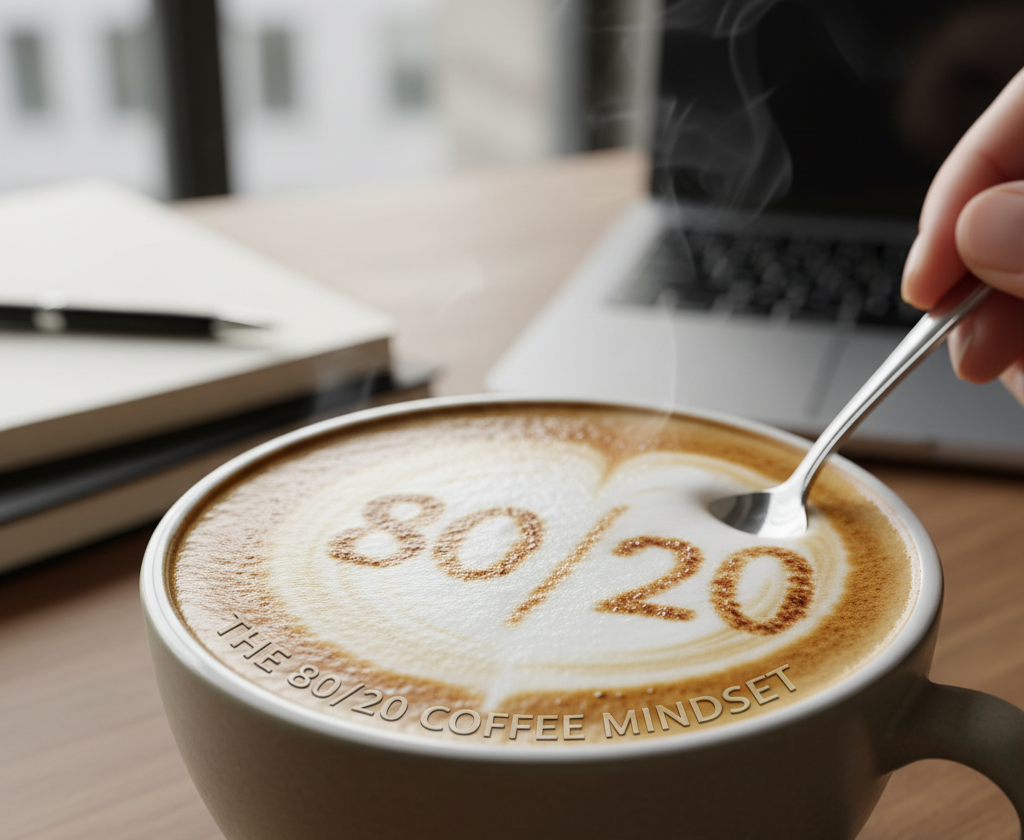
Putting All Three Together: The 80/20 Coffee Mindset
The three versions of the 80/20 rule in coffee actually form a coherent philosophy when combined:
- Focus on the variables that matter most (bean quality, grind consistency, water quality, ratio) and don't obsess over the rest until you've mastered these
- Understand blend engineering — 80% Arabica/20% Robusta exists for a reason, and knowing why makes you a smarter buyer
- Apply balance to your lifestyle — drink mostly clean, simple coffee for health benefits, allow yourself enjoyment without rigidity
The common thread across all three is the same insight Pareto first observed in 1896: not all inputs are created equal, and identifying the critical few that drive the most important outcomes is the most efficient path to improvement. In coffee as in everything else, chasing perfection across every variable simultaneously is the enemy of consistent progress.
Applying the 80/20 Rule Practically: A Home Brewer's Checklist
If you want to apply the 80/20 rule to immediately improve your coffee, work through this checklist in order. Each item offers significantly more return than the ones below it:
- ✅ Buy freshly roasted specialty beans with a visible roast date — within 5 to 21 days of today
- ✅ Upgrade to a burr grinder if you're using a blade grinder — even a basic hand grinder is a dramatic improvement
- ✅ Grind immediately before brewing — not in advance
- ✅ Use filtered water — not straight tap water
- ✅ Use a kitchen scale for consistent coffee-to-water ratio
- ✅ Control your water temperature — 90 to 96°C, not boiling
- ✅ Bloom your coffee if using a filter method — 30 to 45 seconds
- ⬜ Then and only then: start adjusting finer variables like pour pattern, agitation, and filter pre-rinsing
If you complete the first seven steps and you're still not happy with your cup — then you've earned the right to start obsessing over the finer details. Most people, applying only the first four or five steps, find that their coffee improves dramatically and they stop looking for the next variable to adjust.
Frequently Asked Questions
What is the 80/20 rule for coffee?
The 80/20 rule for coffee has three main interpretations. First, the Pareto Principle applied to brewing: 80% of your cup quality comes from 20% of the variables — specifically bean freshness, grind consistency, water quality, and ratio. Second, the classic Italian espresso blend ratio of 80% Arabica to 20% Robusta, engineered for crema stability and flavor balance. Third, a lifestyle approach: drink your coffee clean 80% of the time for maximum health benefits, and enjoy it however you like 20% of the time.
What are the most important variables in coffee brewing?
Based on the Pareto Principle applied to coffee by Barista Hustle's Matthew Perger, the variables that drive approximately 80% of cup quality are: bean quality and freshness (the single most impactful factor), grind size and consistency (burr vs. blade grinder matters enormously), water quality and temperature (90–96°C, filtered), and coffee-to-water ratio (approximately 1:15 to 1:17 for filter coffee). Everything else — pour pattern, agitation, exact bloom timing, filter brand — offers incremental improvement once these fundamentals are solid.
Why is espresso blend 80% Arabica and 20% Robusta?
The 80/20 Arabica-Robusta espresso blend is engineered for balance: Arabica provides complex flavor notes, sweetness, and aromatic complexity; Robusta provides CO2 for thick, stable crema formation, higher caffeine content (which acts as a surfactant in crema structure), and greater intensity when cutting through milk in cappuccinos and lattes. 100% Arabica espresso often struggles to produce the thick, tiger-striped crema of traditional Italian espresso — the 20% Robusta addition solves this structural problem without significantly compromising flavor quality when high-grade Robusta is used.
How do I use the 80/20 rule to improve my coffee at home?
Start with the variables that have the biggest impact and work down: buy fresh specialty beans (roasted within 5–21 days), upgrade to a burr grinder if you use a blade grinder, use filtered water at 90–96°C, and use a kitchen scale for consistent ratios. These four changes alone will produce more improvement than any combination of minor adjustments. Only after mastering these fundamentals should you start adjusting finer variables like pour pattern, agitation, and pre-infusion timing.
What is the coffee compass 80/20 method?
The Coffee Compass is a diagnostic tool developed by Barista Hustle to help brewers identify and fix extraction problems. Paired with the 80/20 method, it works as follows: if your coffee tastes bitter or astringent, extract less (coarser grind, shorter time, less water); if it tastes sour or weak, extract more (finer grind, longer time, more water); if it tastes balanced and sweet, you've found the sweet spot. The 80/20 method focuses on this extraction sweet spot as the primary target — find it, and you've achieved roughly 80% of the coffee's potential with minimal complexity.
The Bottom Line
The 80/20 rule is one of the most useful mental models you can apply to coffee — whether you're a new home brewer trying to stop wasting money on equipment you don't need, an espresso lover trying to understand why your crema keeps collapsing, or someone who just wants a practical framework for enjoying coffee without overthinking it.
Focus on the critical 20% first: bean quality, grind consistency, water, and ratio. Understand the engineering behind 80/20 espresso blends. Apply balance to your coffee lifestyle. Do those three things and you'll get more out of every cup — with less effort, less equipment, and less obsession — than the average coffee enthusiast who spends years chasing marginal variables without ever nailing the fundamentals.
And about that first critical 20% — bean quality: it genuinely is the most important variable in the equation. Freshly roasted, single-origin specialty coffee from a high-altitude farm with careful processing produces a cup that no amount of brewing technique can replicate with inferior beans. The quality of what goes into your grinder determines the ceiling of what can come out of your brewer. Start there, and the rest of the 80/20 improvements compound from a much higher baseline.
If you'd like to read other articles similar to What Is the 80/20 Rule for Coffee? (It Means Three Different Things) you can visit the category The Art and Science of Coffee: Guides, Reviews, and Expert Tips.
Does Coffee Affect Cortisol Levels? The Science Behind Caffeine and Your Stress Hormone

Is Coffee Good for Depression Risk? What the Research Actually Shows

Is Coffee Bad for Anxiety? What the Science Actually Shows
The 5 Elements of Coffee Tasting Every Coffee Lover Should Know
What Is Green Coffee? How Raw Beans Differ From Roasted — and What That Means for Your Health
How Is Coffee Decaffeinated? The 4 Methods Explained — Including the One You Should Avoid
What Is Coffee Degassing? Why Fresh Roasted Beans Release CO2 — and Why It Matters
What Is a Coffee Cooperative? How They Help Farmers — and Why They Matter for Your Cup
How Altitude Affects Coffee Flavor: Why High-Grown Coffee Tastes Different
Leave a Reply
Related post