
Why Does My Coffee Taste Sour? The Real Causes — and How to Fix Each One
Sour coffee is one of the most common brewing complaints — and one of the most reliably fixable. Unlike bitter coffee (which can come from many sources), sour coffee almost always points to one root cause: under-extraction. Understanding why under-extraction produces sourness, and what specifically causes it in your particular setup, gives you a clear path from a sharp, unpleasant cup to a balanced, sweet one.
Here's the complete picture — the chemistry, the causes, the diagnosis, and the exact fix for every brewing method.
Table of contents
- The First Thing to Understand: Sour ≠ Bitter (And Both ≠ Acidic)
- Why Under-Extraction Causes Sourness: The Chemistry
- The 6 Main Causes of Sour Coffee
- The Sour Coffee Diagnostic: Find Your Cause in 3 Steps
- Sour Coffee by Brewing Method: Specific Causes and Fixes
- The Sour-to-Sweet Spectrum: What to Taste For
- Is Sour Coffee Safe to Drink?
- Frequently Asked Questions
- The Bottom Line
The First Thing to Understand: Sour ≠ Bitter (And Both ≠ Acidic)
Before diagnosing your coffee, it's worth being precise about what you're actually tasting — because sour, bitter, and acidic are three distinct experiences that require completely different fixes.
Acidity (Good)
Acidity in coffee is a positive quality. It's the bright, lively, refreshing quality that makes specialty coffee feel alive — like the pleasant tartness of a ripe apple or a citrus fruit. Good acidity is structured, sweet-edged, and integrated. It enhances the cup rather than dominating it. Ethiopian and Kenyan coffees are celebrated partly for their acidity. This is not what you're trying to fix.
Sourness (Bad — What This Article Addresses)
Sourness is unbalanced, unpleasant sharpness. It feels harsh, hollow, and puckering — like biting into an unripe fruit or tasting vinegar. It dominates the cup rather than enhancing it. There's no sweetness to balance it, no complexity behind it. It often intensifies as the coffee cools. This is the problem sourness, and it's what this article is about.
☕ Recommended by cocondo.coffee
Cocondo Orgánico — The only certified organic coffee from Antioquia, Colombia
Reserve Your Bag →Bitterness (Different Problem)
Bitterness comes from over-extraction — the opposite of sourness. It's harsh, dry, and astringent, with a lingering aftertaste. The fix for bitterness is the exact opposite of the fix for sourness. If you're not sure which problem you have, ask: does the coffee taste sharp and thin with no sweetness (sourness/under-extraction) or harsh and drying with a heavy, lingering aftertaste (bitterness/over-extraction)? Getting this diagnosis right is the most important step.
Why Under-Extraction Causes Sourness: The Chemistry
Coffee compounds dissolve in water in a specific sequence — and this sequence is the key to understanding why sour coffee happens.
When hot water contacts coffee grounds, it begins extracting compounds in rough order of solubility:
- Acids first (0–18% extraction): Organic acids — citric acid, malic acid, acetic acid, and chlorogenic acids — are highly soluble and extract rapidly. They produce the bright, sharp, tart flavors.
- Sugars and sweet compounds (18–22% extraction): These take longer to dissolve — they're what balance the acids and produce the sweetness and caramel notes that make coffee enjoyable.
- Bitter compounds (22%+ extraction): Tannins, quinic acid, and other bitter phenolics dissolve last. These are what you want to avoid pulling too many of.
A 2024 study by Bratthäll et al. published in Heliyon confirmed that organic acids are polar and highly soluble — they extract in the early stages of brewing regardless of water composition. Sugars that would balance them remain locked in the grounds until extraction goes further.
The target extraction yield for balanced coffee is 18–22% by weight of the grounds (the SCA Golden Cup Standard). Under-extraction falls below 18%. At that level, the acids have been pulled but the balancing sugars haven't — so the cup tastes sharply sour with no sweetness to compensate.
The simple version: Your brew stopped too early. The acids came out. The sweetness didn't. Fix the extraction and the sourness goes away.
The 6 Main Causes of Sour Coffee
Cause 1: Grind Too Coarse (Most Common)
This is the most frequent cause of sour coffee across all brewing methods. When your grind is too coarse:
- Individual particles are large, with less surface area exposed to water
- Water flows through the grounds too quickly — especially in pour-over and espresso
- The brief contact time extracts the fast-dissolving acids but can't reach the slower-dissolving sugars
- Result: acid-dominant, thin, sour cup
This is why grind size is almost always the first variable to adjust when fixing sour coffee. Going finer increases surface area, slows water flow, and extends contact time — all of which push extraction further into the sweet zone.
The fix: Move your grinder one to two notches finer. Taste. Repeat in single-notch increments until the sourness resolves and sweetness appears. Don't adjust multiple variables simultaneously — you need to know which change made the difference.
Cause 2: Brew Time Too Short
Insufficient contact time between water and coffee is essentially the same problem as grind being too coarse — both result in under-extraction by ending the brew cycle before sugars can dissolve. But the mechanisms differ:
- French press: Plunging too early, not steeping long enough
- Pour-over: Pouring water too fast, total brew time under 2.5 minutes
- Espresso: Shot running too fast (under 20 seconds for a standard double)
- Drip machine: Machine brewing cycle shorter than optimal (usually a machine quality issue)
The fix: Extend contact time by the method appropriate to your brewing approach. For French press, add 30 to 60 seconds to your steep. For pour-over, slow your pour rate or grind finer (which slows drawdown). For espresso, grind finer to slow the shot. Target brew times: French press 4 minutes, pour-over 3 to 4 minutes total, espresso 25 to 30 seconds.
Cause 3: Water Temperature Too Low
Water temperature directly controls extraction efficiency. At the correct range (90–96°C / 195–205°F), water has sufficient thermal energy to dissolve sugars, aromatic compounds, and the body-building melanoidins that balance acids. Below 90°C, extraction becomes selective — primarily acids dissolve while sugars and heavier compounds resist.
Common temperature problems:
- Letting the kettle cool too long after boiling before pouring
- Not preheating your brewing vessel — a cold French press or pour-over dripper drops water temperature by 5 to 10°C on contact
- Cheap drip machines that never reach optimal temperature (a very common issue — most budget drip machines brew at 80–85°C)
- High altitude brewing — water boils at lower temperatures above sea level (at 2,000m, water boils at ~93°C rather than 100°C)
The fix: Use a temperature-controlled kettle if possible. If not, bring water to a full boil and wait exactly 30 seconds before pouring — this typically drops temperature to approximately 94–96°C. Preheat your brewing vessel by pouring a small amount of hot water through it and discarding before brewing. For drip machines, consider upgrading to an SCA-certified model that guarantees proper brewing temperature.
Cause 4: Under-Roasted or Poorly Developed Beans
This is a bean problem, not a brewing problem — and it's important to distinguish it because no amount of grind adjustment or temperature control can fix it.
During roasting, raw organic acids in the green bean are transformed through the Maillard reaction and caramelization into the sugars, aromatic compounds, and complex flavors that define good coffee. If roasting is cut short — or if the roast develops too quickly without enough time for the internal bean temperature to properly transform these compounds — the raw acids remain largely intact. They dissolve directly into your cup during brewing, producing a sharp, grassy, sour flavor that tastes almost fermented or vegetal rather than bright and fruity.
Signs your beans may be under-roasted or poorly developed:
- Sourness is present even with a properly fine grind, correct temperature, and adequate brew time
- The sourness has a grassy, hay-like, or fermented quality rather than a clean citric sharpness
- The beans look pale or uneven — lighter on one side, darker on another
- The roaster has no roast date or you have no way to verify development quality
The fix: Unfortunately, you can't fix under-developed beans through brewing. Buy from reputable specialty roasters who show a roast date and can speak to their roast development process. Avoid suspiciously cheap "specialty" coffee — proper roast development takes time, and that time costs money.
Cause 5: Ultra-Fresh Beans (Too Recently Roasted)
This surprises people: coffee roasted within the past 1 to 4 days can taste sour — not because anything is wrong with the beans, but because they're still actively degassing CO2. As discussed in the 15-15-15 rule and coffee bloom articles, freshly roasted beans release large amounts of CO2 that physically interfere with even water extraction. The escaping gas creates uneven extraction across the coffee bed, and the resulting cup can taste sharp, metallic, or sour even with perfect technique.
The fix: Wait. The optimal brewing window for most coffees is 5 to 21 days post-roast. If you just received a bag roasted 2 days ago, give it until day 5 to 7. The sourness will often resolve on its own without any brewing adjustment.
Cause 6: Wrong Coffee-to-Water Ratio (Too Much Water)
Using too little coffee for the amount of water — or too much water for the amount of coffee — dilutes the extraction and weakens the body that balances acidity. The acids are extracted but there's insufficient sweetness and body to counterbalance them. The result is a watery, sour cup that lacks substance.
Target ratios by method:
- Pour-over / drip: 1:15 to 1:17 (grams of coffee to grams of water)
- French press: 1:15 to 1:17
- Espresso: 1:2 to 1:2.5 (dose to yield — 18g in, 36–45g out)
- Cold brew concentrate: 1:4 to 1:5
- AeroPress: 1:10 to 1:15 (flexible by recipe)
The fix: Use a kitchen scale and weigh both your coffee and water. Volumetric scoops are inconsistent — the same scoop can vary by 20% depending on grind size and how the grounds settle. A $10 digital scale eliminates ratio inconsistency entirely.
The Sour Coffee Diagnostic: Find Your Cause in 3 Steps
Rather than guessing, use this systematic approach:
- Check your beans first. Look for a roast date. Beans roasted 1 to 4 days ago → wait. Beans with no roast date, or roasted more than 6 weeks ago → replace. Beans that smell grassy or hay-like rather than roasty and complex → likely under-developed, replace.
- Check your ratio. Are you measuring by weight? If you're using scoops, switch to a scale. Verify your coffee-to-water ratio matches the target for your method.
- Adjust extraction. If beans and ratio are correct, the sourness is an extraction problem. Start with grind size — go one to two notches finer and retaste. If sourness reduces but doesn't fully resolve, also check water temperature (should be 90–96°C) and brew time (should match method-specific targets).
Change one variable at a time. If you adjust grind, temperature, and brew time simultaneously, you can't know which change fixed the problem — and you'll have trouble reproducing the result consistently.
Sour Coffee by Brewing Method: Specific Causes and Fixes
Espresso
What sour espresso feels like: Sharp, thin, lemony or green-apple quality. Lacks sweetness and body. Often tastes hollow or unfinished. May feel puckering. Shot typically ran too fast — under 20 seconds for a standard double.
Most common causes: Grind too coarse (shot runs fast), tamping too light (creates channels where water flows through without full contact), dose too low, water temperature too low, beans too fresh (1 to 4 days post-roast).
Systematic fix order:
- Stabilize your dose first (18 to 20g for a double) — don't change this during troubleshooting
- Go finer on the grind — in small increments, taste after each adjustment
- Target a 25 to 30 second extraction time for a 36 to 40g yield
- If grind alone doesn't fix it, raise brew temperature by 1°C increments
- Ensure even tamping — uneven pressure creates channels where water bypasses grounds, causing simultaneous over and under-extraction
Pour-Over (V60, Chemex, Kalita)
What sour pour-over feels like: Bright but unpleasant tartness, thin body, no sweetness, sharp finish. Total brew time likely under 2.5 minutes.
Most common causes: Grind too coarse (water drains too fast), water temperature too low, bloom too short (CO2 interference causes uneven extraction), pouring too fast.
Systematic fix order:
- Check total brew time — target 3 to 4 minutes. If drawing down in under 2.5 minutes, grind finer
- Ensure proper bloom — 30 to 45 seconds with 2x the coffee weight in water. Skipping bloom causes uneven extraction
- Verify water temperature is 90–96°C (not straight from the boil)
- Slow your pour rate — a gooseneck kettle gives you the control needed to maintain consistent flow speed
French Press
What sour French press feels like: Thin, sharp, lacks the full body French press is known for. Usually caused by too-short steeping time or insufficient water temperature.
Most common causes: Steep time too short (plunging before 4 minutes), water temperature too low (cold French press drops temperature on contact), grind too fine for the method.
Systematic fix order:
- Preheat your French press by filling it with hot water, waiting 30 seconds, discarding, then brewing. This prevents 5–10°C temperature loss on contact
- Use a 4-minute steep minimum — set a timer, don't estimate
- If sourness persists after 4 minutes at proper temperature, try 4.5 to 5 minutes
- Check grind — French press uses coarse grind, but "coarse" means different things on different grinders. Aim for a texture like coarse sea salt or breadcrumbs
Drip Machine
What sour drip coffee feels like: Consistently thin and sour regardless of adjustments — often a machine temperature issue rather than a user technique issue.
Most common causes: Machine not reaching 90°C (most common cause in budget drip machines), grind too coarse for the basket design, stale or pre-ground coffee.
Systematic fix order:
- Check if your machine is SCA-certified — most budget machines brew at 80–85°C, which is below the extraction threshold for balanced coffee. If your machine is under-temperature, grind adjustments have limited effect
- Use freshly ground coffee at medium grind — pre-ground commercial coffee compounds machine limitations
- Consider upgrading to an SCA-certified drip brewer if temperature is the confirmed issue
AeroPress
What sour AeroPress feels like: Sharp, thin, underdeveloped — lacks the smooth, concentrated quality AeroPress can produce.
Most common causes: Steep time too short, plunging too fast (extending total contact time below the sweet zone), grind too coarse for chosen recipe.
Fix: Use a medium-fine grind and steep for at least 1 to 2 minutes before pressing. Plunge slowly and steadily over 20 to 30 seconds. AeroPress is one of the most forgiving methods — small grind adjustments produce rapid flavor improvements.
Cold Brew
What sour cold brew feels like: Unusual for properly made cold brew (the cold water naturally extracts fewer acids), but can happen with too short a steep time or overly fresh beans.
Most common causes: Steeped fewer than 12 hours, beans too fresh, grind too coarse for desired steep time.
Fix: Steep for at least 16 hours (for concentrate ratios). If beans are roasted within the past 5 days, give them another few days before using for cold brew. For shorter steep times, grind slightly finer.
The Sour-to-Sweet Spectrum: What to Taste For
As you adjust your extraction, here's what the flavor transitions feel like:
- Very under-extracted: Sharp, hollow, puckering sourness. Grassy or fermented quality. No body, no sweetness, no finish.
- Under-extracted: Sour and thin. Some flavor complexity appearing but no balance. Acidity is present but unpleasant.
- Approaching sweet spot: Sourness fading. Sweetness starting to emerge. The cup tastes more complete. Acidity is now bright rather than harsh.
- In the sweet spot (18–22% extraction): Balanced sweetness and acidity. Body is present. Finish is clean and pleasant. The coffee tastes like what it's supposed to taste like.
- Approaching over-extraction: Sweetness starting to decline. Bitterness beginning to appear. Body becoming heavier.
- Over-extracted: Bitter, dry, harsh. Astringent finish. Sweetness is gone.
The target zone is clearly identifiable once you know what to taste for. You're looking for the cup where sourness has resolved and sweetness has appeared — but bitterness hasn't yet arrived.
Is Sour Coffee Safe to Drink?
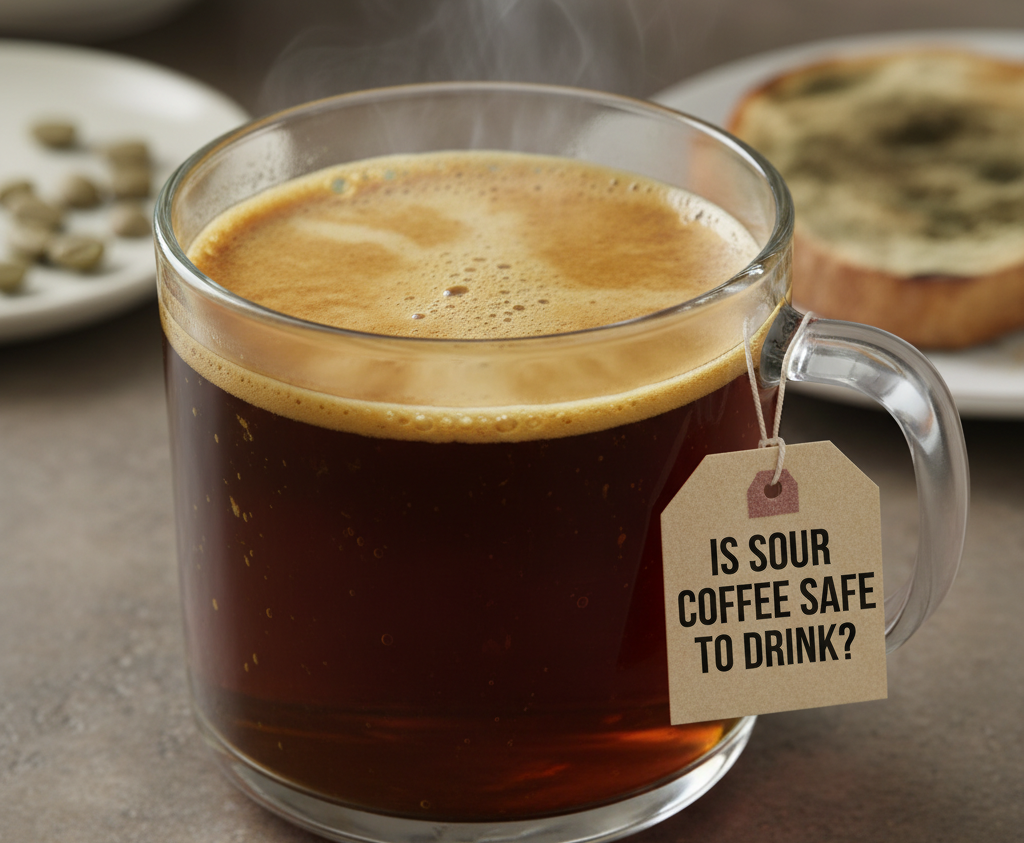
Yes — sour coffee is unpleasant but not harmful. Under-extracted coffee simply has an imbalanced flavor profile; it hasn't spoiled and contains no harmful compounds. The exception: if your coffee tastes sour AND smells musty, mold-like, or distinctly "off" — that may indicate a storage or bean quality problem rather than an extraction issue. In that case, the beans themselves may be the problem and should be replaced.
Frequently Asked Questions
Why does my coffee taste sour?
Sour coffee almost always means under-extraction — the brew stopped before enough sweetness dissolved to balance the naturally-extracted acids. The most common causes are a grind that's too coarse, water temperature below 90°C, brew time too short, or a coffee-to-water ratio that's too weak. Beans that are under-roasted, too freshly roasted (within 1 to 4 days), or stale can also produce sourness regardless of technique. Start by adjusting grind size one notch finer and retasting.
Why does my espresso taste sour?
Sour espresso is almost always under-extraction caused by a shot running too fast. A shot that finishes in under 20 seconds hasn't spent enough time extracting sweetness. Grind finer to slow the shot — target 25 to 30 seconds for a standard double (18g in, 36–40g out). Also verify water temperature (should be 92–96°C) and tamping consistency (uneven tamping creates channels that bypass grounds).
Why does my coffee taste sour but not bitter?
Sourness without bitterness confirms under-extraction — you've extracted the early-stage acids but haven't reached the middle stage where sweetness extracts or the late stage where bitterness extracts. This is the most common and most fixable extraction problem. Grind finer, extend brew time, or raise water temperature to push extraction further into the balanced zone.
Is sour coffee the same as acidic coffee?
No — these are importantly different. Acidity is a positive quality in specialty coffee: the bright, lively, refreshing quality from organic acids like citric and malic acid. Good acidity feels structured and sweet-edged. Sourness is unpleasant: sharp, hollow, puckering, with no sweetness to balance it. Sourness is what happens when those same acids dominate the cup without the balancing sugars and body that proper extraction provides. If your Ethiopian coffee tastes "bright and citrusy," that's acidity. If it tastes "sharp and unpleasant with no body," that's sourness from under-extraction.
Can stale beans cause sour coffee?
Yes — but in a different way than under-extraction. Stale beans have lost their sweetness through oxidation, meaning even properly extracted coffee from stale beans tastes flat, thin, and sour because there's little sweetness left in the bean to extract. The fix is fresh beans, not extraction adjustment. Check for a roast date and aim for beans roasted within the past 5 to 21 days.
Why does my light roast coffee taste sour?
Light roasts have naturally higher acidity than dark roasts — this is intentional and desirable in specialty coffee. However, light roasts are also denser beans that require slightly higher extraction temperatures and finer grinds than dark roasts to extract properly. If your light roast tastes sourly unpleasant rather than brightly fruity, you're likely under-extracting. Try water at 93–96°C (slightly higher than for medium-dark roasts) and grind a notch finer than you would for medium roast.
The Bottom Line
Sour coffee has one root cause — under-extraction — and a clear, systematic path to fixing it. Start with grind size (go finer), then verify water temperature (90–96°C), then check brew time (method-specific targets), then confirm ratio (1:15 to 1:17 for most filter methods). Change one variable at a time and taste after each adjustment.
The distinction that matters most: sourness is an extraction problem, not a bean problem — unless your beans are under-roasted, too fresh, or severely stale. In those cases, no brewing adjustment compensates for what's chemically absent in the bean itself.
And that's the deeper lesson: sourness problems get easier to solve when you start with quality beans. Freshly roasted, properly developed specialty coffee — with its full complement of sugars, acids, and aromatic compounds intact — responds predictably to extraction adjustments. When the sweetness is there to be extracted, you just need to find the right conditions to extract it. Single-origin Colombian coffee from high-altitude farms like those in Antioquia, with naturally developed sweetness and balanced acidity, is one of the most forgiving origins for home brewers learning to dial in their extraction — complex enough to be rewarding, balanced enough to be approachable.
If you'd like to read other articles similar to Why Does My Coffee Taste Sour? The Real Causes — and How to Fix Each One you can visit the category The Art and Science of Coffee: Guides, Reviews, and Expert Tips.
Does Coffee Affect Cortisol Levels? The Science Behind Caffeine and Your Stress Hormone

Is Coffee Good for Depression Risk? What the Research Actually Shows

Is Coffee Bad for Anxiety? What the Science Actually Shows
The 5 Elements of Coffee Tasting Every Coffee Lover Should Know
What Is Green Coffee? How Raw Beans Differ From Roasted — and What That Means for Your Health
How Is Coffee Decaffeinated? The 4 Methods Explained — Including the One You Should Avoid
What Is Coffee Degassing? Why Fresh Roasted Beans Release CO2 — and Why It Matters
What Is a Coffee Cooperative? How They Help Farmers — and Why They Matter for Your Cup
How Altitude Affects Coffee Flavor: Why High-Grown Coffee Tastes Different
Leave a Reply
Related post