

Coffee Varietals Explained: What They Are and Why They Matter for What's in Your Cup
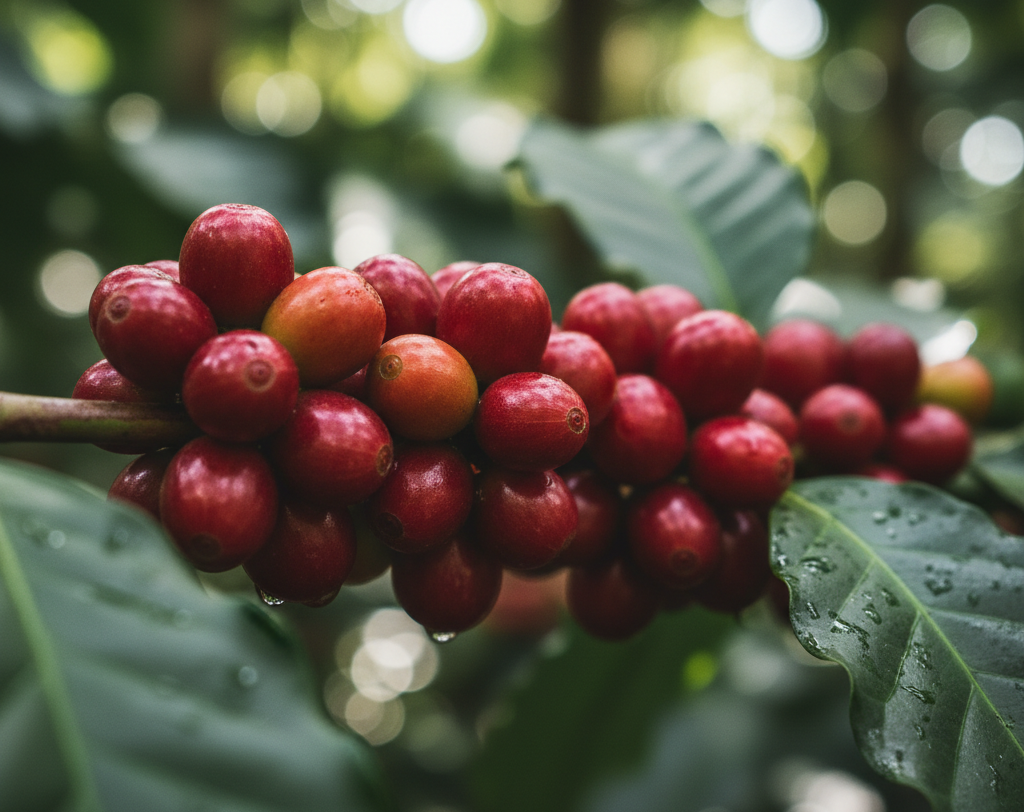
You've probably noticed coffee bag labels mentioning names like "Bourbon," "Caturra," or "Gesha" alongside origin information. These aren't farm names or processing methods — they're the genetic identity of the coffee plant itself. And just like wine grapes (Cabernet Sauvignon vs Pinot Noir) or apple varieties (Fuji vs Granny Smith), different coffee varietals produce dramatically different flavor experiences even when grown in the same soil, at the same altitude, and processed the same way.
Understanding coffee varietals is one of the most direct paths to understanding why your cup tastes the way it does — and how to navigate toward the flavors you love.
Table of contents
- What Is a Coffee Varietal?
- The Family Tree: How Almost All Coffee Comes from Two Plants
- The Major Coffee Varietals: A Complete Guide
- The Varietal-Terroir Interaction: Why the Same Varietal Tastes Different Everywhere
- Varietal Selection: What It Means for Farmers
- How to Use Varietal Information When Buying Coffee
- Frequently Asked Questions
- The Bottom Line
What Is a Coffee Varietal?
A coffee varietal (also called a coffee variety or cultivar) is a specific genetic type within the Coffea arabica or Coffea canephora (Robusta) species. Varietals have distinct characteristics — flavor compounds, plant structure, cherry size, altitude adaptability, yield, and disease resistance — that come from their genetic makeup and interact with their growing environment.
Think of it like this: all Arabica coffee is the same species, just as all wine grapes belong to the Vitis vinifera species. But the difference between a glass of Cabernet Sauvignon and a glass of Pinot Noir is dramatic — different flavors, different aromas, different textures — because they're different varietals of the same species. Coffee works exactly the same way.
The precise number of different coffee varietals globally is unknown. Ethiopia alone has more than 10,000 identified and distinguishable varieties collected and documented — and likely many more not yet catalogued. Most of the world's commercially important coffee varietals, however, descend from just two foundational plants.
☕ Recommended by cocondo.coffee

Cocondo Orgánico — The only certified organic coffee from Antioquia, Colombia
Reserve Your Bag →The Family Tree: How Almost All Coffee Comes from Two Plants
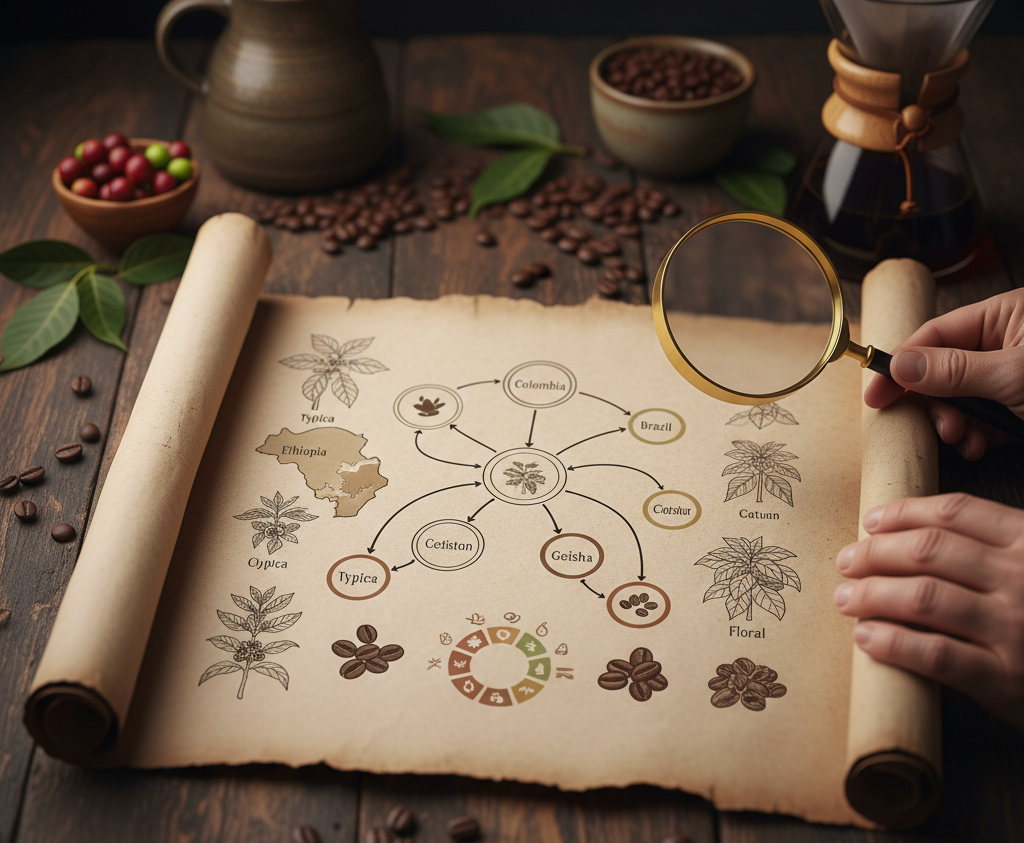
Here's a remarkable fact that most coffee drinkers don't know: virtually every coffee varietal you'll encounter traces its genetic lineage back to just two ancestors — Typica and Bourbon.
The story begins in Ethiopia, where Coffea arabica evolved naturally over thousands of years. Coffee was first cultivated in Yemen in the 15th century, and the plants taken from Ethiopia to Yemen were the seeds of all subsequent cultivation. From Yemen, coffee spread to the rest of the world through two main genetic lineages:
- Typica lineage: Coffee brought to India (1600s), then to the Dutch colonies in Java (1690s), then to Amsterdam's botanical garden, then to Martinique (1720), and from there throughout the Americas. Typica became the foundational variety of most Latin American coffee.
- Bourbon lineage: French missionaries brought coffee to the island of Bourbon (now Réunion) off Madagascar in the early 1700s. This population evolved separately from Typica for over 150 years, developing distinct genetic characteristics. In the 19th century, Bourbon was introduced to East Africa and the Americas.
From these two ancestral lines — and their crosses, mutations, and hybrids with each other and with local wild coffee populations — virtually the entire modern coffee varietal landscape was born.
Understanding this family tree explains something that initially seems puzzling: why a Bourbon from Colombia tastes different from a Bourbon from Rwanda, and why a Caturra (a Bourbon mutation) tastes different from both. Genetics is one layer. Terroir is another. They interact to produce the specific cup in your hand.
The Major Coffee Varietals: A Complete Guide
Typica — The Original
Origin: The foundational Arabica varietal, originating in Ethiopia and Yemen, brought to Latin America through Dutch colonial trade routes in the early 1700s.
Plant characteristics: Tall, conical-shaped plant with large leaves. Low to moderate yield. Long spaces between branches. Susceptible to most major coffee diseases including coffee leaf rust.
Altitude range: Best above 1,200 masl. Adapts well to cold, high-altitude conditions.
Flavor profile: Clean and balanced with high natural sweetness. Notes of dried fruit, stone fruit (black cherry, plum), and delicate florals. Mild, refined acidity. Lower production makes it rarer and often more expensive.
Where you'll find it: Jamaica Blue Mountain, Kona (Hawaii), Peru, parts of Mexico and Central America. Less common in modern commercial production due to low yield — most Typica has been replaced by more productive mutations.
Why it matters: Typica is the genetic root of most coffee. Understanding it sets the baseline — other varietals are departures from, or improvements on, Typica's fundamental character.
Bourbon — Sweet Complexity
Origin: A natural mutation of Typica that evolved separately on the island of Bourbon (Réunion) for over 150 years before being reintroduced to the mainland. Genetic testing confirms Typica and Bourbon were the two main seeds taken from Ethiopia to Yemen — making Bourbon an ancient genetic cousin rather than a recent mutation.
Plant characteristics: Tall, bushy plant. Approximately 30% more productive than Typica. Round cherries that ripen to red or yellow (Yellow Bourbon is a distinct sub-variety). Susceptible to disease but produces exceptional cup quality.
Altitude range: 1,000–2,000 masl. Grows well across a broad altitude range.
Flavor profile: Brown sugar sweetness, fruit notes of cherry and peach, round and complex body. Considered one of the most balanced and enjoyable flavor profiles in coffee — neither aggressively acidic nor flat. The "reference point" that many other varietals are compared to.
Where you'll find it: Colombia, Central America, East Africa (Rwanda and Burundi are particularly celebrated for their Bourbon), Brazil. One of the most widely grown specialty varietals globally.
Why it matters: Bourbon is the parent of Caturra, Catuai, Pacas, and many other important varietals. Its sweetness and balance make it a standard of quality that the specialty coffee world returns to repeatedly.
Caturra — The Productive Workhorse
Origin: A natural dwarf mutation of Bourbon, first identified near the town of Caturra in Minas Gerais, Brazil. Compact size and much higher productivity than Bourbon made it attractive to farmers.
Plant characteristics: Short and bushy — significantly more compact than Bourbon or Typica. Dense secondary branching. Large leaves with wavy borders. High yield. Available in red and yellow cherry sub-varieties.
Altitude range: Adaptable, but best quality above 1,200 masl.
Flavor profile: Similar to Bourbon but brighter and more acidic — less sweetness and body, more brightness and citrus. Citrus notes, good acidity, medium body. Clean cup. At high altitudes, Caturra can be exceptional; at lower altitudes, it can taste flat.
Where you'll find it: Colombia (one of the most widely grown varietals), Costa Rica, Nicaragua, Guatemala, Brazil. Extremely common in specialty coffee.
Why it matters: Caturra represents the trade-off between cup quality and farm practicality. It's smaller than Bourbon, easier to harvest, and more productive — but sacrifices some of Bourbon's sweetness and body. Most Colombian specialty coffee you've ever had has a significant Caturra component.
Castillo — Colombia's Disease-Resistant Hybrid
Origin: Developed by Colombia's national coffee research center Cenicafé specifically to combine good cup quality with resistance to coffee leaf rust (la roya) — the fungal disease that devastated Colombian coffee production in the 1980s and 2000s. Released in 2005 after decades of breeding work.
Plant characteristics: Compact, disease-resistant, high-yielding. Available in multiple regional sub-varieties (Castillo El Tambo, Castillo Naranjal, etc.) each adapted to specific Colombian microclimates.
Flavor profile: Clean, balanced, versatile. Chocolate, caramel, and mild citrus notes. Less complex than Bourbon at its best, but consistent and reliable. When grown at high altitude with careful processing, Castillo can produce exceptional specialty cups.
Where you'll find it: Colombia — it's now one of the most widely planted varietals in the country, particularly in regions affected by coffee leaf rust outbreaks.
Why it matters: Castillo is the practical backbone of Colombian coffee production. Its disease resistance has allowed hundreds of thousands of Colombian smallholder farmers to maintain productive farms despite recurring rust outbreaks. It's a reminder that varietal selection involves trade-offs: pure cup quality vs. agricultural viability.
Tabi — Colombia's New Classic
Origin: Another Cenicafé development, released in 2002. A triple hybrid of Typica, Bourbon, and the Timor Hybrid (a natural Arabica-Robusta hybrid that contributed disease resistance genes).
Plant characteristics: Tall, more similar to Typica and Bourbon than to compact modern hybrids. Better disease resistance than pure Bourbon or Typica. Moderate yield.
Flavor profile: Considered to have Bourbon-like sweetness with additional complexity from its diverse genetic background. Stone fruit, chocolate, mild florals. Many Colombian specialty producers regard Tabi as one of the most promising varietals for achieving both cup quality and agronomic sustainability.
Where you'll find it: Colombia, increasingly in specialty lots from innovative producers in Antioquia, Huila, and Cauca.
Why it matters: Tabi represents the direction Colombian coffee breeding is moving — trying to recover the cup quality of Typica and Bourbon while maintaining enough disease resistance and productivity for modern farming realities.
Catuai — Brazil's Hybrid Workhorse
Origin: A cross between Mundo Novo (itself a natural Typica-Bourbon hybrid) and Caturra, bred by the Instituto Agronômico de Campinas (IAC) in São Paulo, Brazil. Released in the 1950s–60s.
Plant characteristics: Compact, very high-yielding, adaptable. Available in Red Catuai and Yellow Catuai sub-varieties. One of the most productive commercial coffee varietals.
Flavor profile: Brown sugar sweetness with nutty, chocolatey character. Pastry-like, mild cooked fruit. Moderate acidity. Accessible and approachable — the foundation of many Brazilian specialty coffees.
Where you'll find it: Brazil (dominant variety), Central America, particularly Honduras.
Gesha / Geisha — The World's Most Celebrated Varietal
Origin: Originally collected from the Gori Gesha forest in southwestern Ethiopia in the 1930s by British botanists. Distributed to Tanzania, Costa Rica, and other Central American countries in the 1950s and 1960s. Largely ignored for decades due to low yield and brittle branches — until a lot from Hacienda La Esmeralda in Panama's Boquete region won the 2004 Best of Panama competition and shattered every expectation of what coffee could taste like.
Plant characteristics: Tall, with distinctive umbrella-shaped top. Long distances between branches, thin trunk. Very low yield — produces a fraction of what Bourbon or Caturra produces per tree. Brittle branches. Susceptible to wind damage. Difficult and expensive to grow.
Altitude range: Best above 1,500 masl. Expresses its most distinctive character at the highest altitudes.
Flavor profile: Intensely floral — jasmine, bergamot, and rose notes that can be overwhelming in their beauty. Tea-like delicacy. Tropical fruit (mango, passion fruit, peach). Incredibly complex, often described as unlike any other coffee. When experienced at its best, it genuinely stops people in their tracks.
Where you'll find it: Panama (the global benchmark — particularly Hacienda La Esmeralda and other Boquete producers), Ethiopia (original wild population), Colombia (Cauca and Nariño are producing outstanding Gesha lots), Costa Rica, Guatemala.
Price context: A honey-processed Gesha from Elida Estate in Panama set an auction record of $13,518 USD per kilogram in 2024. In 2025, a Panama Gesha lot from Hacienda La Esmeralda sold for $30,204 USD per kilogram at the Best of Panama auction — the highest price ever paid for green coffee at auction. Brewed cups of Gesha at high-end specialty cafés can cost $30 to $75 USD.
Why it matters: Gesha redefined what the specialty coffee industry understood to be possible in a cup. Its commercial success demonstrated that exceptional genetics, grown at the right altitude with the right care, could command prices that made quality-focused farming financially viable — transforming how producers worldwide think about varietal selection.
SL-28 and SL-34 — Kenya's Classics
Origin: Developed by Scott Agricultural Laboratories (hence "SL") in Kenya in the 1930s. SL-28 was selected from a Tanganyika drought-resistant variety; SL-34 was selected from a variety of uncertain origin found in Kabete, Kenya. Both were selected specifically for yield and adaptability to Kenyan conditions.
Plant characteristics: SL-28 is particularly drought-resistant. Both varieties are tall-growing with large leaves. SL-34 is more productive than SL-28 but considered slightly less distinctive in cup quality.
Altitude range: Best at 1,500–2,200 masl in Kenya's growing regions.
Flavor profile: The most immediately distinctive coffee varietal profile — intense blackcurrant, grapefruit, tomato-adjacent acidity, syrupy body, wine-like complexity. Particularly prominent in SL-28. There are 60 to 80-year-old SL-28 trees in Kenya that are still productive and producing remarkable cups.
Where you'll find it: Kenya almost exclusively. Some SL-28 has been planted experimentally in other origins (Panama, Colombia, El Salvador) with mixed results — the Kenyan terroir appears essential to the full expression of its distinctive profile.
Pink Bourbon — The Important Misconception
Origin: Despite the name, Pink Bourbon is not actually in the Bourbon family. It's an African heirloom varietal — genetic testing has confirmed its Ethiopian origins, not a Bourbon mutation. The pink cherry color (somewhere between red and yellow) gave it the "Bourbon" label that stuck despite being botanically misleading.
Where you'll find it: Colombia — particularly Huila and Cauca, where it has become one of the most sought-after specialty lots. Some Ethiopian origins.
Flavor profile: Remarkably complex — typically described as tropical fruit, stone fruit, florals, and honey sweetness simultaneously. Very high potential cup quality when grown at altitude with careful processing. Competitive coffees from Colombia featuring Pink Bourbon have consistently won Cup of Excellence competitions.
Why it matters: Pink Bourbon is one of the specialty coffee world's great recent discoveries — a varietal that was almost unknown outside Colombia until the mid-2010s and is now one of the most coveted in global specialty markets. Its story also illustrates the ongoing genetic detective work in coffee: names mislead, and understanding what's actually in the plant requires proper botanical analysis.
Heirloom — Ethiopia's Living Archive
What it means: "Heirloom" or "Ethiopian Heirloom" isn't a single varietal — it's a collective term used when the specific variety of an Ethiopian coffee isn't known or when a coffee contains a mix of Ethiopia's native wild and semi-wild varieties.
Why it exists: Ethiopia has over 10,000 identified coffee varieties, many of which have never been formally catalogued or named. When a cooperative harvests coffee from smallholder farms that each grow their own local population of wild or semi-wild trees — all different — calling it "Heirloom" acknowledges the genetic diversity rather than misrepresenting it as a single named variety.
Flavor implication: Ethiopian Heirloom coffees are often extraordinarily complex precisely because they contain multiple genetic profiles contributing simultaneously to the cup. The jasmine-and-blueberry profile of a Yirgacheffe natural may involve dozens of distinct native varieties whose individual contributions are impossible to separate.
Maragogipe — The Elephant Bean
Origin: A natural mutation of Typica with exceptionally large beans (up to 3x the size of normal coffee beans), first discovered near the city of Maragogipe in Bahia, Brazil.
Flavor profile: Light-bodied, delicate, low acidity. Mild, sweet, somewhat floral. The large bean size means slower, more uniform roasting — the size is more striking than the flavor is exceptional.
Where you'll find it: Brazil, Mexico, Guatemala, Nicaragua. Increasingly rare as low yield makes it commercially challenging.
The Varietal-Terroir Interaction: Why the Same Varietal Tastes Different Everywhere
One of the most important things to understand about coffee varietals is that genetics alone doesn't determine flavor. The interaction between the varietal's genetic potential and the growing environment — altitude, soil, climate, shade coverage, processing — determines the actual cup profile.
A Bourbon grown in Rwanda at 1,800 masl on volcanic soil with shade canopy tastes different from a Bourbon grown in Colombia at 1,400 masl in open sun on clay-loam soil — even though they're the same varietal. The varietal sets the potential; the terroir determines how much of that potential is realized and in which direction.
This is why serious coffee buyers don't just look at the origin or just at the varietal — they look at the combination. A high-altitude Gesha in Colombia from a careful producer in Cauca can be extraordinary; a poorly managed Gesha at low altitude might be unremarkable despite its famous genetics.
Varietal Selection: What It Means for Farmers
For coffee farmers, varietal selection is one of the most consequential long-term decisions they make — because coffee trees take 3 to 5 years to first produce fruit and last 20 to 30 years or more in production. The choice of varietal determines:
- Yield: Modern hybrids (Catuai, Castillo) produce significantly more coffee per tree than heirloom varietals (Typica, Bourbon). For smallholder farmers with limited land, this directly affects income.
- Disease resistance: Coffee leaf rust (Hemileia vastatrix) can devastate non-resistant varietals. The 2012 Central American rust epidemic destroyed up to 40% of some crops. Resistant varietals (Castillo, Catimor, Lempira) allow farmers to maintain production through outbreaks.
- Cup quality potential: Higher quality varietals (Bourbon, Gesha, SL-28) command premium prices in the specialty market but require more careful management and provide lower yields.
- Climate adaptation: As growing conditions shift with climate change, altitude-specific varietal choices become increasingly critical.
The Colombian coffee research center Cenicafé has been particularly innovative in developing varietals that balance these competing priorities — Castillo and Tabi both represent attempts to give Colombian farmers access to disease resistance without sacrificing the cup quality that drives specialty premiums.
How to Use Varietal Information When Buying Coffee
Once you understand the major varietals, the information on a coffee bag becomes much more useful:
- "Bourbon" on a Colombian bag → expect sweetness, cherry, caramel, round body. Less brightness than Caturra, more sweetness. Worth paying premium for Bourbon lots if sweetness is your priority.
- "Caturra" on a Colombian bag → expect brightness, citrus, clean cup. More acidic and less sweet than Bourbon but very consistent. Widely available.
- "Castillo" on a Colombian bag → reliable quality, disease-resistant, accessible. Good everyday specialty coffee from Colombian farms that prioritize agricultural sustainability.
- "Tabi" on a Colombian bag → a promising signal of innovation and quality focus. Producers who specifically grow and market Tabi are usually invested in cup quality.
- "Gesha/Geisha" on any bag → expect to pay significantly more. Expect intense florals and tea-like complexity. Worth the price for a special occasion; probably not for everyday drinking.
- "Pink Bourbon" on a Colombian bag → expect complexity and tropical fruit character. One of the most exciting Colombian varietals in the current specialty market.
- "SL-28" or "SL-34" → almost certainly Kenyan. Expect intense, distinctive acidity. Not for everyone, but extraordinary if that profile speaks to you.
- "Heirloom" → Ethiopian coffee with diverse native genetics. Expect complexity and unpredictability — each lot is its own thing.
Frequently Asked Questions
What is a coffee varietal?
A coffee varietal (also called variety or cultivar) is a specific genetic type within the Coffea arabica or Coffea canephora species, with distinct characteristics including flavor compounds, plant structure, altitude adaptability, yield, and disease resistance. Just as wine grapes (Cabernet Sauvignon vs Pinot Noir) or apples (Fuji vs Granny Smith) produce different experiences despite being the same species, different coffee varietals produce dramatically different flavor profiles. Most commercial coffee varietals trace their genetic lineage back to two foundational ancestors: Typica and Bourbon.
What is the difference between Bourbon and Caturra coffee?
Bourbon is the foundational sweet, complex variety — brown sugar sweetness, round cherry and peach notes, balanced acidity, full body. Caturra is a natural dwarf mutation of Bourbon — more compact and productive, but somewhat less sweet and more acidic. Caturra is brighter and lighter-bodied than Bourbon. Both are excellent specialty varietals; Bourbon tends to be more prized for pure cup quality, while Caturra is more practical for farmers due to its smaller size and higher yield.
What makes Gesha coffee so special?
Gesha (also spelled Geisha) produces an intensely floral, tea-like cup profile — jasmine, bergamot, tropical fruit — that is genuinely unlike any other coffee varietal. Its flavor complexity, rarity (very low yield per tree), and the difficulty of growing it well make it the most celebrated and expensive coffee varietal in the world. A Hacienda La Esmeralda Gesha lot sold for $30,204 USD per kilogram at the 2025 Best of Panama auction. The varietal originated in Ethiopia's Gori Gesha forest and became globally famous after winning the 2004 Best of Panama competition.
What coffee varietals are grown in Colombia?
The primary Colombian coffee varietals include: Caturra (one of the most widely grown), Castillo (developed by Cenicafé for disease resistance, now dominant in many regions), Tabi (a newer Cenicafé hybrid prized for cup quality), Colombia variety (a Catimor-based hybrid also developed for rust resistance), Bourbon (grown in specialty-focused farms), Pink Bourbon (increasingly sought-after in Huila and Cauca), and Gesha (grown by innovative specialty producers). The diversity of Colombian varietals contributes significantly to the range of flavor profiles available from Colombian specialty coffee.
Is Pink Bourbon a type of Bourbon?
Despite the name, no — Pink Bourbon is not genetically in the Bourbon family. Genetic testing has confirmed that Pink Bourbon is an African heirloom varietal with Ethiopian origins. The name refers to the pink color of the ripe cherry (somewhere between red and yellow Bourbon cherries) rather than a genetic relationship. Pink Bourbon is primarily grown in Colombia's Huila and Cauca departments and produces exceptional, complex cups that have won multiple Cup of Excellence competitions.
How do varietals affect the taste of coffee?
Coffee varietals affect taste through their genetic coding for specific flavor precursor compounds — the chemical building blocks that become flavor molecules during roasting. Different varietals have different concentrations of sugars, organic acids, aromatic precursors, and lipids. These interact with growing environment (terroir) and processing to produce the final flavor profile. A Bourbon's sweetness comes partly from its genetic tendency to accumulate specific sugars; a Gesha's florals come from its genetic production of specific aromatic precursors. Varietals set the potential; terroir and processing determine how fully that potential is expressed.
The Bottom Line
Coffee varietals are the genetic dimension of your cup — the part that's determined before the bean ever sees a roaster or a brewing device. Typica and Bourbon are the foundational ancestors of virtually all modern coffee. Their mutations and hybrids — Caturra, Catuai, Tabi, Castillo — represent centuries of natural evolution and deliberate breeding. Gesha represents the discovery that genetics alone can produce flavor complexity previously unimagined. And Ethiopia's heirloom diversity reminds us that we've barely scratched the surface of what coffee can taste like.
When you see a varietal on a coffee bag, it's an invitation to taste genetics expressed through terroir. A Colombian Tabi from Antioquia isn't just a Colombian coffee — it's a specific genetic lineage interacting with specific volcanic soil, a specific altitude range, specific shade canopy conditions, and specific processing traditions. The varietal is one thread in that story, but it's an essential one.
Pay attention to varietals. They're coffee's most underread label element — and often the most predictive of what you'll taste in the cup.
If you'd like to read other articles similar to Coffee Varietals Explained: What They Are and Why They Matter for What's in Your Cup you can visit the category The Art and Science of Coffee: Guides, Reviews, and Expert Tips.
Does Coffee Affect Cortisol Levels? The Science Behind Caffeine and Your Stress Hormone

Is Coffee Good for Depression Risk? What the Research Actually Shows

Is Coffee Bad for Anxiety? What the Science Actually Shows
The 5 Elements of Coffee Tasting Every Coffee Lover Should Know
What Is Green Coffee? How Raw Beans Differ From Roasted — and What That Means for Your Health
How Is Coffee Decaffeinated? The 4 Methods Explained — Including the One You Should Avoid

What Is Coffee Degassing? Why Fresh Roasted Beans Release CO2 — and Why It Matters
What Is a Coffee Cooperative? How They Help Farmers — and Why They Matter for Your Cup
How Altitude Affects Coffee Flavor: Why High-Grown Coffee Tastes Different
Leave a Reply
Related post