

What Is Coffee Terroir? How Geography Shapes the Flavor in Your Cup
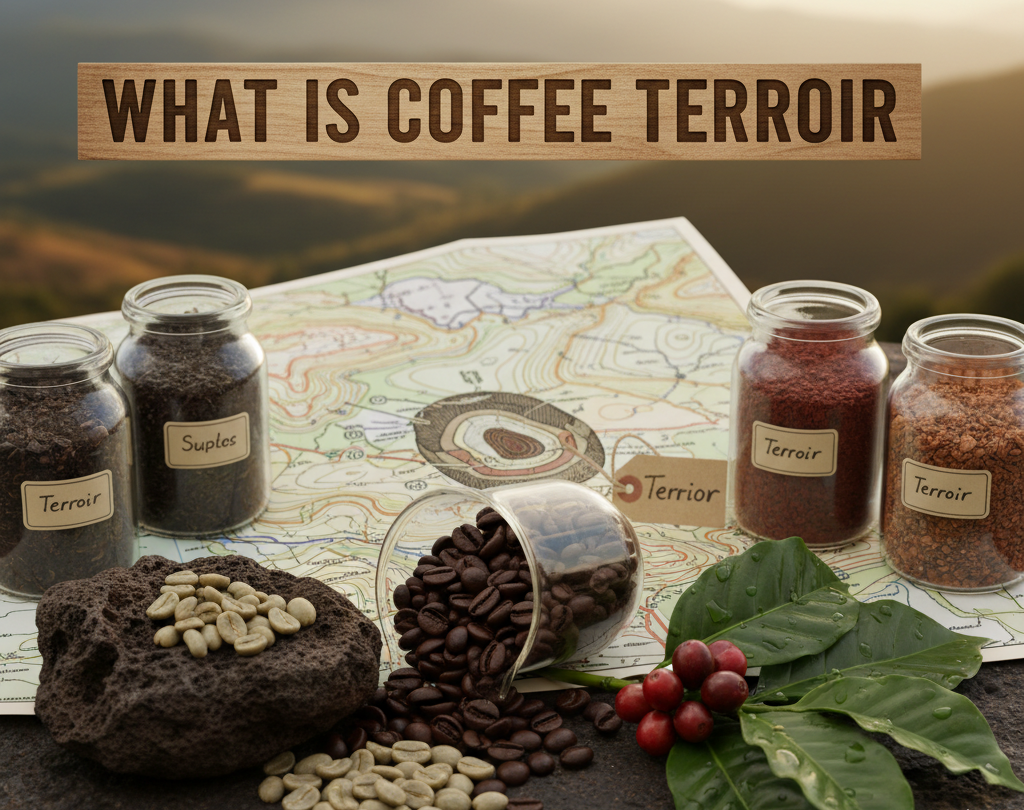
Pick up a bag of Ethiopian coffee and a bag of Colombian coffee, brew them the same way on the same day with the same equipment, and they will taste completely different. Not slightly different — dramatically, unmistakably different. One might taste like jasmine and blueberry. The other like chocolate and caramel. Same plant species. Same roast level. Same brewing method.
The reason for this difference has a name: terroir.
Terroir is the single most powerful concept in specialty coffee — and one of the least understood by most coffee drinkers. Understanding it changes how you read a coffee label, how you choose what to buy, and ultimately how you experience every cup you drink.
Table of contents
- What Does Terroir Mean?
- The Three Scales of Coffee Terroir
- The Five Elements of Coffee Terroir
- How Terroir Translates to Your Cup: A Practical Map
- Terroir and Climate Change: An Emerging Threat
- Why Terroir Matters for Coffee Consumers
- Antioquia as a Terroir Case Study
- Frequently Asked Questions
- The Bottom Line
What Does Terroir Mean?
Terroir (pronounced "tair-WAHR") is a French word with no perfect English equivalent. It refers to the complete set of environmental factors in a specific place that leave their mark on an agricultural product grown there. The concept originated in the French wine industry — where it was used to explain why Burgundy and Bordeaux wines taste radically different despite using grapes of the same species — but the principle applies to any agricultural product sensitive enough to its environment to express those differences in flavor.
Coffee is one of the most terroir-expressive crops in the world. A coffee plant is extraordinarily sensitive to its growing environment — the soil beneath its roots, the temperature of the air around its cherries, the pattern of rainfall, the intensity of sunlight, the ecosystem above and around it. Every one of these factors influences what compounds develop inside the coffee cherry, and those compounds ultimately become the flavors in your cup.
When you taste "something floral and citrusy" in an Ethiopian coffee, you are tasting the actual chemical signature of that specific growing environment. When you taste "chocolate and brown sugar" in a Colombian coffee, you are tasting a different environment's signature. The terroir is in the cup — not as an abstraction, but as real molecular compounds that your palate detects.
☕ Recommended by cocondo.coffee
Cocondo Orgánico — The only certified organic coffee from Antioquia, Colombia
Reserve Your Bag →The Three Scales of Coffee Terroir
Coffee terroir operates at three distinct scales — understanding all three helps explain both the broad regional differences between origins and the subtle differences between farms in the same region:
Macroterroir — Country and Regional Level
The broadest scale. Countries and large regions within them share general climate patterns, altitude ranges, and soil types that produce consistent broad flavor profiles. Ethiopia is known for floral, fruity, tea-like coffees. Brazil is known for chocolate, nuts, and low acidity. Colombia is known for balance, sweetness, and caramel. These are macroterroir signatures — reliable patterns that hold across thousands of individual farms within each origin.
Macroterroir is what allows a coffee buyer to say "I want something fruity and floral — give me an Ethiopian" and be reliably correct. It's the foundation of coffee's geographic vocabulary.
Mesoterroir — Sub-Regional and Valley Level
Within a country or major region, different sub-regions produce meaningfully different coffees due to variations in altitude, drainage patterns, specific soil composition, rainfall distribution, and microclimate. This is mesoterroir.
In Colombia, for example:
- Huila (southwestern Colombia, 1,500–2,000 masl): Complex fruit-forward coffees with bright acidity, stone fruit, and chocolate notes. Unique combination of volcanic soil, cloud forest mist, and high altitude.
- Nariño (near Ecuador, 1,800–2,300 masl — among the highest-altitude coffee in the world): Intense, bright, almost wine-like acidity. Dense beans, complex sweetness. The extreme altitude produces Colombia's most distinctive high-acid specialty lots.
- Antioquia (northwest Colombia, 1,200–2,100 masl): More balanced profile — chocolate, caramel, mild citrus brightness, medium body. The combination of volcanic subsoil, variable altitude, and shade canopy produces a more accessible but genuinely complex cup than either Huila or Nariño extremes.
- Cauca (central Colombia, 1,700–2,000 masl): Similar to Huila with more pronounced tropical fruit notes. Often produces competition-level microlots.
A trained coffee professional can often identify not just "Colombian coffee" but the specific department from a blind tasting — that's how distinctly mesoterroir expresses itself.
Microterroir — Farm and Plot Level
The most specific scale. Within a single sub-region, individual farms produce coffees that differ based on their specific slope orientation, particular soil composition, tree canopy density, elevation variation within the farm, and local water sources. This is microterroir — the fingerprint of a single farm or even a single plot within a farm.
Microterroir is why microlots exist. When a farmer identifies a specific block of land that consistently produces exceptional, distinctive cups — different from the rest of the farm — that block is harvested separately and sold as a microlot. The buyer is purchasing a specific microterroir expression.
The Five Elements of Coffee Terroir
Within any scale, five primary environmental factors drive terroir expression in coffee:
1. Altitude
Altitude is the single most discussed and documented terroir factor in coffee — and for good reason. Its effect on flavor is dramatic, well-studied, and reliably predictable.
At higher altitudes, temperatures are cooler. Coffee cherries develop more slowly — sometimes taking 30 to 50% longer to ripen than at lower altitudes. This extended maturation allows:
- More complete and complex sugar development — producing greater natural sweetness
- More balanced organic acid development — producing structured, bright acidity rather than harsh sourness
- Higher bean density — producing more concentrated flavor compounds per gram of coffee
- More diverse aromatic precursor compounds — producing greater flavor complexity after roasting
Coffee professionals classify bean density by altitude:
- Strictly Soft Bean (SSB): Below 1,200 masl — simpler flavor, lower acidity, nutty/chocolate profile
- Hard Bean (HB) / High Grown (HG): 1,200–1,370 masl — good flavor development, balanced acidity
- Strictly Hard Bean (SHB) / Strictly High Grown (SHG): Above 1,370 masl — the specialty designation. Dense beans, complex flavor, higher acidity and sweetness
In practice, the best specialty coffees consistently come from above 1,500 masl, with exceptional lots often from 1,800 to 2,100 masl or higher. The Titiribí area of Antioquia — where some of Colombia's most carefully farmed organic specialty lots are produced — sits at approximately 1,200 to 1,800 masl, placing it firmly in the specialty quality range.
2. Soil Composition
Coffee plants absorb minerals directly from the soil through their root systems, and those minerals become part of the cherry and ultimately the bean. Different soil types create measurably different flavor profiles:
Volcanic soils — found in Guatemala, Costa Rica, Kenya, parts of Colombia, and Ethiopia's Sidama region — are rich in minerals including potassium, phosphorus, and magnesium, with excellent drainage and high organic matter content. They produce coffees with distinctive mineral complexity, bright acidity, and dense bean structure. Kenyan and Guatemalan coffees' characteristic intensity is substantially a volcanic soil signature.
Red clay soils — found across Kenya's Central Province and parts of Ethiopia — have exceptional water retention, high mineral content, and specific iron compounds. Kenya's SL-28 and SL-34 varieties grown in these soils produce the blackcurrant and citrus acidity that defines Kenyan specialty coffee.
Sandy loam soils — Brazil's Cerrado and Sul de Minas regions — drain quickly and retain less moisture, producing faster-ripening cherries with simpler, smoother profiles. Brazil's characteristic low-acid, nutty, chocolatey cups are partly a sandy loam signature.
Rich organic soils with forest cover — as in Ethiopia's Yirgacheffe and parts of Colombia's Antioquia — support the most complex microbial communities in the soil, which in turn produce the most complex and expressive flavor profiles. Coffee grown in soil rich with microbial diversity and leaf litter from shade trees absorbs a more varied mineral and organic compound profile than coffee in chemically maintained monocultures.
This is one reason shade-grown, organically farmed coffee from biologically active soils tends to produce more complex cups than sun-grown, chemically fertilized coffee: the soil's biodiversity is directly expressed in the bean's flavor complexity.
3. Climate: Temperature, Rainfall, and Seasonal Patterns
Coffee plants require very specific climatic conditions. The ideal temperature range for Arabica is 15 to 24°C (59 to 75°F). Within this range, cooler temperatures slow cherry development (complexity-building); warmer temperatures speed it (simplicity). But both extremes — too cold, too hot — damage the plant and produce defective or underdeveloped beans.
Temperature variation between day and night is particularly important — large diurnal temperature swings (warm days, cold nights) are associated with the most complex flavor development. Ethiopia's highlands, Colombia's Andes, and Guatemala's Antigua all have this quality. The cool nights slow the ripening process and allow more complete sugar development, while the warm days drive photosynthesis and energy production. Colombian growing regions with significant day-night temperature variation consistently produce more complex cups than regions with more stable temperatures.
Rainfall patterns determine the quality of cherry development. Consistent, moderate rainfall during flowering and early cherry development, followed by a dry period during harvest, produces the most uniform and high-quality fruit. Erratic rainfall — too much water causing uneven maturation, or drought stress causing premature ripening — produces inconsistent quality. Coffee regions with defined wet and dry seasons produce more predictable quality than regions with year-round rainfall.
Cloud cover and mist — found in highland regions where coffee farms sit above the cloud line or in valleys that capture moisture from the Pacific or Atlantic — reduce direct solar radiation on the coffee plant. This slows maturation (like altitude) and produces the "misty highlands" flavor profile associated with some of the most complex coffees in the world: Yirgacheffe's distinctive tea-like character is substantially the product of its cloud forest environment.
4. Ecosystem and Biodiversity
The biological environment surrounding the coffee plant is a terroir factor that receives less attention than soil or altitude but is equally significant — particularly for the soil microbiome.
Coffee plants grown within or adjacent to diverse native forest ecosystems benefit from:
- Mycorrhizal fungi networks that extend the plant's root system and transfer minerals and water more efficiently than the plant's roots alone can reach
- Natural pest control from birds, bats, and beneficial insects that reduce the stress damage that triggers defensive compound production in the plant
- Diverse soil microbiomes from leaf litter and decomposing organic matter that produce complex mineral and organic compound profiles unavailable from synthetic fertilizers
- Genetic diversity from cross-pollination with wild coffee relatives and other plant species that creates unique compound profiles in each harvest
- Volatile compound exchange — coffee plants growing near flowering trees, herbs, and fruit trees absorb aromatic volatile compounds through their leaves and roots that can subtly influence the cherry's flavor profile
This is part of the terroir argument for organically managed, shade-grown coffee: the biological richness of the growing environment is not just ethically better and more sustainable — it produces more complex, expressive flavors because the plant is drawing nutrients and compounds from a more diverse biological system.
5. Human Terroir — The People and Their Practices
This is the terroir factor that most discussions overlook — or treat as separate from "real" terroir. But in coffee, as in wine, human knowledge, technique, and tradition are inseparable parts of terroir expression.
The same coffee cherry, from the same tree, on the same farm, will taste dramatically different depending on:
- Harvest selection: Farmers who selectively pick only fully ripe red cherries (selective picking) produce fundamentally different coffee from those who strip-harvest entire branches at once. Selective picking ensures uniform ripeness; strip harvesting produces a mix of ripe, unripe, and overripe cherries in the same bag.
- Processing method: The farmer's choice of washed, natural, or honey processing dramatically alters the flavor profile of even the same green bean. This choice is partly an expression of local tradition, available water resources, and infrastructure — all human dimensions of terroir.
- Fermentation management: The duration, temperature, and microorganism management during fermentation (a step in both washed and natural processing) creates unique flavor compounds. Farmers with generations of fermentation knowledge produce consistently better-controlled, more flavorful lots than those without that accumulated expertise.
- Drying practices: Raised bed drying versus patio drying, drying duration, turning frequency, and protection from rain all affect how volatile compounds develop and preserve during drying. These practices are often family-specific traditions passed down through generations.
When a specific farm's coffee tastes exceptional year after year — more complex, more distinctive than neighboring farms at the same altitude with the same soil — the difference is often this human terroir: the accumulated knowledge, care, and technique of a specific farming family.
This is why direct trade relationships matter for terroir expression. When a roaster knows the specific family and their specific practices, they can communicate about quality, experiment with processing variations, and reinvest in the techniques that make that farm's terroir uniquely expressive. Commodity buying treats terroir as irrelevant — all coffee at a given grade is interchangeable. Specialty buying treats terroir as the entire point.
How Terroir Translates to Your Cup: A Practical Map
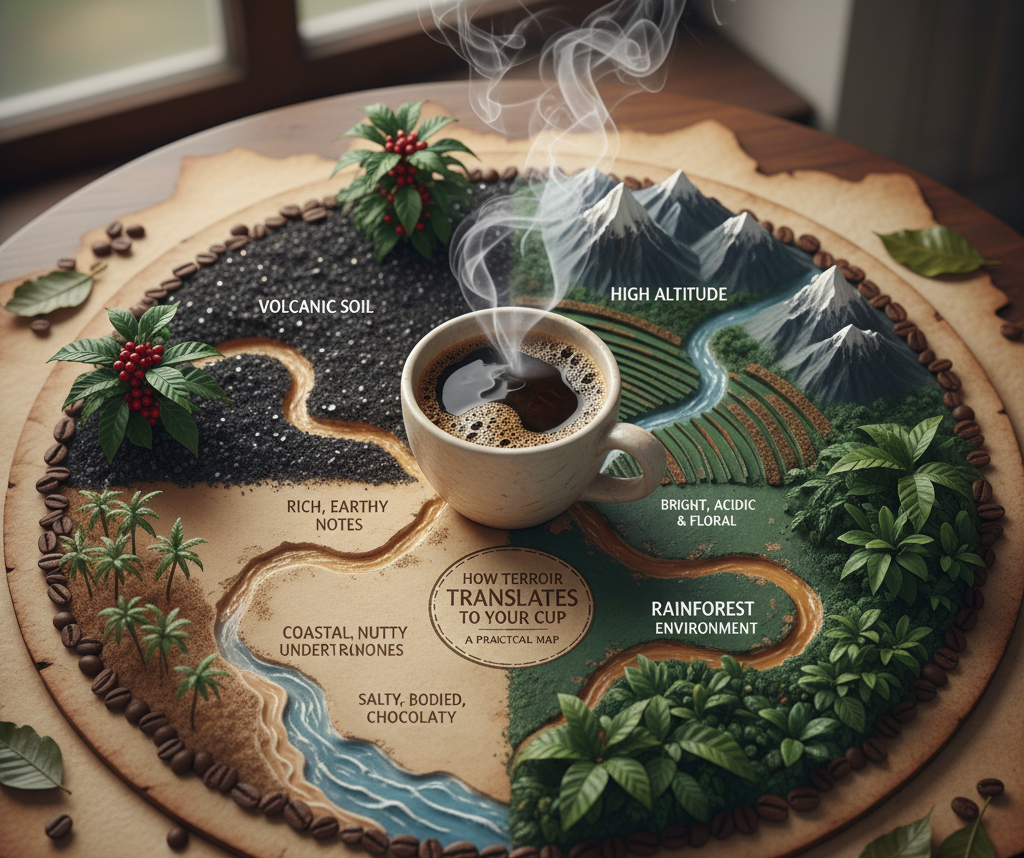
Understanding the environmental factors helps you predict what you'll taste. Here's how terroir signatures manifest in flavor:
High Altitude + Volcanic Soil + Cool Nights → Bright, Complex, Fruity
Examples: Ethiopian Yirgacheffe, Kenyan AA, Colombian Nariño
Slow cherry development + mineral-rich soil = high density beans with diverse aromatic precursors. Roasted: intense floral notes (jasmine, rose), citrus (lemon, grapefruit, bergamot), berry (blueberry, blackcurrant), sometimes wine-like. High acidity, medium-light body, long complex finish.
High Altitude + Rich Organic Soil + Forest Ecosystem → Balanced, Sweet, Complex
Examples: Colombian Antioquia and Huila, Guatemalan Antigua, Costa Rican Tarrazú
Altitude-driven slow development + biologically rich soil = well-developed sugars and balanced acids. Roasted: chocolate, caramel, stone fruit (peach, apricot), mild citrus brightness. Balanced acidity, medium-full body, sweet finish. The most approachable and widely loved specialty coffee profile.
Lower Altitude + Sandy Loam + Warm Climate → Smooth, Low-Acid, Nutty
Examples: Brazilian Cerrado and Minas Gerais, Honduran low-altitude farms, Indian Arabica
Faster development + well-draining soil = lower acid accumulation, higher sugar conversion. Roasted: milk chocolate, hazelnut, brown sugar, almond, low brightness. Full body, low acidity, smooth and approachable. Classic espresso base profile.
Wet-Hulled Processing + Heavy Rainfall + Forest Soil → Earthy, Heavy, Distinctive
Examples: Sumatran Mandheling, Sulawesi Toraja
Unique wet-hulling process (removes parchment while still wet) + humid environment = distinctive earthy, spicy, cedar and dark chocolate profile. Very full body, low acidity, complex but unusual. Polarizing — some people's favorite, others find it too earthy.
Terroir and Climate Change: An Emerging Threat
A 2025 study published in PLOS Climate examined data from more than 500 agricultural varieties across wine-growing regions worldwide and found that every growing region on Earth has been affected by climate change — with significant increases in peak temperatures and growing season shifts fundamentally altering terroir conditions that had been stable for centuries.
For coffee, the implications are direct and serious. The "coffee belt" — the narrow band of latitudes and altitudes where Arabica can grow — is already shifting. Regions that have produced specific flavor profiles for generations are experiencing temperature increases that push growing conditions outside their historical ranges:
- Ethiopian highlands have recorded temperature increases of 0.28°C per decade since the 1970s — modest but cumulative, already affecting cherry development patterns
- Colombian growing regions are experiencing erratic rainfall that disrupts the defined wet/dry seasonal cycles that have historically structured harvest quality
- Central American farms at lower altitudes are losing viable growing conditions entirely as minimum viable temperatures for quality Arabica shift upward
The response from the specialty coffee community has been adaptive: farms are moving cultivation to higher altitudes, introducing heat-tolerant varietals while preserving traditional ones, and implementing shade-growing practices that moderate microclimate temperatures. The Titiribí region of Antioquia — where farms already operate under forest canopy at 1,200 to 1,800 masl — is better positioned than exposed, monoculture farms at lower altitudes because the shade canopy buffers temperature extremes and the altitude provides a margin above the minimum viable range.
This is another dimension of why the sourcing choices you make as a consumer matter: farms using shade-grown, organically managed, altitude-appropriate farming practices are both producing better terroir expression now and building resilience against the climate shifts that will reshape coffee geography in the coming decades.
Why Terroir Matters for Coffee Consumers
Understanding terroir changes your relationship with coffee from passive consumption to active exploration. Practically, it means:
- You can navigate by flavor: Want bright and floral? Seek Ethiopian or Kenyan at altitude. Want smooth and chocolatey? Seek Brazilian or Colombian at moderate altitude. Want something earthy and unusual? Seek Sumatran. The terroir map is a flavor navigation system.
- You understand why seasonal variation happens: Each harvest is different because the growing season was different. A hotter, drier year produces different flavors than a cool, well-rained year — even on the same farm. This isn't inconsistency; it's terroir expressing seasonal reality.
- You know what to look for on a label: Specific region + altitude + farm name + processing method = a complete terroir description. The more specific the label, the more the roaster is committed to terroir expression rather than commodity homogenization.
- You can taste intentionally: When you drink an Ethiopian natural knowing it comes from 2,000 masl volcanic soil in the cloud forest, and you detect jasmine and blueberry, you're experiencing a direct sensory connection to that specific environment. That connection is what specialty coffee is ultimately about.
Antioquia as a Terroir Case Study
Colombia's Antioquia department offers one of the most instructive terroir case studies available because it contains enormous variation within a relatively compact geography — from low-altitude valleys at 800 masl to high-altitude farms above 2,000 masl, with both volcanic and alluvial soils, Pacific moisture and Andean wind patterns, and a tradition of smallholder farming that preserves farm-level terroir expression rather than blending it away.
Within Antioquia, the area around Titiribí — where volcanic subsoil, shade canopy, and altitudes of 1,200 to 1,800 masl intersect — produces a terroir profile that combines:
- Sufficient altitude for specialty bean density and flavor complexity
- Rich volcanic and organic soil from decades of shade tree leaf litter decomposition
- Cloud forest mesoclimate that moderates temperature extremes and extends cherry development
- Multigenerational farming knowledge specific to the local conditions
- Organic management that preserves soil biological diversity
The result is a terroir expression characterized by balanced chocolate and caramel sweetness, mild citrus brightness, medium-full body, and a clean, sweet finish — the profile that makes well-grown Antioquian coffee one of the most accessible and satisfying specialty origins for a wide range of coffee drinkers.
Frequently Asked Questions
What is coffee terroir?
Coffee terroir is the complete set of environmental factors — soil composition, altitude, climate, rainfall patterns, ecosystem, and farming practices — that give coffee from a specific place its distinctive flavor characteristics. Borrowed from the wine world, the concept explains why coffees from different origins taste completely different despite coming from the same plant species. Terroir is why Ethiopian coffee tastes floral and fruity, Colombian coffee tastes like chocolate and caramel, and Kenyan coffee tastes intensely berry-like — the growing environment imprints itself directly on the flavor compounds in the bean.
How does altitude affect coffee flavor?
Higher altitude means cooler temperatures, which slows the maturation of coffee cherries. This slower development allows more complete sugar formation (more natural sweetness), more balanced organic acid development (brighter, structured acidity), and higher bean density (more concentrated flavor compounds). Coffee grown above 1,500 masl consistently produces more complex flavor profiles than lower-altitude coffee. Above 1,800 masl, coffees often develop the intense floral, fruity, and complex characters that define the highest-scoring specialty lots.
Does soil type affect coffee flavor?
Yes — significantly. Coffee plants absorb minerals directly from the soil, and those minerals influence flavor development in the cherry. Volcanic soils (Kenya, Guatemala, parts of Colombia and Ethiopia) produce coffees with distinctive mineral complexity and bright acidity. Sandy loam soils (Brazil) produce smoother, lower-acid cups. Rich organic soils under shade canopy (Ethiopia's cloud forests, Colombia's traditionally farmed regions) support complex microbial communities that produce diverse mineral and organic compound profiles in the bean — one reason organically farmed, shade-grown coffees often taste more complex.
Is terroir the same in coffee as in wine?
The concept is the same — both describe how a specific growing environment leaves its mark on an agricultural product's flavor — but the mechanisms differ in some ways. In wine, the same grape variety grown in different soils can produce radically different wines largely through soil mineral absorption and climate effects on sugar/acid balance. In coffee, terroir operates through similar mechanisms (soil minerals, altitude, climate) but is also significantly shaped by post-harvest processing choices (washed, natural, honey) that have no direct equivalent in wine production. The human terroir dimension — processing knowledge and tradition — is arguably more prominent in coffee than in wine.
Why do coffees from the same country taste different?
Because terroir operates at multiple scales — country-level patterns (macroterroir) are real, but sub-regional differences (mesoterroir) are equally significant. Colombia is a perfect example: coffees from Nariño, Huila, Antioquia, and Cauca all carry the broad "Colombian" profile (balanced, sweet, medium body) but are distinctly different in specific character due to differences in altitude, soil composition, and microclimate. A coffee professional can often identify the Colombian department from a blind tasting — that's how expressive mesoterroir is within a single country.
The Bottom Line
Terroir is not a marketing concept — it's the scientific and agricultural reality that explains why your cup tastes the way it does. The soil, altitude, climate, ecosystem, and people behind your coffee aren't background details. They are the flavor in your cup.
Understanding terroir transforms coffee from a commodity into something genuinely interesting: an agricultural product that captures a specific place, a specific season, and a specific human tradition in every sip. Once you understand it, you can't unknow it — every bag you pick up becomes a terroir story, and every cup becomes a chance to taste somewhere real.
The most direct way to experience terroir is through single-origin specialty coffee from traceable, carefully managed farms. The label tells you where; the terroir tells you what that where actually means for what's in your cup. Find a Colombian Antioquia from a specific farm at altitude, a Kenyan from volcanic red clay soils, and an Ethiopian from cloud forest highlands — taste them side by side, and terroir becomes not a concept but an experience you'll recognize every time.
If you'd like to read other articles similar to What Is Coffee Terroir? How Geography Shapes the Flavor in Your Cup you can visit the category The Art and Science of Coffee: Guides, Reviews, and Expert Tips.
Does Coffee Affect Cortisol Levels? The Science Behind Caffeine and Your Stress Hormone

Is Coffee Good for Depression Risk? What the Research Actually Shows

Is Coffee Bad for Anxiety? What the Science Actually Shows
The 5 Elements of Coffee Tasting Every Coffee Lover Should Know
What Is Green Coffee? How Raw Beans Differ From Roasted — and What That Means for Your Health
How Is Coffee Decaffeinated? The 4 Methods Explained — Including the One You Should Avoid

What Is Coffee Degassing? Why Fresh Roasted Beans Release CO2 — and Why It Matters
What Is a Coffee Cooperative? How They Help Farmers — and Why They Matter for Your Cup
How Altitude Affects Coffee Flavor: Why High-Grown Coffee Tastes Different
Leave a Reply
Related post