

How to Describe Coffee Flavor: The Complete Vocabulary Guide (For Any Level)

You take a sip of a really good coffee and something happens. You know it's different from your usual cup — more complex, more interesting, maybe even beautiful. But when someone asks what it tastes like, the best you can manage is "it's really good" or "it tastes like... coffee."
That gap between experience and language is completely normal. Coffee is one of the most chemically complex beverages humans consume — over 800 aromatic volatile compounds, thousands of extractable molecules, flavors influenced by genetics, altitude, soil, fermentation, roasting, and brewing. Describing it precisely takes vocabulary most people were never taught.
This guide gives you that vocabulary — organized by category, explained in plain terms, and paired with a practical framework you can actually use the next time you pick up an interesting cup.
Table of contents
- Why Describing Coffee Matters (It's Not Just About Sounding Fancy)
- The Two Things You're Actually Describing
- The Core Character Vocabulary: 6 Essential Terms
- Flavor Note Vocabulary by Category
- A Practical Framework: How to Describe Any Coffee in 3 Steps
- How to Build Your Coffee Vocabulary Over Time
- Frequently Asked Questions
- The Bottom Line
Why Describing Coffee Matters (It's Not Just About Sounding Fancy)
There are two genuinely practical reasons to develop coffee flavor vocabulary beyond being able to sound knowledgeable at a café:
1. It helps you buy better coffee. When you can articulate that you like coffee with "bright acidity, caramel sweetness, and medium body" versus "low acidity, chocolate, and heavy body," a good roaster or barista can recommend exactly what you want. Without that language, you're relying on packaging aesthetics and brand recognition. With it, you're navigating by taste.
2. It trains your palate to detect more. Describing flavor isn't just reporting what you taste — it actively improves what you taste. Researchers in sensory science call this "verbal overshadowing in reverse": having vocabulary for a flavor increases your ability to detect it in future encounters. When you know the word "bergamot," you start noticing bergamot. When you know what "winey acidity" means, you start distinguishing it from "citric acidity." Language and perception are deeply linked in olfaction and flavor perception.
☕ Recommended by cocondo.coffee
Cocondo Orgánico — The only certified organic coffee from Antioquia, Colombia
Reserve Your Bag →The Two Things You're Actually Describing
Before getting into specific words, it helps to understand that when you describe coffee, you're always describing one of two things:
Flavor Notes: What It Reminds You Of
Flavor notes are the specific sensory associations your brain makes when drinking coffee — "this reminds me of blueberries," "there's something chocolatey here," "this is like lemon zest." These comparisons work because coffee contains actual chemical compounds found in those other foods. Ethyl-3-methylbutanoate, present in some Ethiopian coffees, is the same compound that gives blueberries their distinctive flavor. Your brain correctly identifies it — it just happens to be in coffee rather than a bowl of fruit.
The language of flavor notes is associative and personal. No blueberry was added to your coffee. The coffee's chemistry is producing a signal your brain recognizes as blueberry.
Important nuance: The most honest way to describe flavor notes is "this reminds me of" rather than "this tastes like." You can't taste blueberry in coffee if you've never eaten a blueberry — your description is always filtered through your own sensory memory. Using "reminds me of" acknowledges that subjectivity while still communicating meaningfully.
Character: How It Feels and Behaves
Character describes the structural qualities of the coffee — acidity, body, sweetness, bitterness, balance, and finish. These are the dimensions of the coffee's architecture, not its specific flavor associations. A coffee can have "bright citric acidity, medium-full body, caramel sweetness, and a long, clean finish" — these character descriptors tell you the coffee's structure regardless of what specific flavors you personally identify.
The most useful coffee descriptions combine both: "I'm getting a winey, almost fermented quality (flavor note), with high brightness and light body (character), and it finishes with something floral" paints a complete picture that another person can recognize and confirm.
The Core Character Vocabulary: 6 Essential Terms
These six terms describe the structural qualities of any coffee. Mastering them gives you a foundation for every other description.
1. Acidity
In coffee, acidity is not a flaw — it's one of the most desirable qualities in specialty coffee when it's pleasant and appropriate. Acidity describes the bright, lively, enlivening quality that makes coffee feel alive rather than flat. It's the same quality that makes a glass of good wine feel vibrant rather than dull.
Acidity in coffee is caused by organic acids — primarily citric acid (fruity, clean brightness), malic acid (apple-like, soft), tartaric acid (grape-like, wine quality), and chlorogenic acids (present in all coffee but most noticeable in light roasts).
Vocabulary for acidity:
- Bright: High, clean, lively acidity — feels refreshing and crisp. Common in Ethiopian washed coffees and Kenyan coffees.
- Crisp: Clean acidity with a clear, defined character — like biting into a fresh apple.
- Winey: A particular type of acidity associated with fermented fruit — grape-like, slightly complex, occasionally vinegar-adjacent. Common in Ethiopian naturals.
- Lively: Acidity that feels animated and energetic in the cup — the coffee feels "awake."
- Soft: Gentle, mild acidity that doesn't demand attention — malic acid tends to feel softer than citric.
- Mellow: Low acidity that barely registers — typical of Brazilian and Indonesian coffees.
- Flat: Absence of meaningful acidity — can feel dull, often from over-roasting or stale beans.
- Sharp: Acidity that feels aggressive or unpleasant — usually a negative descriptor, or indicates over-extraction or robusta content.
Note on sourness: Sourness and acidity are often confused. Good acidity is pleasant and integrated — it lifts the cup and adds complexity. Sourness is unpleasant and separate — it feels like something went wrong in the processing or extraction. If the coffee makes you wince, that's sourness, not acidity.
2. Body
Body describes the physical weight and texture of the coffee in your mouth — how it feels, not how it tastes. Think of the difference between drinking water (light body) versus whole milk (full body). Coffee falls somewhere on that spectrum.
Vocabulary for body:
- Light-bodied: Thin, delicate, almost tea-like in weight. Common in light roast Ethiopian filter coffees. Feels clean and transparent.
- Medium-bodied: The middle ground — neither thin nor heavy. A comfortable weight that doesn't distract from flavor.
- Full-bodied: Heavy, rich, substantial in the mouth. Common in darker roasts, French press coffee, and espresso.
- Silky: Smooth and almost frictionless — a pleasant texture quality that makes the coffee feel refined.
- Syrupy: Thick and viscous — the coffee seems to coat the mouth. Often used for cold brew or very high-quality naturally processed coffees.
- Velvety: Rich and smooth with a soft, plush texture — common in well-extracted espresso with a good crema integration.
- Watery: Thin and lacking substance — usually indicates under-extraction or too little coffee in the ratio.
- Coating: Leaves a film on the palate after swallowing — can be positive (rich, satisfying) or negative (oily, heavy).
3. Sweetness
Natural sweetness — the presence of sugars that survived roasting and extraction — is one of the most important quality indicators in specialty coffee. A sweet cup requires quality beans, careful roasting, and proper extraction. Stale, poorly roasted, or over-extracted coffee lacks sweetness entirely.
Vocabulary for sweetness:
- Sweet: Broad positive descriptor — the coffee has natural sugar presence without anything added.
- Caramel: Warm, buttery, slightly burnt-sugar sweetness — from caramelization during roasting. Very common in Colombian medium roasts.
- Brown sugar: Earthier, more complex sweetness than caramel — molasses-adjacent but lighter.
- Honey: Floral-touched sweetness, somewhat syrupy — common in honey-processed coffees and certain Ethiopian washed beans.
- Molasses: Deep, dark, almost bitter sweetness — found in very dark roasts or Brazilian naturals.
- Sugary: Clean, simple sweetness — like dissolving white sugar in water, uncomplicated but pleasant.
- Jammy: Concentrated, almost preserved-fruit sweetness — found in well-developed natural processed coffees.
4. Bitterness
Bitterness is present in virtually all coffees — it's not inherently bad. Good bitterness is a structural element that adds complexity and backbone. Bad bitterness is harsh, dominant, and lingers unpleasantly.
Vocabulary for bitterness:
- Clean bitterness: Present but balanced — like dark chocolate or espresso that makes you reach for another sip rather than grimace.
- Roasty: Bitterness that comes from the roasting process — toast, dark grain, or slightly charred quality. Can be pleasant or excessive.
- Harsh: Aggressive, unpleasant bitterness — typically from over-extraction, poor quality beans, or very dark roasting past the point of flavor development.
- Dry: A specific quality of bitterness that creates a drying sensation on the palate — from tannins. Often a negative indicator.
- Astringent: Extreme drying effect — feels like sucking on a tea bag left too long. Almost always a flaw indicator in coffee.
5. Balance
Balance describes how well all the attributes work together. A balanced coffee has its acidity, sweetness, body, and bitterness in proportion — none overwhelms the others. Balance doesn't mean boring — it means harmonious.
Vocabulary for balance:
- Balanced: All attributes in pleasant proportion — complete, harmonious, nothing missing or dominant.
- Complex: Many distinct attributes that layer on each other — can be balanced or intentionally imbalanced in interesting ways.
- One-dimensional: Dominated by a single attribute — usually bitterness or roastiness. Typically a negative descriptor for specialty coffee.
- Structured: A coffee where you can sense distinct stages of flavor — an entry, a mid-palate development, and a finish that differ meaningfully from each other.
6. Finish (Aftertaste)
The finish is what remains after you swallow. A quality coffee often has a finish that evolves — different attributes emerge as the cup and the aftertaste cool and develop.
Vocabulary for finish:
- Long finish: The aftertaste lingers pleasantly for 20 to 60 seconds — a sign of quality and complexity.
- Short finish: The flavor drops off quickly after swallowing — less complex, though not necessarily bad.
- Clean finish: Nothing unpleasant lingers — the aftertaste is neutral or gently pleasant.
- Sweet finish: A sweetness that persists after swallowing — one of the most desirable quality indicators.
- Bitter finish: Bitterness that remains and dominates — can be positive (dark chocolate) or negative (harsh, dry).
Flavor Note Vocabulary by Category
These are the specific flavor associations — what the coffee reminds you of. Organized by category to mirror the Coffee Flavor Wheel structure.
Fruity
The most celebrated category in specialty coffee — these notes come primarily from naturally occurring organic acids and aromatic esters, particularly in light roasts and natural processed coffees.
- Berry: Blueberry, blackberry, strawberry, raspberry, cranberry — most common in Ethiopian naturals and Kenyan washed coffees
- Citrus: Lemon, lime, grapefruit, orange, bergamot — associated with bright, high-altitude washed coffees; particularly common in Ethiopian Yirgacheffe and Kenyan AA
- Stone fruit: Peach, apricot, plum, nectarine, cherry — often found in Colombian and Central American coffees
- Tropical: Mango, papaya, pineapple, passion fruit — increasingly common in anaerobic and experimental process coffees
- Dried fruit: Raisin, date, prune, fig — common in darker roasts and some naturally processed coffees where fruit sugars have concentrated
- Apple: Green apple (sharp, bright) or red apple (sweeter, rounder) — common in Latin American washed coffees with malic acid
Floral
Among the most delicate and ephemeral of coffee notes — often among the first to be lost as the cup cools. Highest in light roasts and certain Ethiopian and Panamanian origins.
- Jasmine: The most common floral descriptor in Ethiopian Yirgacheffe coffees — light, sweet, intensely fragrant
- Rose: Heavier, more complex floral note — found in some Ethiopian and Colombian high-altitude coffees
- Chamomile: Soft, herbal-floral — subtle and tea-like
- Lavender: Slightly medicinal florality — found in some anaerobic process coffees
- Orange blossom: Sweet, citrus-floral note — where fruit and floral categories overlap
Sweet / Caramel / Chocolate
The most widely enjoyed flavor category — accessible to beginners and enjoyed by nearly everyone. Dominant in medium-to-dark roasts and Brazilian, Colombian, and Central American coffees.
- Milk chocolate: Sweet, creamy, approachable chocolate — the most common chocolate descriptor in Colombian medium roasts
- Dark chocolate: Richer, more bitter-chocolate quality — common in dark roasts and espresso; less sweet than milk chocolate
- Cocoa: Dry, powdery chocolate quality — like unsweetened cocoa powder; drier and more bitter than chocolate descriptors
- Caramel: Warm, buttery, toasted sugar — very common in medium roasts from Colombia, Costa Rica, and Guatemala
- Toffee: Deeper, more concentrated caramel — like a butterscotch or caramel candy
- Vanilla: Soft, creamy sweetness — found in some honey-processed and natural coffees
- Brown sugar: Earthy sweetness with molasses depth — less refined than white sugar, more complex
Nutty
A warm, comforting category most common in Brazilian, Colombian, and other Latin American coffees. Popular and approachable.
- Hazelnut: The most common nut descriptor — roasted, slightly sweet, very accessible
- Almond: Slightly bitter, clean nut quality — like marzipan but less sweet
- Walnut: Earthier, more bitter than hazelnut or almond — often paired with dark chocolate notes
- Pecan: Sweet, buttery nut quality — softer and sweeter than walnut
- Peanut: Earthy, slightly savory nut note — more common in lower-grade coffees; occasionally appears as a mild background in certain Sumatran origins
Spicy
Warm, aromatic spice notes — distinct from "sharp" or "hot." These are aromatic spice associations, not heat sensations.
- Cinnamon: Warm, sweet-spicy — common in natural processed coffees and some medium-dark roasts
- Clove: Deeper, more intense warmth — occasionally found in Indonesian and some Ethiopian coffees
- Cardamom: Complex, slightly floral spice — sometimes found in anaerobic process coffees
- Black pepper: Pungent, sharp warmth — occasional background note in Robusta-containing blends
- Anise: Licorice-adjacent, slightly sweet — occasionally found in dark roasts
Roasted
These notes come from the roasting process itself — they increase as roast level darkens. At appropriate levels, they add pleasant depth; at excessive levels, they overpower other attributes.
- Toasted grain: Like warm toast or freshly baked bread — pleasant and common in medium-dark roasts
- Tobacco: Dry, slightly earthy, warm — sometimes found in full-city and dark roasts; can be positive in moderate amounts
- Smoky: Reminiscent of smoke or char — typical of very dark roasts or over-extraction; usually a negative indicator in specialty coffee
- Roasty: The generic taste of the roasting process — neutral to positive at moderate levels
- Cereal: Like untoasted grain or raw oats — typically a negative indicator, associated with under-developed roasting
Earthy / Savory
Less common in high-quality specialty coffee but present in certain origins — particularly Indonesian (Sumatran, Sulawesi) coffees and some older crop beans.
- Earthy: Rich, soil-like quality — wet earth after rain; common in Sumatran coffees and sometimes desirable in small amounts
- Mushroom: Umami-forward, meaty, slightly savory — rare and origin-specific
- Cedar: Dry, woody, aromatic — sometimes found in Indonesian origins
- Leather: Dry, slightly animal — can appear in some wet-hulled Indonesian coffees
Negative / Defect Vocabulary
Knowing the words for what's wrong is as important as knowing words for what's right — these help you identify problems and communicate them accurately.
- Sour: Unpleasant sharpness — indicates under-extraction or processing defects; distinct from pleasant acidity
- Fermented: Over-fermented quality — like vinegar, kombucha that's gone too far, or overripe fruit; a processing defect
- Medicinal: Phenolic, chemical, antiseptic quality — indicates contamination during processing or storage
- Rubbery: Like rubber bands or inner tubes — typically a Robusta characteristic or processing defect
- Musty: Mold-adjacent, damp basement quality — indicates improper storage or transport
- Papery: Cardboard-like flatness — indicates severely stale beans
- Astringent: Extreme drying, puckering effect — over-extraction or very high tannin content
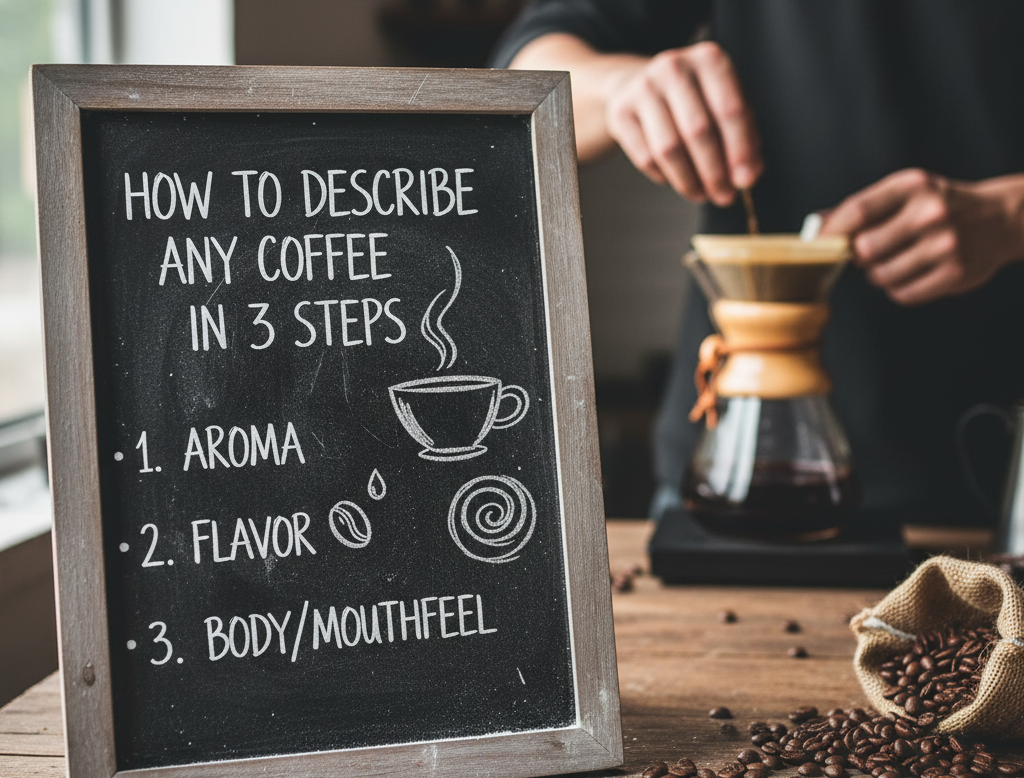
A Practical Framework: How to Describe Any Coffee in 3 Steps
Here's a simple structure you can use immediately to describe any coffee with confidence and clarity:
Step 1: Describe the Structure (Character)
Start with the three most important structural qualities:
- Acidity: High/medium/low — bright/soft/crisp/mellow?
- Body: Light/medium/full — silky/syrupy/watery?
- Sweetness: High/medium/low — caramel/honey/brown sugar?
Example: "This coffee has bright, citrusy acidity, light to medium body, and a noticeable caramel sweetness."
Step 2: Identify the Flavor Associations (Notes)
What does it remind you of? Start broad (fruity, chocolatey, floral) and narrow down:
- First impression on the palate?
- What develops mid-sip?
- What do you notice as it cools?
Example: "I'm getting something lemony up front, then a bit of stone fruit — maybe apricot — in the middle, and a light chocolate note as it cools."
Step 3: Describe the Finish
What lingers after you swallow? How long? Is it pleasant?
Example: "The finish is long and sweet, with a faint floral quality that sticks around for a while."
Putting it together: "This coffee has bright, citrusy acidity with light-medium body and nice caramel sweetness. I'm getting lemon up front, then something like apricot mid-cup, and light chocolate as it cools. The finish is long, sweet, with a hint of jasmine."
That's a complete, useful coffee description that any roaster or barista would immediately recognize and that you could use to find similar coffees in the future.
How to Build Your Coffee Vocabulary Over Time
Vocabulary development isn't passive — it requires deliberate practice. Here's what actually works:
- Cup two coffees side by side. Comparison accelerates learning more than anything else. When you taste two coffees simultaneously, differences that would be invisible in isolation become obvious. An Ethiopian natural next to a Colombian washed teaches you more about acidity, body, and fruit character in one session than months of drinking single coffees.
- Keep a tasting journal. Write notes immediately, even if they're vague. "Reminds me of something warm and fruity, maybe dried fruit?" is better than nothing. Return to the journal when you have the vocabulary to refine your notes.
- Eat the references. When a coffee bag says "blackberry and dark chocolate," find actual blackberries and dark chocolate (70%+). Taste them before and after your coffee. Calibrate the association. This is how professional Q Graders train — the reference is as important as the coffee.
- Use your vocabulary with intention. Don't just drink — notice. Ask yourself the three structural questions (acidity, body, sweetness) every time you drink a new coffee. The habit of asking builds the habit of detecting.
- Give yourself permission to be wrong. "I taste something that might be raspberry or maybe cherry — something red-fruited" is a perfectly valid description from someone developing their palate. The vocabulary develops through use, not through waiting until you're certain.
Frequently Asked Questions
How do you describe coffee to someone who has never had it?
Focus on the structural qualities rather than specific flavor notes: "It's bitter but in a way that's complex — like dark chocolate rather than medicine. It can have brightness like citrus, warmth like toasted nuts, sometimes a sweetness like caramel. The aroma is usually more inviting than the first sip, but the two come together as you get used to it." For someone nervous about bitterness, mention that lighter roasts and good specialty coffee often have very little bitterness and can taste fruity and sweet.
What words do people use to describe good coffee?
The most common positive descriptors for high-quality specialty coffee include: bright (acidity), clean (no off-flavors), complex (many distinct notes), balanced (attributes in proportion), sweet (natural sugar presence), smooth (pleasant texture, low harsh bitterness), and layered (flavors that develop and change through the sip and aftertaste). Specific flavor notes like "blueberry," "jasmine," "dark chocolate," "caramel," and "citrus" are also widely used for quality coffee with distinct character.
What are the basic coffee flavor categories?
Based on the SCA Coffee Flavor Wheel, the nine primary flavor categories in coffee are: fruity (berries, citrus, stone fruit, tropical), floral (jasmine, rose, chamomile), sweet (caramel, chocolate, vanilla, honey), nutty/cocoa (hazelnut, almond, chocolate), spicy (cinnamon, clove, cardamom), roasted (toast, tobacco, smoke), green/vegetative (herb, grain), sour/fermented (winey, vinegar, overripe), and other/defects (chemical, medicinal, musty). For everyday coffee drinkers, the first five categories are the most relevant and commonly encountered.
Why can't I taste the flavors listed on a coffee bag?
Several factors may prevent you from tasting listed notes. Your coffee may be stale — flavor notes require freshness, and they degrade rapidly after roasting. Your brewing method may not suit the beans — a coffee designed to express floral and citrus notes through pour-over may taste flat through a French press. You may not have encountered those reference flavors before — you can't taste bergamot in coffee if you've never smelled bergamot. And finally, tasting notes are always somewhat subjective — what a professional cupper describes as "blackberry" may register as "something dark and fruity" to your palate. All of these are normal. Start with broad categories and work toward specificity over time.
The Bottom Line
Describing coffee isn't about pretension or technical performance — it's about making a fleeting sensory experience communicable and reproducible. The framework is simple: describe the structure first (acidity, body, sweetness), then add flavor associations, then describe the finish. Everything else is refinement.
The vocabulary comes with practice, and the practice comes with drinking coffee mindfully — with the three structural questions in mind, a flavor wheel nearby, and the willingness to commit impressions to paper even when they're vague.
Start with the coffees that give you the most to work with. Single-origin specialty coffee — particularly from origins known for expressive, distinctive profiles — rewards descriptive effort with layers of flavor that standard commercial coffee simply doesn't contain. An Ethiopian natural, a Colombian washed from Antioquia, or a Kenyan AA give you more vocabulary to discover than anything you'll find in a supermarket aisle. The language develops where the flavor is.
If you'd like to read other articles similar to How to Describe Coffee Flavor: The Complete Vocabulary Guide (For Any Level) you can visit the category The Art and Science of Coffee: Guides, Reviews, and Expert Tips.
Does Coffee Affect Cortisol Levels? The Science Behind Caffeine and Your Stress Hormone

Is Coffee Good for Depression Risk? What the Research Actually Shows

Is Coffee Bad for Anxiety? What the Science Actually Shows
The 5 Elements of Coffee Tasting Every Coffee Lover Should Know
What Is Green Coffee? How Raw Beans Differ From Roasted — and What That Means for Your Health
How Is Coffee Decaffeinated? The 4 Methods Explained — Including the One You Should Avoid
What Is Coffee Degassing? Why Fresh Roasted Beans Release CO2 — and Why It Matters
What Is a Coffee Cooperative? How They Help Farmers — and Why They Matter for Your Cup
How Altitude Affects Coffee Flavor: Why High-Grown Coffee Tastes Different
Leave a Reply
Related post