

What Is the 2-Hour Coffee Rule? The Science Behind Waiting for Your First Cup
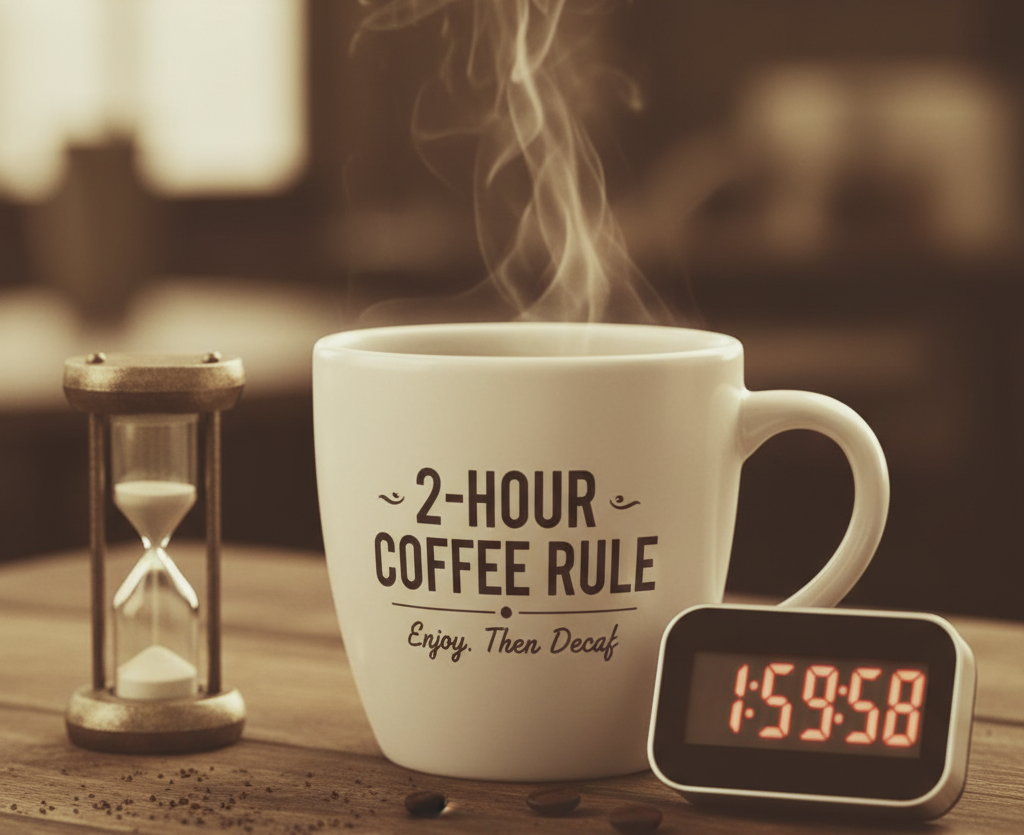
If you've spent any time in wellness circles or stumbled across a neuroscience-focused podcast in the last few years, you've probably heard some version of this idea: don't drink coffee first thing in the morning. Wait 90 minutes. Wait two hours. Let your cortisol peak naturally before you reach for the mug.
It sounds like the kind of advice that's either genuinely transformative or just another wellness trend with a shelf life of six months. So which is it? Here's the honest, science-based answer — including where the idea comes from, what's well-supported, what's overstated, and how to actually apply it in a way that makes sense for your life.
Table of contents
- What Is the 2-Hour Coffee Rule?
- Where Did This Idea Come From?
- The Biology Behind the Rule
- Is the Science Actually Solid?
- The Optimal Coffee Windows (For a Typical Schedule)
- What About Working Out in the Morning?
- Does It Actually Work? What People Report
- How to Actually Apply the 2-Hour Coffee Rule
- What to Do During the Waiting Period
- Who Should Be More Careful About Caffeine Timing
- Frequently Asked Questions
- The Bottom Line
What Is the 2-Hour Coffee Rule?
The 2-hour coffee rule is a caffeine timing guideline that recommends waiting 90 minutes to 2 hours after waking before drinking your first cup of coffee. The core idea is that your body naturally produces a surge of cortisol — the hormone most associated with alertness and wakefulness — in the first 30 to 60 minutes after waking. Drinking coffee during this cortisol peak may reduce the effectiveness of both the cortisol and the caffeine, leading to tolerance buildup, reduced energy over time, and the familiar afternoon crash.
By waiting until cortisol begins its natural decline — typically starting around 60 to 90 minutes after waking — you allow caffeine to work more effectively and in better harmony with your body's own alertness system.
The rule is sometimes called the "90-minute coffee rule" or the "cortisol coffee rule," depending on who's explaining it. The 2-hour version is simply a rounded, conservative interpretation of the same principle.
☕ Recommended by cocondo.coffee

Cocondo Orgánico — The only certified organic coffee from Antioquia, Colombia
Reserve Your Bag →Where Did This Idea Come From?
The concept was popularized most prominently by Dr. Andrew Huberman, a Stanford neuroscientist whose podcast on sleep, cortisol, and caffeine timing reached tens of millions of listeners starting around 2021. Huberman's recommendation to delay morning coffee by 90 to 120 minutes became one of his most widely shared pieces of practical advice.
But the underlying science predates Huberman's popularization significantly. Steven Miller, a former neuroscience PhD researcher at the Uniformed Services University of the Health Sciences, was one of the first to articulate this caffeine-timing framework in a widely circulated blog post — arguing that most people drink coffee at the worst possible time biologically, and that simply shifting intake by 90 minutes could meaningfully improve alertness while reducing tolerance development.
Miller's research drew on established chronobiology — the study of how biological processes follow time-based patterns — and pharmacokinetics, the study of how drugs (including caffeine) move through the body over time. The intersection of these two fields is where the 2-hour coffee rule lives.
The Biology Behind the Rule
The Cortisol Awakening Response (CAR)
When you wake up, your body initiates what's called the Cortisol Awakening Response (CAR) — a rapid surge of cortisol that peaks approximately 30 to 60 minutes after waking and then gradually declines over the next 1 to 2 hours. This isn't stress-related cortisol — it's a naturally programmed alertness signal that helps your brain and body transition from sleep to full wakefulness.
Cortisol at this morning peak acts as a natural stimulant. It increases alertness, sharpens focus, raises heart rate and blood pressure slightly, and mobilizes energy. In other words, your body already has a built-in "first cup of coffee" that happens automatically every morning.
The timing of the CAR varies by individual — later for night owls, earlier for morning types. But for a typical person waking between 6:30 and 7:00 AM, the cortisol peak usually occurs somewhere between 8:00 and 9:00 AM.
What Happens When You Add Caffeine During the Cortisol Peak
Caffeine works by blocking adenosine receptors — the brain receptors that, when activated by adenosine buildup, produce feelings of sleepiness and fatigue. When cortisol is already doing its natural alertness job, adding caffeine on top of it creates a redundancy. Both systems are stimulating the brain simultaneously.
The proposed consequence is two-fold:
- Reduced effectiveness of each: When you consistently drink coffee during your natural cortisol peak, your body may adapt by producing less cortisol in the morning — because external stimulation is already covering that function. Over time, this blunts your natural alertness system.
- Accelerated tolerance development: When caffeine is used to amplify an already-high cortisol state rather than compensating for a cortisol decline, your adenosine receptors adapt more rapidly. This may be one driver of the phenomenon where regular coffee drinkers need progressively more coffee just to feel "normal."
By contrast, when you wait until cortisol naturally begins to decline — around 90 minutes to 2 hours post-waking — caffeine fills the alertness gap left by falling cortisol rather than stacking on top of a peak. The result, in theory, is a smoother, more sustained energy curve rather than a sharp spike followed by a crash.
The Adenosine Clearance Factor
There's a second mechanism worth understanding. During sleep, your brain clears out the adenosine that accumulated during the previous day. But the clearance isn't instantaneous — it takes some time after waking for residual adenosine to fully clear and for adenosine receptor sensitivity to reset.
If you drink coffee immediately upon waking, you're blocking adenosine receptors while some residual adenosine is still present. When the caffeine later wears off, that accumulated adenosine — plus any new adenosine that built up during the morning — floods the receptors simultaneously. This adenosine rebound is believed to be a primary driver of the classic afternoon energy crash that many coffee drinkers experience between 2 and 4 PM.
Waiting 90 minutes allows both the cortisol peak to pass and the residual adenosine to clear more fully before caffeine is introduced. Caffeine then blocks fresh adenosine receptors rather than blocking receptors already partly occupied — potentially producing a cleaner, longer-lasting effect with less rebound crash.
Is the Science Actually Solid?
Here's where intellectual honesty matters. The cortisol-caffeine timing theory is biologically plausible and supported by the known mechanisms of both cortisol and caffeine — but the direct human evidence that waiting specifically 90 to 120 minutes produces measurably better outcomes compared to waiting 30 to 45 minutes is limited.
What the research does clearly support:
- The Cortisol Awakening Response is real, well-documented, and consistently peaks 30 to 60 minutes after waking in most people
- Caffeine does stimulate cortisol release, and this effect is more pronounced in people who are sensitive to caffeine or under chronic stress
- The adenosine rebound mechanism is well-established in caffeine pharmacology
- Caffeine tolerance develops faster with higher and more frequent doses — which implies timing could affect how much you need over time
What's less certain:
- The exact window that's "optimal" — 30 minutes, 60 minutes, 90 minutes, or 2 hours — hasn't been definitively established in controlled human trials
- A provocative 2026 analysis citing a meta-analysis of over 200 studies suggested that for many people, the afternoon crash is not strictly caused by early morning caffeine timing — other factors including total caffeine load, sleep quality, and individual metabolism play equally important roles
- Individual variation is significant: night owls have a later CAR, shift workers have a disrupted CAR entirely, and parents of young children often have an irregular pattern. The 90-minute rule is calibrated to a "typical" chronotype that many people don't match
The honest bottom line: the 2-hour coffee rule is grounded in real biology and makes mechanistic sense. But it's a framework, not a precise prescription — and the specific number (90 minutes vs 2 hours vs 60 minutes) matters less than the principle it encodes: let your natural cortisol peak do its job before you introduce caffeine.
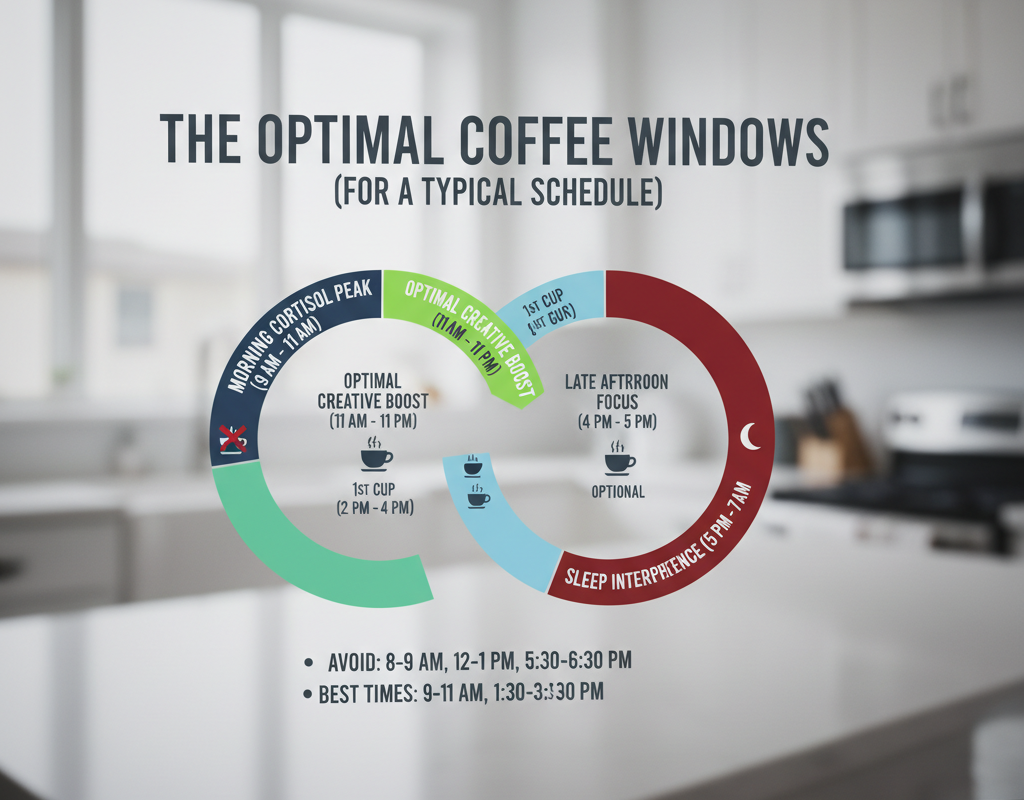
The Optimal Coffee Windows (For a Typical Schedule)
Research in chronobiology — combined with the 2B-Alert mathematical model developed by military sleep researchers to predict caffeine's effects across different timing scenarios — points to two primary optimal windows for coffee consumption during a standard day:
Window 1: 9:30 AM to 11:30 AM
For a typical person waking between 6:30 and 7:00 AM, this is when cortisol is reliably declining from its morning peak and adenosine has been cleared. Caffeine taken in this window fills the alertness gap left by falling cortisol. The 2B-Alert model identifies this as the period where caffeine provides the greatest performance benefit per milligram consumed — meaning you need less caffeine to feel more alert.
Window 2: 1:00 PM to 2:00 PM
Many people experience a natural cortisol trough in the early afternoon — the post-lunch dip that causes the familiar 2 PM sluggishness. A cup of coffee in this window can effectively counter this dip. However, given caffeine's 5 to 6 hour half-life, afternoon coffee should be limited to ensure it clears before bedtime.
What About Working Out in the Morning?
Morning exercise complicates the 2-hour rule significantly. If you're training at 6:00 AM before work, you have a genuine performance and safety reason to consume caffeine before your cortisol peak has declined. Caffeine meaningfully improves athletic performance — endurance, strength output, reaction time — and that benefit doesn't disappear because your cortisol is also elevated.
Most exercise physiologists and sleep researchers who discuss the 2-hour rule acknowledge this exception: if you're doing intense morning exercise, pre-workout caffeine is a legitimate exception to the timing guideline. The performance benefit during training outweighs the theoretical efficiency loss from stacking caffeine on cortisol in this specific context.
After your workout, letting cortisol naturally decline before your next cup remains sensible.
Does It Actually Work? What People Report
Anecdotally, the experiences reported by people who have tried the delayed coffee approach are consistently positive — though this is self-selected reporting, not controlled research. Common reports include:
- Smoother, more sustained energy throughout the morning rather than a sharp early spike
- Less reliance on a second or third cup to maintain alertness through mid-morning
- Reduced or eliminated afternoon crash around 2 to 3 PM
- Better sleep quality, particularly when combined with an afternoon caffeine cutoff
- Increased sensitivity to caffeine's effects — the same amount of coffee feels more effective
The VeraTenet analysis quoted one person's experience: "I was a three-cup-before-9 AM person. My energy still crashed every afternoon. When I tried waiting 90 minutes for my first cup — just as an experiment — I couldn't believe the difference. Same coffee. Same amount." This type of anecdote doesn't prove the mechanism, but it's consistent with what the biology predicts.
How to Actually Apply the 2-Hour Coffee Rule
You don't have to be rigid about exactly 120 minutes. Here's a practical framework:
- Hydrate immediately upon waking. Drink 400 to 500 ml of water first. After 7 to 8 hours without fluid, your body is mildly dehydrated — and dehydration mimics fatigue. Rehydrating before caffeine means you're not confusing thirst-fatigue with adenosine-fatigue.
- Get morning light exposure. Sunlight — even 5 to 10 minutes of natural outdoor light — accelerates the Cortisol Awakening Response and helps set your circadian rhythm more precisely. This makes the cortisol peak sharper and shorter, so you reach the decline phase sooner.
- Wait 60 to 90 minutes minimum, 90 to 120 minutes ideally. If you wake at 7:00 AM, aim for your first coffee between 8:30 and 9:00 AM. If that feels impossible right now, start by pushing your first cup 30 minutes later than usual and build from there.
- Stop caffeine by early afternoon. The timing of your last cup matters as much as your first. Given caffeine's 5 to 6 hour half-life, a 2:00 PM cutoff for a 10:30 PM bedtime is the research-backed standard.
- Don't drink on an empty stomach. Pairing your delayed coffee with breakfast or a small snack reduces cortisol stimulation from caffeine and helps buffer the gastric acid production that coffee triggers.
What to Do During the Waiting Period
The most common objection to the 2-hour rule is practical: "I can't function for 2 hours without coffee." Here's the honest response to that — if you genuinely cannot function for 90 minutes after waking without caffeine, that's a sign of significant caffeine dependence, not a physiological necessity. Your body is producing cortisol and clearing adenosine during sleep specifically to enable morning wakefulness. The perceived inability to function is largely learned helplessness driven by tolerance.
That said, the transition can be uncomfortable for the first few days. Things that help:
- Decaf coffee — gets you the ritual and most of the antioxidants without the caffeine that disrupts the timing
- Morning water with lemon — mild alertness boost from hydration
- Morning movement or exercise — amplifies the cortisol awakening response naturally
- Cold exposure — even a brief cold rinse in the shower triggers noradrenaline release and natural alertness
Most people who try the delay for 5 to 7 days report that the adjustment period is shorter than expected — and that by the end of the first week, they no longer feel the desperate need for immediate morning coffee they thought they had.
Who Should Be More Careful About Caffeine Timing
- People with chronic stress or elevated cortisol: Caffeine raises cortisol, and this effect is more pronounced in people already under chronic stress. For high-stress individuals, drinking coffee during the morning cortisol peak amplifies an already elevated stress response — potentially contributing to anxiety and jitteriness that wouldn't occur later in the morning.
- People with anxiety disorders: Caffeine amplifies the physiological stress response. Timing it during the cortisol peak creates a compounding effect that can be particularly pronounced for anxiety-prone individuals.
- People with adrenal fatigue or HPA axis dysregulation: For people with disrupted cortisol patterns, the standard 2-hour rule may not apply in the same way — their CAR may be blunted or shifted, requiring an individualized approach.
- Shift workers and new parents: Disrupted sleep patterns shift the cortisol rhythm entirely. The optimal coffee timing for someone working a night shift is completely different from a day worker's, and the 2-hour rule needs to be recalibrated around actual wake time and sleep quality.
Frequently Asked Questions
What is the 2-hour coffee rule?
The 2-hour coffee rule is a caffeine timing guideline recommending that you wait 90 minutes to 2 hours after waking before drinking your first cup of coffee. The principle is rooted in the Cortisol Awakening Response — the natural surge of cortisol your body produces in the first 30 to 60 minutes after waking. By waiting until this cortisol peak passes, caffeine can work more effectively in filling the alertness gap, rather than stacking on top of your body's own alertness hormones. The result is intended to be smoother, more sustained energy and a reduced afternoon crash.
What is the best time to drink coffee in the morning?
For a typical person waking between 6:30 and 7:00 AM, the research-supported optimal window for the first coffee is between 9:30 and 11:30 AM — when the morning cortisol peak has passed and residual adenosine has cleared. This is when caffeine provides the greatest benefit per milligram consumed. A secondary optimal window occurs between 1:00 and 2:00 PM to counter the post-lunch cortisol dip, though afternoon coffee should be limited to protect sleep quality.
Is it bad to drink coffee first thing in the morning?
Not catastrophically — but it may be suboptimal for energy and tolerance over time. Drinking coffee during the morning cortisol peak means caffeine is stacking on top of your body's own alertness signal rather than complementing it. Over time, this may contribute to faster tolerance development (needing more coffee for the same effect) and a more pronounced afternoon energy crash. For most healthy adults, shifting their first cup by 60 to 90 minutes makes a noticeable practical difference.
Does coffee increase cortisol?
Yes — caffeine stimulates cortisol release. This effect is real and measurable, particularly in people who are sensitive to caffeine or under chronic stress. In regular coffee drinkers, some tolerance to caffeine's cortisol-stimulating effect develops over time. The concern with drinking coffee during the natural morning cortisol peak is that you're adding a caffeine-driven cortisol spike on top of the already-high natural peak — potentially amplifying stress responses and contributing to jitteriness and anxiety in sensitive individuals.
Can I drink decaf during the 2-hour waiting window?
Yes — decaf is a perfectly reasonable option during the waiting period. Since decaf contains only 2 to 15 mg of caffeine per cup (compared to 95+ mg in regular coffee), it won't meaningfully interfere with adenosine receptors or amplify the cortisol peak. You still get the ritual, the warmth, the antioxidants, and most of coffee's health benefits — just without the caffeine timing concern.
What happens if you drink coffee on an empty stomach in the morning?
Drinking coffee on an empty stomach amplifies its cortisol-stimulating effect, accelerates caffeine absorption into the bloodstream (producing a sharper spike), and stimulates gastric acid production — which can cause stomach irritation, nausea, or heartburn in sensitive individuals. Pairing your morning coffee with food or waiting until after breakfast addresses all three of these issues simultaneously.
The Bottom Line
The 2-hour coffee rule is not a rigid law — it's a biologically grounded principle that offers a practical framework for making caffeine work more effectively for you. The core insight is simple: your body produces its own cortisol-driven alertness signal every morning. Caffeine works best when it complements that signal's decline rather than competing with its peak.
Whether you implement the full 2-hour delay, a 90-minute delay, or simply push your first cup 30 minutes later than usual — any movement in this direction is likely to produce some benefit. The people who report the most dramatic differences are typically those who previously had coffee within 10 to 15 minutes of waking every single day, often before doing anything else.
Start with hydration, get some morning light, and let your cortisol do its job first. Then make that first cup count — with quality beans that deliver the full antioxidant and flavor profile that makes waiting worth it. Single-origin specialty coffee, freshly roasted and properly brewed, has a significantly more complex and rewarding flavor profile than the commercial blends most people reach for in those first desperate morning minutes. When you finally have that cup — at 9:30 AM, with your cortisol naturally declining and your adenosine cleared — it's going to taste better anyway.
If you'd like to read other articles similar to What Is the 2-Hour Coffee Rule? The Science Behind Waiting for Your First Cup you can visit the category The Art and Science of Coffee: Guides, Reviews, and Expert Tips.
Does Coffee Affect Cortisol Levels? The Science Behind Caffeine and Your Stress Hormone

Is Coffee Good for Depression Risk? What the Research Actually Shows

Is Coffee Bad for Anxiety? What the Science Actually Shows

The 5 Elements of Coffee Tasting Every Coffee Lover Should Know

What Is Green Coffee? How Raw Beans Differ From Roasted — and What That Means for Your Health
How Is Coffee Decaffeinated? The 4 Methods Explained — Including the One You Should Avoid
What Is Coffee Degassing? Why Fresh Roasted Beans Release CO2 — and Why It Matters

What Is a Coffee Cooperative? How They Help Farmers — and Why They Matter for Your Cup

How Altitude Affects Coffee Flavor: Why High-Grown Coffee Tastes Different
Leave a Reply
Related post