

Why Put Cinnamon in Coffee? 6 Real Benefits — Plus the One Warning Most People Miss

Adding cinnamon to coffee has gone from a niche habit to a widely popular practice — and for good reason. It's not just a flavor trend. The combination has genuine, science-backed benefits that make your morning cup measurably better for you. But there's also one important caveat that most articles skip over, and it's worth knowing before you reach for that cinnamon jar every morning.
Here's everything you need to know: what cinnamon actually does in coffee, the six benefits backed by real research, exactly how much to use, and the one thing you need to check on your cinnamon label before you make it a daily habit.
Table of contents
- What Happens When You Add Cinnamon to Coffee?
- Benefit 1: It Significantly Boosts Your Coffee's Antioxidant Power
- Benefit 2: It Helps Regulate Blood Sugar — Especially After Your Morning Coffee
- Benefit 3: It Amplifies Coffee's Anti-Inflammatory Effects
- Benefit 4: It Enhances Cognitive Function and Brain Protection
- Benefit 5: It Makes Coffee Naturally Sweeter — Reducing Your Need for Sugar
- Benefit 6: It Supports Heart Health Through Multiple Pathways
- The One Warning You Need to Know: Ceylon vs Cassia Cinnamon
- How Much Cinnamon to Put in Coffee — And When
- Does Cinnamon Change the Taste of Coffee?
- Cinnamon Coffee vs. Cinnamon Supplements
- Frequently Asked Questions
- The Bottom Line
What Happens When You Add Cinnamon to Coffee?
Before getting into the benefits, it helps to understand what cinnamon actually is and why it does what it does.
Cinnamon comes from the dried inner bark of trees in the Cinnamomum genus. Its characteristic flavor and aroma come primarily from a compound called cinnamaldehyde — the oily substance that gives cinnamon its heat and spice. Beyond cinnamaldehyde, cinnamon also contains significant amounts of polyphenols, flavonoids, and other plant compounds that drive most of its health effects.
When you add cinnamon to coffee, several things happen simultaneously:
☕ Recommended by cocondo.coffee

Cocondo Orgánico — The only certified organic coffee from Antioquia, Colombia
Reserve Your Bag →- Cinnamaldehyde and other volatile aromatic compounds from cinnamon integrate with coffee's own aromatic profile, adding warm, spicy, slightly sweet complexity
- Cinnamon's polyphenols combine with coffee's chlorogenic acids, creating a higher total antioxidant load in the cup
- Cinnamon's natural sweetness (from aldehyde compounds) partially masks coffee's bitterness, reducing the perceived need to add sugar
- The bioactive compounds in cinnamon — particularly cinnamaldehyde and cinnamic acid — become bioavailable through the hot liquid, allowing your body to absorb them
The combination is more than additive. A 2022 chapter published by Wiley Online Library on the molecular mechanisms of coffee, ginger, and cinnamon noted that these compounds demonstrate "antioxidant, antidiabetic, anti-inflammatory, cardioprotective, and hepatoprotective effects" — multiple mechanisms working through different pathways simultaneously.
Benefit 1: It Significantly Boosts Your Coffee's Antioxidant Power
Both coffee and cinnamon are exceptional antioxidant sources independently. Together, they create one of the most antioxidant-dense common beverages available.
Coffee is already the single largest source of dietary antioxidants for most people in Western countries — primarily through its chlorogenic acids and melanoidins. Cinnamon adds a different class of antioxidants: polyphenols including procyanidins, catechins, and cinnamaldehyde derivatives that protect cells from oxidative damage through mechanisms different from coffee's own antioxidants.
Research published in the Journal of Agricultural and Food Chemistry found that cinnamon outranked many commonly cited "superfoods" including garlic and oregano in antioxidant activity per gram. A 2020 research review found that cinnamon supplementation may increase total antioxidant capacity — the body's overall ability to counteract oxidative stress — in measurable clinical terms.
Adding just ¼ teaspoon of cinnamon to your coffee has been shown to boost its antioxidant activity by up to 25% without adding significant calories. For something you're doing every day, that compounding antioxidant benefit is genuinely meaningful over time.
Benefit 2: It Helps Regulate Blood Sugar — Especially After Your Morning Coffee
This is probably cinnamon's most clinically studied and well-supported benefit — and it's particularly relevant when combined with coffee.
Coffee itself causes a temporary spike in blood sugar and a reduction in insulin sensitivity in some people, particularly those with type 2 diabetes or metabolic syndrome. This happens because caffeine temporarily impairs glucose uptake by cells. It's one of the more complex aspects of coffee's health profile — beneficial long-term but creating short-term glycemic fluctuations in sensitive individuals.
Cinnamon works through multiple mechanisms to counteract this:
- Mimics insulin: Cinnamaldehyde activates insulin receptors and improves insulin signaling, helping cells absorb glucose more efficiently
- Slows glucose absorption: Cinnamon slows gastric emptying and reduces the rate at which carbohydrates are broken down into glucose in the digestive tract
- Reduces post-meal blood sugar spikes: Multiple studies show cinnamon supplementation reduces fasting blood glucose by 10 to 29% in people with type 2 diabetes
A meta-analysis of clinical trials found that cinnamon significantly reduced fasting blood glucose, total cholesterol, LDL cholesterol, and triglycerides in people with type 2 diabetes. Even for people without diabetes, adding cinnamon to your morning coffee may help smooth out the blood sugar fluctuation that caffeine can cause — making your energy more stable and reducing the likelihood of an energy crash later in the morning.
Benefit 3: It Amplifies Coffee's Anti-Inflammatory Effects
Both coffee and cinnamon are independently associated with reduced inflammation — and they work through complementary mechanisms that create a stronger combined effect.
Coffee's chlorogenic acids reduce inflammatory markers like TNF-alpha and IL-6. Cinnamon's cinnamaldehyde and cinnamic acid compounds reduce the activity of NF-κB — a protein complex that controls the transcription of inflammatory genes and is implicated in many chronic inflammatory conditions.
Research shows cinnamon can reduce levels of C-reactive protein (CRP) and interleukin-6 — two of the most widely measured biomarkers of systemic inflammation. When combined with coffee's anti-inflammatory compounds, you're addressing inflammation through multiple pathways simultaneously rather than one.
Chronic low-grade inflammation is a root driver of cardiovascular disease, type 2 diabetes, neurodegenerative conditions, and metabolic syndrome — all of which coffee already protects against through its own compounds. Adding cinnamon strengthens that protection.
Benefit 4: It Enhances Cognitive Function and Brain Protection
You already know coffee improves short-term focus and alertness through caffeine's adenosine receptor blockade. But cinnamon adds a separate and complementary layer of cognitive benefit.
Research published in the Journal of Neuroimmune Pharmacology found that cinnamon — specifically its sodium benzoate metabolite — may help prevent or delay neurodegenerative diseases including Alzheimer's and Parkinson's by inhibiting the aggregation of tau proteins and protecting dopaminergic neurons. These are the same protein buildups that coffee's phenylindanes and trigonelline work against through different mechanisms.
Studies have also found that cinnamaldehyde may improve working memory and learning ability in animal models, and some human research suggests cinnamon consumption is associated with better performance on cognitive tasks requiring attention and processing speed.
The combination is synergistic: coffee's caffeine provides immediate short-term cognitive enhancement while cinnamon's compounds may offer longer-term neuroprotective benefits — the two mechanisms working across different time horizons simultaneously.
Benefit 5: It Makes Coffee Naturally Sweeter — Reducing Your Need for Sugar
This is the most immediately practical benefit for most people, and it's based on real flavor chemistry rather than psychological suggestion.
Cinnamon contains aldehyde compounds — particularly cinnamaldehyde — that activate sweet taste receptors on the tongue alongside its characteristic spice. This creates a perception of sweetness without any actual sugar or caloric contribution. Cinnamon also partially masks coffee's bitterness through a mechanism similar to salt (which reduces bitter perception), making the overall flavor profile of the coffee appear rounder and more balanced.
For coffee drinkers who routinely add one or two teaspoons of sugar to their morning cups, substituting cinnamon eliminates:
- 16 calories per teaspoon of sugar (32 calories for two teaspoons)
- 4 grams of refined carbohydrates per teaspoon
- Blood sugar spikes from rapid glucose absorption
- Contribution to caffeine tolerance acceleration (sugar spikes followed by insulin responses can amplify caffeine crashes)
Over a year of daily coffee with two teaspoons of sugar replaced by cinnamon, that's approximately 11,680 calories and 2.9 kg of sugar eliminated — without changing how satisfying your morning cup feels.
Benefit 6: It Supports Heart Health Through Multiple Pathways
Coffee already has strong cardiovascular protective effects — reduced heart failure risk, lower stroke risk, and positive effects on vascular function. Cinnamon adds complementary cardiovascular benefits:
- Cholesterol reduction: Studies show daily cinnamon consumption can decrease total cholesterol, LDL ("bad") cholesterol, and triglycerides — all risk factors for cardiovascular disease
- Blood pressure: Some research suggests cinnamon may moderately reduce systolic blood pressure, complementing coffee's long-term positive effects on vascular elasticity
- Anticoagulant properties: Cinnamon contains coumarin compounds (discussed below) that have mild blood-thinning effects, which may reduce clot formation risk
- Endothelial function: Cinnamon's polyphenols support the health of the endothelium — the inner lining of blood vessels — improving their ability to dilate and contract properly
The combination of coffee's heart protective effects and cinnamon's cholesterol and blood pressure benefits creates a complementary cardiovascular support system in a single morning cup.
The One Warning You Need to Know: Ceylon vs Cassia Cinnamon
Here's the part most articles skip, mention briefly, or bury — and it genuinely matters if you're adding cinnamon to your coffee every day.
There are two main types of cinnamon commercially available:
Ceylon Cinnamon ("True Cinnamon")
Produced primarily in Sri Lanka and parts of South India. Lighter in color (tan-beige), with a more delicate, complex, slightly citrusy flavor. Contains very low levels of coumarin — approximately 0.004% by weight. Ceylon cinnamon is safe for daily use at normal quantities.
Cassia Cinnamon (What Most People Have)
The most widely sold cinnamon in North America and Europe — the dark reddish-brown variety sold in most supermarkets. Stronger, more pungent flavor. Contains significantly higher levels of coumarin — approximately 0.4 to 0.8% by weight, meaning Cassia has roughly 100 times more coumarin than Ceylon.
Why does this matter? Coumarin is a naturally occurring compound that, in high doses over extended periods, can cause liver toxicity and damage. The European Food Safety Authority (EFSA) has set a tolerable daily intake (TDI) for coumarin at 0.1 mg per kilogram of body weight. For a 70 kg (154 lb) adult, that's 7 mg of coumarin per day as the upper safe limit.
Half a teaspoon of Cassia cinnamon (approximately 1.3g) contains roughly 5 to 10 mg of coumarin — already at or near the daily safe limit for many adults. If you're adding a teaspoon of Cassia cinnamon to your coffee every day, you may be regularly exceeding the safe coumarin threshold.
For people who use cinnamon occasionally or in small amounts, Cassia is not a significant concern. But for people making cinnamon coffee a daily habit — which is exactly what this article encourages — switching to Ceylon cinnamon is worth doing.
How to identify them:
- Ceylon sticks are thin-walled and multi-layered, like tightly rolled paper. Light brown color.
- Cassia sticks are thick, single-layer, hard, and dark reddish-brown. The cinnamon sticks at most coffee shops are Cassia.
- For ground cinnamon, check the label — it should say "Ceylon" or "true cinnamon." If it just says "cinnamon" without specifying, it's almost certainly Cassia.
- Ceylon is increasingly available at health food stores and online. It typically costs slightly more than Cassia but is well worth it for daily use.
How Much Cinnamon to Put in Coffee — And When
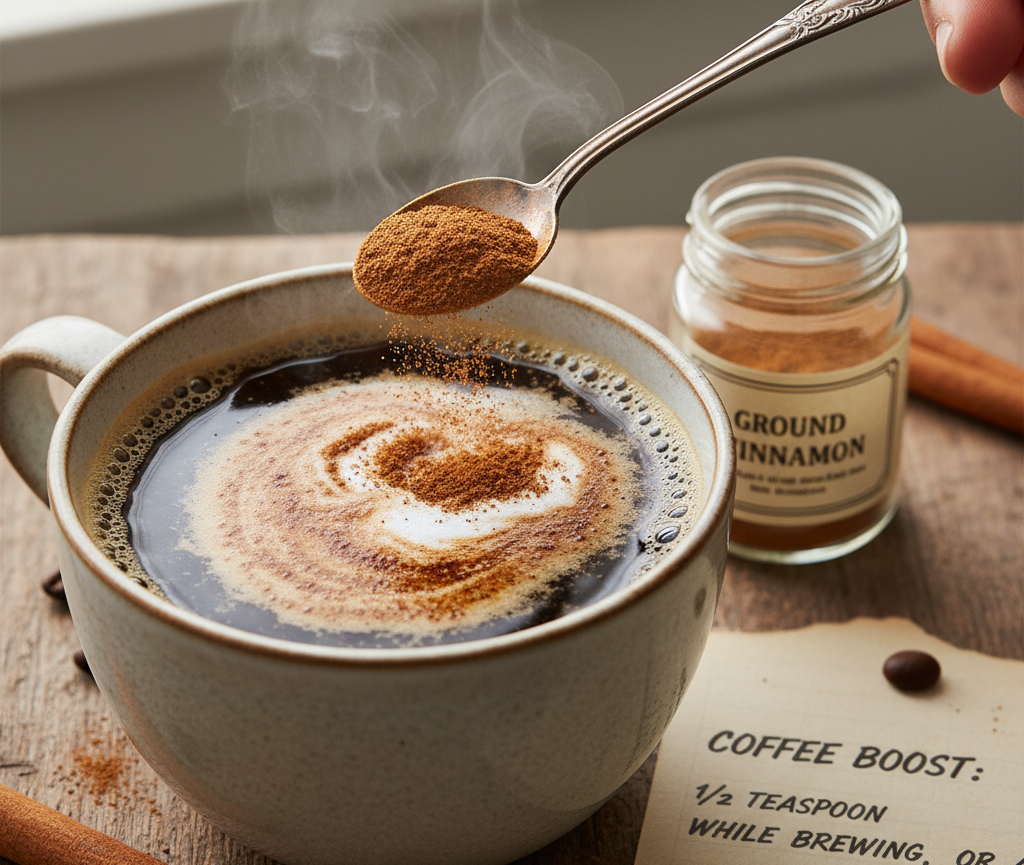
The research-backed effective dose for health benefits is ¼ to ½ teaspoon (0.5 to 1.3 grams) per cup. This delivers meaningful cinnamaldehyde and polyphenol content while staying well within safe daily intake limits — especially with Ceylon cinnamon.
Going beyond ½ teaspoon doesn't linearly increase benefits and can produce an overpowering spice flavor that dominates rather than complements the coffee. The goal is enhancement, not transformation.
When to Add It
- To the grounds before brewing: Adds cinnamon's volatile oils directly into the extraction process. The hot water pulls out cinnamon compounds alongside coffee compounds, creating a more integrated flavor. This is the method recommended by many specialty baristas for maximum flavor integration.
- Stirred into brewed coffee: Easier to control the amount. Stir vigorously — cinnamon doesn't dissolve in water and will settle at the bottom if not mixed well. Some people use a milk frother to integrate it fully.
- As a cinnamon stick stirrer: Elegant presentation with gentle flavor contribution. Less effective for health benefits since the stick releases compounds slowly and you're using far less cinnamon than the ground version.
- In the milk or cream before frothing: Excellent for lattes and cappuccinos — the frothing process disperses cinnamon throughout the milk foam beautifully.
One method to avoid: Never boil cinnamon directly in water at high heat. Excessive heat extracts harsh tannins from cinnamon that make it taste astringent and unpleasant. Coffee's standard brewing temperature (90 to 96°C) is fine; prolonged boiling is not.
Does Cinnamon Change the Taste of Coffee?
Yes — noticeably, and typically in ways most coffee drinkers enjoy. Here's what to expect:
- Warmth and spice: A gentle heat at the back of the throat, more pronounced with Cassia than Ceylon
- Perceived sweetness: The coffee tastes slightly sweeter without anything being added
- Reduced bitterness: The sharpest bitter edges of the coffee are softened
- Aromatic complexity: Cinnamon adds a warm, woody, slightly floral aromatic layer that complements rather than overwhelms good coffee
- Slight texture change: Ground cinnamon adds a very faint gritty texture if not fully dissolved. Using fine-ground cinnamon and stirring well minimizes this.
The flavor impact is most complementary with medium roast coffees that have chocolate, caramel, or nutty notes — cinnamon enhances those naturally. With very light, floral, or citrus-forward specialty coffees, cinnamon can overpower the delicate origin character. With very dark, smoky roasts, cinnamon's spice can clash with the intense roastiness.
The ideal pairing: a medium roast Colombian or Brazilian single-origin, which has the chocolate and caramel notes that harmonize beautifully with cinnamon's warm spice.
Cinnamon Coffee vs. Cinnamon Supplements
You might wonder whether adding cinnamon to your coffee delivers the same benefits as taking a cinnamon supplement capsule. The honest answer is that bioavailability differs.
Cinnamon supplements are typically standardized for cinnamaldehyde content and deliver a precise, concentrated dose. Cinnamon in coffee is less precise but has the advantage of heat-activated volatile compound release — hot water extracts cinnamon's bioactive compounds in a different way than simple encapsulation. Research on coffee-cinnamon combinations specifically (as opposed to cinnamon alone) is limited, but the mechanistic evidence for the combination is strong.
For general health maintenance, cinnamon in your morning coffee is a convenient, enjoyable, and evidence-supported approach. For therapeutic use (active blood sugar management, for example), a standardized supplement under medical guidance may be more appropriate.
Frequently Asked Questions
Why do people put cinnamon in their coffee?
People add cinnamon to coffee for two main reasons: flavor and health. For flavor, cinnamon adds warm, spicy complexity and natural sweetness that reduces the need to add sugar. For health, cinnamon provides meaningful antioxidant, anti-inflammatory, and blood sugar regulatory benefits that complement coffee's own health properties. The combination creates a more flavorful and nutritionally enhanced cup with no added calories.
Does cinnamon in coffee help with weight loss?
It can contribute modestly through several mechanisms. Cinnamon has mild appetite-suppressing properties and improves insulin sensitivity, which reduces fat storage signaling. More practically, replacing daily sugar additions with cinnamon eliminates hundreds of calories per week. Coffee itself is also a mild metabolic stimulant. None of these effects is dramatic on its own, but the combination of eliminating sugar and cinnamon's metabolic effects can support a calorie-controlled approach to weight management.
Is it safe to put cinnamon in coffee every day?
Yes — with an important qualification about which type of cinnamon. Ceylon cinnamon is safe for daily consumption at normal amounts (¼ to ½ teaspoon per cup). Cassia cinnamon — the most common supermarket variety — contains significant coumarin, which can cause liver toxicity at high doses over extended periods. For daily use, switching to Ceylon cinnamon is strongly recommended. At ¼ to ½ teaspoon of Ceylon per day, cinnamon coffee is safe for most healthy adults.
What is the best cinnamon to put in coffee?
Ceylon cinnamon — also called "true cinnamon" — is the best choice for daily coffee use. It has a more delicate, complex, slightly sweet flavor than Cassia, and contains about 100 times less coumarin, making it safe for regular consumption. Look for it labeled specifically as "Ceylon" or "true cinnamon" at health food stores or online. Cassia is fine occasionally but not ideal as a daily habit at meaningful amounts.
Does cinnamon in coffee lower blood sugar?
Cinnamon has been shown to reduce fasting blood glucose by 10 to 29% in people with type 2 diabetes across multiple clinical studies. It improves insulin sensitivity and slows glucose absorption. Adding it to coffee is particularly relevant because caffeine can temporarily reduce insulin sensitivity in some individuals — cinnamon's blood sugar benefits partially offset this effect. For people managing diabetes, cinnamon coffee may be a beneficial addition but should be discussed with a doctor as part of a comprehensive management approach.
The Bottom Line
Adding cinnamon to your coffee is one of the simplest, most evidence-backed upgrades you can make to your morning cup. Better antioxidant protection, improved blood sugar stability, reduced inflammation, cognitive support, natural sweetness without calories, and cardiovascular benefits — all from a quarter teaspoon of spice that costs almost nothing per cup.
The one thing to do before making it a daily habit: check your cinnamon. If it doesn't say "Ceylon" on the label, buy Ceylon. The flavor is more refined, the safety profile for daily use is dramatically better, and it costs only marginally more.
And about those coffee beans themselves — cinnamon works best with quality coffee that has chocolate, caramel, or nutty flavor notes to complement the spice. Single-origin Colombian coffee, particularly from high-altitude regions like Antioquia where the beans develop natural sweetness and chocolate complexity, pairs exceptionally well with Ceylon cinnamon. The warm spice of the cinnamon brings out the caramel and chocolate notes in the coffee, and the coffee's natural body carries the cinnamon's aromatics in a way that neither achieves quite as beautifully alone.
If you'd like to read other articles similar to Why Put Cinnamon in Coffee? 6 Real Benefits — Plus the One Warning Most People Miss you can visit the category The Art and Science of Coffee: Guides, Reviews, and Expert Tips.
Does Coffee Affect Cortisol Levels? The Science Behind Caffeine and Your Stress Hormone

Is Coffee Good for Depression Risk? What the Research Actually Shows

Is Coffee Bad for Anxiety? What the Science Actually Shows
The 5 Elements of Coffee Tasting Every Coffee Lover Should Know
What Is Green Coffee? How Raw Beans Differ From Roasted — and What That Means for Your Health
How Is Coffee Decaffeinated? The 4 Methods Explained — Including the One You Should Avoid

What Is Coffee Degassing? Why Fresh Roasted Beans Release CO2 — and Why It Matters

What Is a Coffee Cooperative? How They Help Farmers — and Why They Matter for Your Cup

How Altitude Affects Coffee Flavor: Why High-Grown Coffee Tastes Different
Leave a Reply
Related post